
Life of Edwin Forrest, the American Tragedian. Volume 2 (of 2)
William Rounseville Alger & Horatio, Jr. Alger
THE CLASSIC COLLECTION · 1892
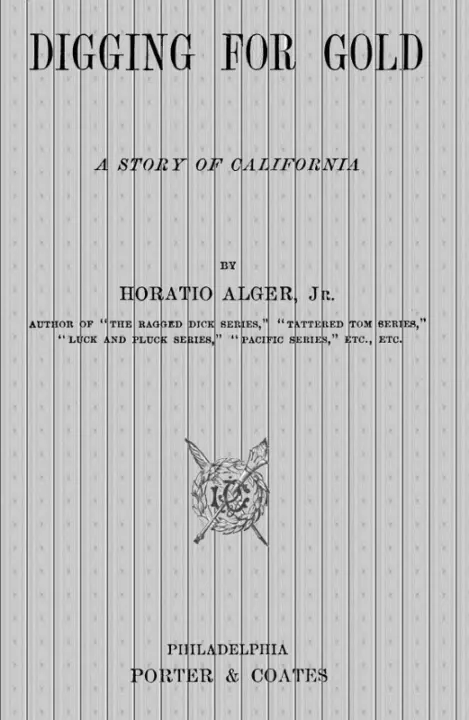
"Digging for Gold: A Story of California" by Horatio Alger, Jr. is a novel written in the late 19th century. The story centers around a young boy named Grant Colburn, whose life is filled with hardships as he works diligently on his stepfather's farm in Iowa. The narrative begins with Grant's longing for a decent suit of clothes for his sixteenth birthday and hints at his dreams of venturing to California during the Gold Rush, where he believes a better life awaits him. At the start of the novel, Grant is introduced as a hardworking and determined young man, struggling under the oppressive thumb of his miserly stepfather, Seth Tarbox. Despite the tough circumstances at home, Grant's aspirations are ignited when he learns about a local boy who struck it rich in California. He bravely confronts his stepfather about his need for new clothes, reveals his indignation at the lack of support from a man who possesses wealth, and dreams about finding fortune out West. The opening chapters set the stage for Grant's eventual journey towards California, emphasizing themes of ambition, social class disparities, and the quest for a better life.
Introduction adapted from the source catalogue; source summaries may be automatically generated.
Free to read · English · 59,065 words · No account needed
MAKE TIME FOR A GOOD BOOK
On by default. Untick to stop anonymous reading totals. Each page counts after 10 seconds in view. How this works.
Anonymous counting is on unless you have switched it off.
“Couple of whiskeys—straight—for me and the kid,” ordered Grant’s companion, as he came to a standstill in front of the bar.
“None for me!” said Grant quickly.
But, all the same, two glasses were set out, and the bottle placed
beside them.
“Pour it out!” said the miner to the barkeeper. “I’m afraid the boy will
get away.”
The barkeeper, with a smile, followed directions, and the two glasses
were filled.
The miner tossed his off at a single gulp, but Grant left his standing.
“Why don’t you drink, boy?” demanded his companion, with an oath.
“I told you I wouldn’t,” said Grant angrily.
“We’ll see if you won’t,” said the miner, and, seizing the glass, he attempted to pour it down Grant’s throat, but his arm was unsteady from the potations he had already indulged in, and the whiskey was spilled, partly on the floor, and partly on the boy’s clothes. Grant seized this opportunity to dash out of the saloon, with the miner after him. Fortunately for him, Bill Turner, as he called himself, tripped and fell, lying prostrate for a moment, an interval which Grant improved to so good purpose that, by the time the miner was again on his feet, he was well out of harm’s way.
“I thought the drinking habit was bad enough at home,” thought Grant; “but no one ever tried to make me drink before.”
And now we will go back and see how it fared with Mr. Cooper.
Some quarter of a mile from the Metropolitan Hotel and Restaurant his attention was drawn to a blacksmith’s shop. That was his own line of business, and he felt a curiosity to interview his California brother-workman.
Entering, he saw a stout, black-bearded man in the act of shoeing a
horse.
“Good-morning, friend,” he said.
“Good-morning, stranger.”
“I thought I’d take a look in, as you are in my line of business.”
“Is that so?” asked the blacksmith, looking up with interest. “How long since you arrived?”
“Just got in this morning.”
“Going to stay in Sacramento?”
“I am ready for anything that will bring money. I suppose I shall go to
the mines.”
“Humph! Why not buy me out, and carry on your old business in
Sacramento?”
“Do you want to sell?” asked Jerry Cooper, surprised.
“Yes; I want a little change. I might go to the mines myself.”
“Can’t you make money blacksmithing?” asked Cooper cautiously.
Your reading position is saved on this browser. Take it to another device with a library code. Reading pages adapt to text, rather than matching a printed edition.
William Rounseville Alger & Horatio, Jr. Alger

William Rounseville Alger & Horatio, Jr. Alger

Horatio, Jr. Alger

Horatio, Jr. Alger
BEHIND THE BOOK
This eBook is for the use of anyone anywhere in the United States and most other parts of the world at no cost and with almost no restrictions whatsoever. You may copy it, give it away or re-use it under the terms of the Project Gutenberg License included with this eBook or online at www.gutenberg.org. If you are not located in the United States, you will have to check the laws of the country where you are located before using this eBook. Read the source licence.
The original source file, including credits and licence, is retained by this library. Request an original-format copy at no charge. Please include the book title and Project Gutenberg identifier #53095.
KEEP YOUR CURIOSITY GOING
Wilfrid Scawen Blunt
Wilfrid Scawen Blunt

E. W. (Edgar Watson) Howe
Cécile Tormay

Moritz Busch
Coulson Kernahan