
Life of Edwin Forrest, the American Tragedian. Volume 2 (of 2)
William Rounseville Alger & Horatio, Jr. Alger
THE CLASSIC COLLECTION · 1892
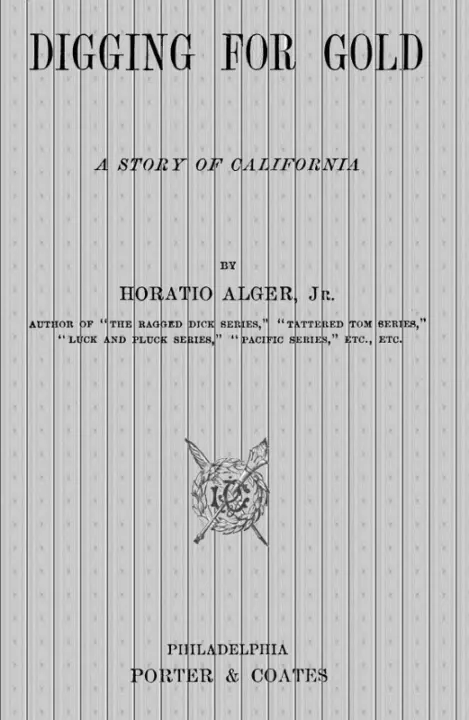
"Digging for Gold: A Story of California" by Horatio Alger, Jr. is a novel written in the late 19th century. The story centers around a young boy named Grant Colburn, whose life is filled with hardships as he works diligently on his stepfather's farm in Iowa. The narrative begins with Grant's longing for a decent suit of clothes for his sixteenth birthday and hints at his dreams of venturing to California during the Gold Rush, where he believes a better life awaits him. At the start of the novel, Grant is introduced as a hardworking and determined young man, struggling under the oppressive thumb of his miserly stepfather, Seth Tarbox. Despite the tough circumstances at home, Grant's aspirations are ignited when he learns about a local boy who struck it rich in California. He bravely confronts his stepfather about his need for new clothes, reveals his indignation at the lack of support from a man who possesses wealth, and dreams about finding fortune out West. The opening chapters set the stage for Grant's eventual journey towards California, emphasizing themes of ambition, social class disparities, and the quest for a better life.
Introduction adapted from the source catalogue; source summaries may be automatically generated.
Free to read · English · 59,065 words · No account needed
MAKE TIME FOR A GOOD BOOK
On by default. Untick to stop anonymous reading totals. Each page counts after 10 seconds in view. How this works.
Anonymous counting is on unless you have switched it off.
“Is he too proud to work on a farm?” sneered Mrs. Bartlett.
“No more than your son Rodney,” calmly replied Mrs. Tarbox.
“I’ve got something better to do than to work on a farm,” said Rodney, in a lofty tone. “Just fancy me in overalls, ma!”
“To be sure!” chimed in his mother.
“It aint no disgrace to wear overalls,” said Seth Tarbox, who did not aspire to be thought genteel, like his daughter and Rodney.
“Of course not, pa!” said Mrs. Bartlett, in a conciliatory tone. “You are a substantial farmer, and find it necessary to superintend your own work.”
“I hope Rodney aint got no foolish notions about bein’ too high-toned
for honest work.”
“No, pa; but Rodney isn’t rugged, and his father and myself mean to make
a lawyer of him.”
“Humph! Some lawyers aint worth their salt.”
“That’s the case with some farmers, too, isn’t it?” returned his
daughter.
“I own you’re right, Sophia. Why, there’s Bill Jones is gettin’ poorer and poorer every year. I’ve got a thousand-dollar mortgage on his farm,” he chuckled, “and I guess I’ll have to foreclose sooner or later.”
“What will become of Mrs. Jones and her young children?” asked Mrs. Tarbox, in a tone of pity.
“That aint my lookout,” said Seth Tarbox, in a hard tone.
“But surely you wouldn’t turn the poor woman out into the street.”
“It aint for me to look out for another man’s wife and children, Mrs. T.,” returned the farmer.
“But the farm must be worth a good deal more than the amount of your
mortgage!”
“Yes,” chuckled the farmer, “it’s well worth three thousand dollars. So much the better for me!”
“You wouldn’t take possession of it, and take such an advantage of the
family!”
“Mrs. T., you don’t understand business. When you talk in that way you only make yourself ridiculous. You’d better leave me to attend to business, and you look after the housekeeping,” and he turned to his daughter for approval.
“You are right, pa,” said Sophia, “and Mrs. Tarbox, though she means well, shows that she doesn’t understand business.”
Mrs. Tarbox bit her lip, but did not reply. She had made the discovery long since that the daughter was as cold and selfish as the father, and probably even more so.
“Mrs. Tarbox, have you got Grant’s last letter?” asked Rodney.
“Yes.”
“Would you mind letting me read it?”
Mrs. Tarbox hesitated a moment, and then replied: “A part of it is private, but I will read you the part in which he speaks of his position and prospects.”
Your reading position is saved on this browser. Take it to another device with a library code. Reading pages adapt to text, rather than matching a printed edition.
William Rounseville Alger & Horatio, Jr. Alger

William Rounseville Alger & Horatio, Jr. Alger

Horatio, Jr. Alger

Horatio, Jr. Alger
BEHIND THE BOOK
This eBook is for the use of anyone anywhere in the United States and most other parts of the world at no cost and with almost no restrictions whatsoever. You may copy it, give it away or re-use it under the terms of the Project Gutenberg License included with this eBook or online at www.gutenberg.org. If you are not located in the United States, you will have to check the laws of the country where you are located before using this eBook. Read the source licence.
The original source file, including credits and licence, is retained by this library. Request an original-format copy at no charge. Please include the book title and Project Gutenberg identifier #53095.
KEEP YOUR CURIOSITY GOING
Wilfrid Scawen Blunt
Wilfrid Scawen Blunt

E. W. (Edgar Watson) Howe
Cécile Tormay

Moritz Busch
Coulson Kernahan