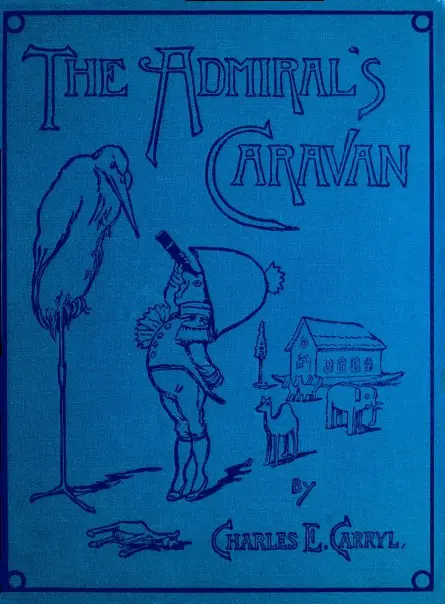
The Admiral’s Caravan
Charles E. (Charles Edward) Carryl
THE CLASSIC COLLECTION · 1884
"Davy and the Goblin" by Charles E. Carryl is a children's fantasy novel written in the late 19th century. It follows the whimsical adventures of a young boy named Davy, who encounters a peculiar goblin on a snowy Christmas Eve, igniting a journey into a world filled with fantastical creatures and thrilling experiences. The story is a playful exploration of imagination and belief, reminiscent of the enchanting tales popularized in children's literature during that era. The opening of the book sets a lively scene where Davy, after a wintry escapade outside, finds himself in a cozy room, only to discover a curious little goblin who claims he will take Davy on a "Believing Voyage." This begins after the goblin chastises Davy for not believing in fairies and other fantastical beings. Davy hesitantly agrees, prompted by a nod from a toy soldier on the shelf, and suddenly the room transforms as they embark on their extraordinary journey aboard a magical clock. The narrative blends humor and adventure as Davy encounters eccentric characters and delightful challenges, indicating that this whimsical journey will be filled with unexpected wonders and playful antics.
Introduction adapted from the source catalogue; source summaries may be automatically generated.
Free to read · English · 26,234 words · No account needed
MAKE TIME FOR A GOOD BOOK
On by default. Untick to stop anonymous reading totals. Each page counts after 10 seconds in view. How this works.
Anonymous counting is on unless you have switched it off.
It's very confining, this living in stables, And passing one's time among wagons and carts; I much prefer dining at gentlemen's tables, And living on turkeys and cranberry tarts.
I find with surprise that I'm constantly sneezing; I'm stiff in the legs, and I'm often for sale; And the blue-bottle flies, with their tiresome teasing, Are quite out of reach of my weary old tail.
"By the way," said Ribsy, getting up and turning himself around, "what
does my tail look like?"
"I think," said Davy, after a careful inspection, "I think it looks something like an old paint-brush."
"So I supposed," said Ribsy, gloomily, and, sitting down again, he went
on with his history:--
As spry as a kid and as trim as a spider
Was I in the days of the Turnip-top Hunt,
When I used to get rid of the weight of my rider
And canter contentedly in at the front.
I never was told that this jocular feature
Of mine was a trick reprehensibly rude,
And yet I was sold, like a commonplace creature,
To work in a circus for lodgings and food.
"I suppose you have never been a circus-horse?" said Ribsy, stopping short in his verses again and gazing inquiringly at Davy.
"Never," said Davy.
"Then you don't know anything about it," said Ribsy. "Here we go
again:"--
Pray why, if you please, should a capable charger Perform on a ladder and prance in a show? And why should his knees be made thicker and larger By teaching him tricks that he'd rather not know?
Oh! why should a horse, for society fitted,
Be doomed to employment so utterly bad,
And why should a coarse-looking man be permitted
To dance on his back on a top-heavy pad?
Here Ribsy paused once more, and Davy, feeling that he ought to make some sort of an answer to such a lot of questions, said helplessly, "I don't know."
"No more do I," said Ribsy, tossing his head scornfully.
It made me a wreck, with no hope of improvement,
Too feeble to race with an invalid crab;
I'm wry in the neck, with a rickety movement
Peculiarly suited for drawing a cab.
They pinch me with straps, and they bruise me with buckles, They drive me too rapidly over the stones;-- A reason, perhaps, why a number of knuckles Have lately appeared on my prominent bones.
"I see them," cried Davy, eagerly; "I thought they were corns."
"Thank you," said Ribsy, haughtily. "As the next verse is the last you needn't trouble yourself to make any further observations."
Your reading position is saved on this browser. Take it to another device with a library code. Reading pages adapt to text, rather than matching a printed edition.
Charles E. (Charles Edward) Carryl
BEHIND THE BOOK
This eBook is for the use of anyone anywhere in the United States and most other parts of the world at no cost and with almost no restrictions whatsoever. You may copy it, give it away or re-use it under the terms of the Project Gutenberg License included with this eBook or online at www.gutenberg.org. If you are not located in the United States, you will have to check the laws of the country where you are located before using this eBook. Read the source licence.
The original source file, including credits and licence, is retained by this library. Request an original-format copy at no charge. Please include the book title and Project Gutenberg identifier #25031.
KEEP YOUR CURIOSITY GOING
Coulson Kernahan

Maurice Baring
Frances Wright
Cécile Tormay
Francis Greenleaf Allinson & Anne C. E. (Anne Crosby Emery) Allinson

Frederic Jesup Stimson