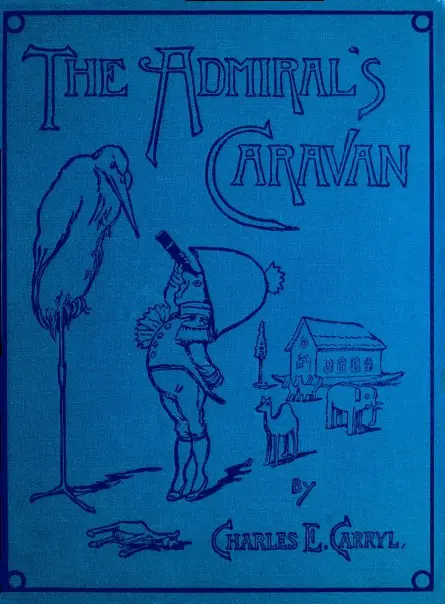
The Admiral’s Caravan
Charles E. (Charles Edward) Carryl
THE CLASSIC COLLECTION · 1884
"Davy and the Goblin" by Charles E. Carryl is a children's fantasy novel written in the late 19th century. It follows the whimsical adventures of a young boy named Davy, who encounters a peculiar goblin on a snowy Christmas Eve, igniting a journey into a world filled with fantastical creatures and thrilling experiences. The story is a playful exploration of imagination and belief, reminiscent of the enchanting tales popularized in children's literature during that era. The opening of the book sets a lively scene where Davy, after a wintry escapade outside, finds himself in a cozy room, only to discover a curious little goblin who claims he will take Davy on a "Believing Voyage." This begins after the goblin chastises Davy for not believing in fairies and other fantastical beings. Davy hesitantly agrees, prompted by a nod from a toy soldier on the shelf, and suddenly the room transforms as they embark on their extraordinary journey aboard a magical clock. The narrative blends humor and adventure as Davy encounters eccentric characters and delightful challenges, indicating that this whimsical journey will be filled with unexpected wonders and playful antics.
Introduction adapted from the source catalogue; source summaries may be automatically generated.
Free to read · English · 26,234 words · No account needed
MAKE TIME FOR A GOOD BOOK
On by default. Untick to stop anonymous reading totals. Each page counts after 10 seconds in view. How this works.
Anonymous counting is on unless you have switched it off.
"So do I," said the cabman. "But it's the best one I can make with this horse. Did you say N.B.?" he asked.
"No, I said B.G.," said Davy.
"All right," said the cabman again, and disappeared from the window. Presently there was a loud trampling overhead, and Davy, putting his head out at the window, saw that the cabman had climbed up on top of the cab and was throwing stones at the horse, which was still sleeping peacefully.
"It's all right," said the cabman, cheerfully, as he caught sight of Davy. "If he doesn't start pretty soon I'll give him some snuff. That always wakes him up."
"Oh! don't do that," said Davy, anxiously. "I'd rather get out and
walk."
"Well, I wish you would," said the cabman, in a tone of great relief. "This is a very valuable stand, and I don't care to lose my place on it;" and Davy accordingly jumped out of the cab and walked away.
Presently there was a clattering of hoofs behind him, and Ribsy came galloping along the road, with nothing on him but his collar. He was holding his big head high in the air, like a giraffe, and gazing proudly about him as he ran. He stopped short when he saw the little boy, and, giving a triumphant whistle, said cheerfully, "How are you again?"
It seemed rather strange to be spoken to by a cab-horse, but Davy answered that he was feeling quite well.
"So am I," said Ribsy. "The fact is, that when it comes to beating a horse about the head with a three-legged stool, if that horse is going to leave at all, it's time he was off."
"I should think it was," said Davy, earnestly.
"You'll observe, of course, that I've kept on my shoes and my collar," said Ribsy. "It isn't genteel to go barefoot, and nothing makes a fellow look so untidy as going about without a collar. The truth is," he continued, sitting down in the road on his hind legs,--"the truth is, I'm not an ordinary horse, by any means. I have a history, and I've arranged it in a popular form, in six canters,--I mean cantos," he added, hastily correcting himself.
"I'd like to hear it, if you please," said Davy, politely.
"Well, I'm a little hoarse,"--began Ribsy.
"I think you're a very big horse," said Davy, in great surprise.
"I'm referring to my voice," said Ribsy, haughtily. "Be good enough not to interrupt me again;" and, giving two or three preliminary whistles to clear his throat, he began:--
Your reading position is saved on this browser. Take it to another device with a library code. Reading pages adapt to text, rather than matching a printed edition.
Charles E. (Charles Edward) Carryl
BEHIND THE BOOK
This eBook is for the use of anyone anywhere in the United States and most other parts of the world at no cost and with almost no restrictions whatsoever. You may copy it, give it away or re-use it under the terms of the Project Gutenberg License included with this eBook or online at www.gutenberg.org. If you are not located in the United States, you will have to check the laws of the country where you are located before using this eBook. Read the source licence.
The original source file, including credits and licence, is retained by this library. Request an original-format copy at no charge. Please include the book title and Project Gutenberg identifier #25031.
KEEP YOUR CURIOSITY GOING
Coulson Kernahan

Maurice Baring
Frances Wright
Cécile Tormay
Francis Greenleaf Allinson & Anne C. E. (Anne Crosby Emery) Allinson

Frederic Jesup Stimson