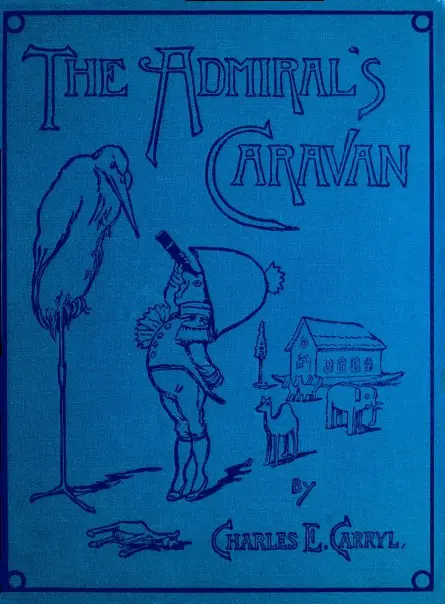
The Admiral’s Caravan
Charles E. (Charles Edward) Carryl
THE CLASSIC COLLECTION · 1884
"Davy and the Goblin" by Charles E. Carryl is a children's fantasy novel written in the late 19th century. It follows the whimsical adventures of a young boy named Davy, who encounters a peculiar goblin on a snowy Christmas Eve, igniting a journey into a world filled with fantastical creatures and thrilling experiences. The story is a playful exploration of imagination and belief, reminiscent of the enchanting tales popularized in children's literature during that era. The opening of the book sets a lively scene where Davy, after a wintry escapade outside, finds himself in a cozy room, only to discover a curious little goblin who claims he will take Davy on a "Believing Voyage." This begins after the goblin chastises Davy for not believing in fairies and other fantastical beings. Davy hesitantly agrees, prompted by a nod from a toy soldier on the shelf, and suddenly the room transforms as they embark on their extraordinary journey aboard a magical clock. The narrative blends humor and adventure as Davy encounters eccentric characters and delightful challenges, indicating that this whimsical journey will be filled with unexpected wonders and playful antics.
Introduction adapted from the source catalogue; source summaries may be automatically generated.
Free to read · English · 26,234 words · No account needed
MAKE TIME FOR A GOOD BOOK
On by default. Untick to stop anonymous reading totals. Each page counts after 10 seconds in view. How this works.
Anonymous counting is on unless you have switched it off.
Davy rushed up to the clock, and, pulling open the little door in the front of it, looked inside. To his great disappointment the Goblin had again disappeared, and there was a smooth, round hole running down into the sand, as though he had gone directly through the beach. He was listening at this hole, in the hope of hearing from the Goblin, when a voice said, "I suppose that's what they call going into the interior of the country;" and, looking up, he saw the Hole-keeper sitting on a little mound in the sand, with his great book in his lap.
The little man had evidently been having a hard time since Davy had seen him. His complexion had quite lost its beautiful transparency, and his jaunty little paper tunic was sadly rumpled, and, moreover, he had lost his cocked hat. All this, however, had not at all disturbed his complacent conceit; he was, if anything, more pompous than ever.
"How did you get here?" asked Davy, in astonishment.
"I'm banished," said the Hole-keeper, cheerfully. "That's better than being boiled, any day. Did you give Robinson my letter?"
"Yes, I did," said Davy, as they walked along the beach together; "but I got it very wet coming here."
"That was quite right," said the Hole-keeper. "There's nothing so tiresome as a dry letter. Well, I suppose Robinson is expecting me by this time, isn't he?"
"I don't know, I'm sure," said Davy. "He didn't say that he was
expecting you."
"He must be," said the Hole-keeper, positively. "I never even mentioned it in my letter; so, of course, he'll know I'm coming. By the way," he added, hurriedly opening his book, and staring anxiously at one of the blank pages, "there isn't a word in here about Billyweazles. This place must be full of 'em."
"What are they?" said Davy.
"They're great pink birds, without any feathers on 'em," replied the Hole-keeper, solemnly. "And they're particularly fond of sugar. That's the worst thing about 'em."
"I don't think there's anything very wicked in that," said Davy.
"Oh! of course you don't," said the Hole-keeper, fretfully. "But you see I haven't any trowsers on, and I don't fancy having a lot of strange Billyweazles nibbling at my legs. In fact, if you don't mind, I'd like to run away from here."
"Very well," said Davy, who was himself beginning to feel rather nervous about the Billyweazles, and accordingly he and the Hole-keeper started off along the beach as fast as they could run.
Presently the Hole-keeper stopped short and said, faintly, "It strikes me the sun is very hot here."
Your reading position is saved on this browser. Take it to another device with a library code. Reading pages adapt to text, rather than matching a printed edition.
Charles E. (Charles Edward) Carryl
BEHIND THE BOOK
This eBook is for the use of anyone anywhere in the United States and most other parts of the world at no cost and with almost no restrictions whatsoever. You may copy it, give it away or re-use it under the terms of the Project Gutenberg License included with this eBook or online at www.gutenberg.org. If you are not located in the United States, you will have to check the laws of the country where you are located before using this eBook. Read the source licence.
The original source file, including credits and licence, is retained by this library. Request an original-format copy at no charge. Please include the book title and Project Gutenberg identifier #25031.
KEEP YOUR CURIOSITY GOING
Coulson Kernahan

Maurice Baring
Frances Wright
Cécile Tormay
Francis Greenleaf Allinson & Anne C. E. (Anne Crosby Emery) Allinson

Frederic Jesup Stimson