THE CLASSIC COLLECTION✦An outlaw’s diary: the CommuneCLASSIC FREE BOOKS
An outlaw’s diary: the Commune
Cécile Tormay
THE CLASSIC COLLECTION · 1865
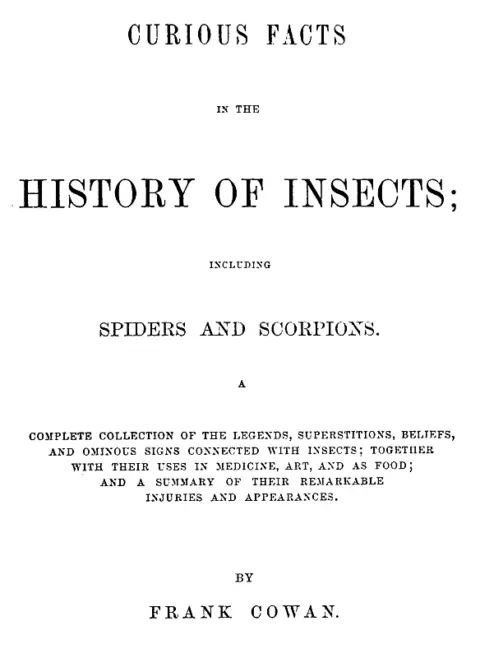
"Curious Facts in the History of Insects; Including Spiders and Scorpions" by Frank Cowan is a scientific publication written in the mid-19th century. The work explores entomology through the lens of legends, superstitions, beliefs, and various uses of insects, alongside their historical significance in medicine, art, and as food. The focus is not just on biological facts, but also on the fascinating folklore and cultural narratives associated with these creatures. At the start of the text, the author outlines his ambition to compile intriguing historical accounts related to insects, moving beyond traditional scientific boundaries. He emphasizes collecting facts from unusual sources, including chronicles and travel books, to illustrate the connections between human culture and the insect world. The opening sets the stage for a detailed examination of specific insects, beginning with the Ladybird, discussing its folklore across different cultures, and thus combining scientific classifications with rich, anecdotal history.
Introduction adapted from the source catalogue; source summaries may be automatically generated.
Free to read · English · 139,897 words · No account needed
MAKE TIME FOR A GOOD BOOK
On by default. Untick to stop anonymous reading totals. Each page counts after 10 seconds in view. How this works.
Anonymous counting is on unless you have switched it off.
Immense swarms of Lady-birds are sometimes observed in England, especially on the southeastern coast. They have been described as extending in dense masses for miles, and consisting of several species intermixed.[21] In 1807, these flights in Kent and Sussex caused no small alarm to the superstitious, who thought them the forerunners of some direful evil. They were, however, but emigrants from the neighboring hop-grounds, where, in their larva state, they had been feasting upon the aphides.[22]
The Lady-bird was formerly considered an efficacious remedy for the colic and measles;[23] and it has been recommended often as a cure for the toothache: being said, when one or two are mashed and put into the hollow tooth, to immediately relieve the pain. Jaeger says he has tried this application in two instances with success.[24]
In the northern part of South America--the Spanish Main--a species of Lady-bug, Captain Stuart tells me, is extensively worn as jewels and ornaments. He may, however, refer to some species of the Gold-beetles--Chrysomelidæ, next mentioned.
Hurdis, who has frequently, in his Poems, availed himself of the modern discoveries in Natural History, has drawn the following accurate and beautiful picture of the Lady-bird in his tragedy of Sir Thomas More:
What d’ye look at?
A little animal, that round my glove,
And up and down to every finger’s tip,
Has traveled merrily, and travels still,
Tho’ it has wings to fly: what its name is
With learned men I know not; simple folk
Call it the Lady-bird.
Poor harmless thing!
Save it.
I would not hurt it for the world;
Its prettiness says, Spare me; and it bears
Armor so beautiful upon its back,
I could not injure it to be a queen:
Look, sir, its coat is scarlet dropp’d with jet,
Its eyes pure ivory.
Child, I’m not blind
To objects so minute: I know it well;
’Tis the companion of the waning year,
And lives among the blossoms of the hop;
It has fine silken wings enfolded close
Under that coat of mail.
I see them, sir,
For it unfurls them now--’tis up and gone.[25]
Southey, also, in his lines addressed to this insect under the name of the Burnie-Bee, has thus elegantly described it:
Back o’er thy shoulders throw thy ruby shards, With many a tiny coal-black freckle deck’d; My watchful eye thy loitering saunter guards, My ready hand thy footsteps shall protect.
So shall the fairy train, by glow-worm light, With rainbow tints thy folding pennons fret, Thy scaly breast in deeper azure dight, Thy burnish’d armor deck’d with glossier jet.[26]
Chrysomelidæ--Gold-beetles.
Your reading position is saved on this browser. Take it to another device with a library code. Reading pages adapt to text, rather than matching a printed edition.
BEHIND THE BOOK
This eBook is for the use of anyone anywhere in the United States and most other parts of the world at no cost and with almost no restrictions whatsoever. You may copy it, give it away or re-use it under the terms of the Project Gutenberg License included with this eBook or online at www.gutenberg.org. If you are not located in the United States, you will have to check the laws of the country where you are located before using this eBook. Read the source licence.
The original source file, including credits and licence, is retained by this library. Request an original-format copy at no charge. Please include the book title and Project Gutenberg identifier #41625.
KEEP YOUR CURIOSITY GOING
Cécile Tormay

Moritz Busch
John L. Ransom

Maurice Baring
Frances Wright
Cécile Tormay