THE CLASSIC COLLECTION✦An outlaw’s diary: the CommuneCLASSIC FREE BOOKS
An outlaw’s diary: the Commune
Cécile Tormay
THE CLASSIC COLLECTION · 1865
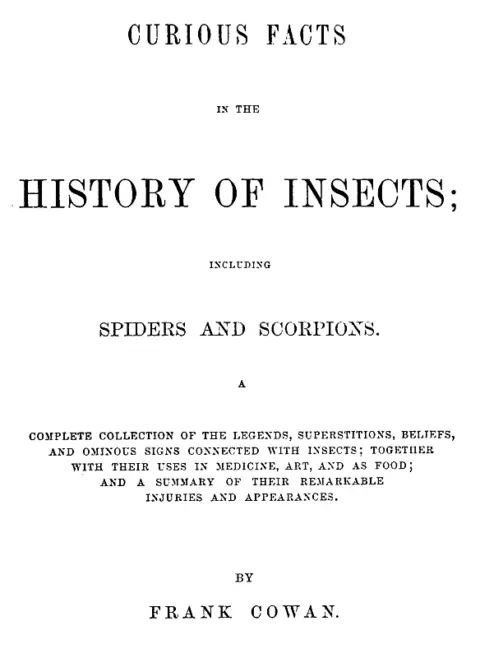
"Curious Facts in the History of Insects; Including Spiders and Scorpions" by Frank Cowan is a scientific publication written in the mid-19th century. The work explores entomology through the lens of legends, superstitions, beliefs, and various uses of insects, alongside their historical significance in medicine, art, and as food. The focus is not just on biological facts, but also on the fascinating folklore and cultural narratives associated with these creatures. At the start of the text, the author outlines his ambition to compile intriguing historical accounts related to insects, moving beyond traditional scientific boundaries. He emphasizes collecting facts from unusual sources, including chronicles and travel books, to illustrate the connections between human culture and the insect world. The opening sets the stage for a detailed examination of specific insects, beginning with the Ladybird, discussing its folklore across different cultures, and thus combining scientific classifications with rich, anecdotal history.
Introduction adapted from the source catalogue; source summaries may be automatically generated.
Free to read · English · 139,897 words · No account needed
MAKE TIME FOR A GOOD BOOK
On by default. Untick to stop anonymous reading totals. Each page counts after 10 seconds in view. How this works.
Anonymous counting is on unless you have switched it off.
Lady, Lady Lanners,
Lady, Lady Lanners,
Tak’ up your clowk about your head,
An’ flee awa’ to Flanners (Flanders).
Flee ower firth, and flee ower fell,
Flee ower pule and rinnan’ well,
Flee ower muir, and flee ower mead,
Flee ower livan, flee ower dead,
Flee ower corn, and flee ower lea,
Flee ower river, flee ower sea,
Flee ye east, or flee ye west,
Flee till him that lo’es me best.
So it seems that also in Scotland, the Lady-bird, which is still a great favorite with the Scottish peasantry, has been used for divining one’s future helpmate. This likewise appears from a rhyme from the north of Scotland, which dignifies the insect with the title of Dr. Ellison:
Dr. Dr. Ellison, where will I be married?
East, or west, or south, or north?
Take ye flight and fly away.
It is sometimes also termed Lady Ellison, or knighted Sir Ellison; while other Scottish names of it are Mearns, Aberd, The King, and King Galowa, or Calowa. Under this last title of dignity there is another Scottish rhyme, which evinces also the general use of this insect for the purpose of divination:
King, King Calowa,
Up your wings and flee awa’
Over land, and over sea;
Tell me where my love can be.[16]
There is a Netherlandish tradition that to see Lady-birds forebodes good luck;[17] and in England it is held extremely unlucky to destroy these insects. Persons killing them, it is thought, will infallibly, within the course of the year, break a bone, or meet with some other dreadful misfortune.[18]
In England, the children are accustomed to throw the Lady-bird into the air, singing at the same time,--
Lady-bird, lady-bird, fly away home;
Your house is on fire, your children’s at home,
All but one that ligs under the stone,--
Ply thee home, lady-bird, ere it be gone.[19]
Or, as in Yorkshire and Lancashire,--
Lady-bird, lady-bird, eigh thy way home;
Thy house is on fire, thy children all roam,
Except little Nan, who sits in her pan,
Weaving gold laces as fast as she can.[20]
Or, as most commonly with us in America,--
Lady-bird, lady-bird, fly away home,
Your house is on fire, and your children all burn.
The meaning of this familiar, though very curious couplet, seems to be this: the larvæ, or young, of the Lady-bird feed principally upon the aphides, or plant-lice, of the vines of the hop; and fire is the usual means employed in destroying the aphides; so that in killing the latter, the former, which had come for the same purpose, are likewise destroyed.
Your reading position is saved on this browser. Take it to another device with a library code. Reading pages adapt to text, rather than matching a printed edition.
BEHIND THE BOOK
This eBook is for the use of anyone anywhere in the United States and most other parts of the world at no cost and with almost no restrictions whatsoever. You may copy it, give it away or re-use it under the terms of the Project Gutenberg License included with this eBook or online at www.gutenberg.org. If you are not located in the United States, you will have to check the laws of the country where you are located before using this eBook. Read the source licence.
The original source file, including credits and licence, is retained by this library. Request an original-format copy at no charge. Please include the book title and Project Gutenberg identifier #41625.
KEEP YOUR CURIOSITY GOING
Cécile Tormay

Moritz Busch
John L. Ransom

Maurice Baring
Frances Wright
Cécile Tormay