THE CLASSIC COLLECTION✦An outlaw’s diary: the CommuneCLASSIC FREE BOOKS
An outlaw’s diary: the Commune
Cécile Tormay
THE CLASSIC COLLECTION · 1865
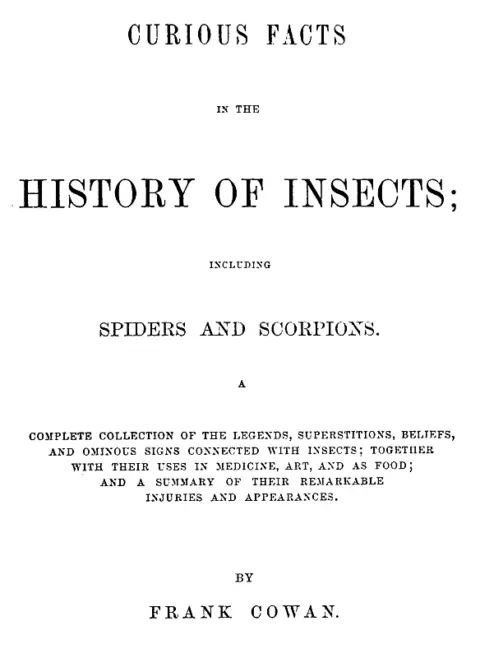
"Curious Facts in the History of Insects; Including Spiders and Scorpions" by Frank Cowan is a scientific publication written in the mid-19th century. The work explores entomology through the lens of legends, superstitions, beliefs, and various uses of insects, alongside their historical significance in medicine, art, and as food. The focus is not just on biological facts, but also on the fascinating folklore and cultural narratives associated with these creatures. At the start of the text, the author outlines his ambition to compile intriguing historical accounts related to insects, moving beyond traditional scientific boundaries. He emphasizes collecting facts from unusual sources, including chronicles and travel books, to illustrate the connections between human culture and the insect world. The opening sets the stage for a detailed examination of specific insects, beginning with the Ladybird, discussing its folklore across different cultures, and thus combining scientific classifications with rich, anecdotal history.
Introduction adapted from the source catalogue; source summaries may be automatically generated.
Free to read · English · 139,897 words · No account needed
MAKE TIME FOR A GOOD BOOK
On by default. Untick to stop anonymous reading totals. Each page counts after 10 seconds in view. How this works.
Anonymous counting is on unless you have switched it off.
2. When at C time, the ibis is worshiped, suppose the masses have lost the reason (which in the case of the Egyptians is an allowable supposition, since it is an historical fact that but the initiated knew the reasons for their manner of worship), and serpents are its food, is it not plain then that if the food be taken away the sacred bird cannot live? Hence at C time are serpents preserved and protected as food for the ibis; and as this protecting care increases as above, till at D they are reverenced, and at E worshiped. To this second class may be referred the crocodile, which was preserved, etc. as food for the ichneumon, a sacred animal of the first class.
3. Analogies between animals, and even plants, and certain sources of goodness, or objects of wonder, as the sun, and motion of the stars, were at A time, noticed; at B, respected or reverenced; and at C, worshiped. Thus, among plants, became the onion sacred, from the resemblance of the laminæ which compose it, in a transverse section, to circles--to the orbits of the planets. And thus the Scarabæus from the analogies between its movements and shape and the motions of the sun, traced, as we have before remarked on the authority of several ancient writers, became also an object of adoration.
4. A fourth reason may also be given, which follows as a consequence of the latter. If such analogy, as, for example, that between the beetle and the sun, had been observed in the time of picture and hieroglyphic writing, to represent the sun, the beetle would have been taken. Now, it is a well-authenticated fact, that these hieroglyphics in time became sacred, and, if the beetle was found among them, it for this, if for no other reason, would have been looked upon with the same veneration.
5. Good men, too, to preserve the lives of animals oftentimes wantonly taken, introduce them into fables and poetry, and connect pleasing tales with them. The “Babes in the Wood” have so fixed the respect for the tameness of the robin, that it is even now deemed a sacrilege with our boys to stone this bird. And may there not have been such good men, and such tender stories, among the Egyptians, and the remembrance of whom and which long lost by the lapse of time?
[122] Kirb. and Sp. Introd., i. 33.
[123] Ins. of China, p. 6.
[124] Nat. Hist., xxix. 6 (38).
[125] Nat. Hist., xxx. 11 (30). Holland, Trans., ii. 390.
[126] James’ Med. Dict.
[127] Donovan’s Ins. of China, p. 6.
[128] Theatr. Ins., p. 160. Topsel’s Hist. of Beasts, p. 1012.
Your reading position is saved on this browser. Take it to another device with a library code. Reading pages adapt to text, rather than matching a printed edition.
BEHIND THE BOOK
This eBook is for the use of anyone anywhere in the United States and most other parts of the world at no cost and with almost no restrictions whatsoever. You may copy it, give it away or re-use it under the terms of the Project Gutenberg License included with this eBook or online at www.gutenberg.org. If you are not located in the United States, you will have to check the laws of the country where you are located before using this eBook. Read the source licence.
The original source file, including credits and licence, is retained by this library. Request an original-format copy at no charge. Please include the book title and Project Gutenberg identifier #41625.
KEEP YOUR CURIOSITY GOING
Cécile Tormay

Moritz Busch
John L. Ransom

Maurice Baring
Frances Wright
Cécile Tormay