THE CLASSIC COLLECTION✦Primitive Manners and CustomsCLASSIC FREE BOOKS
Primitive Manners and Customs
James Anson Farrer
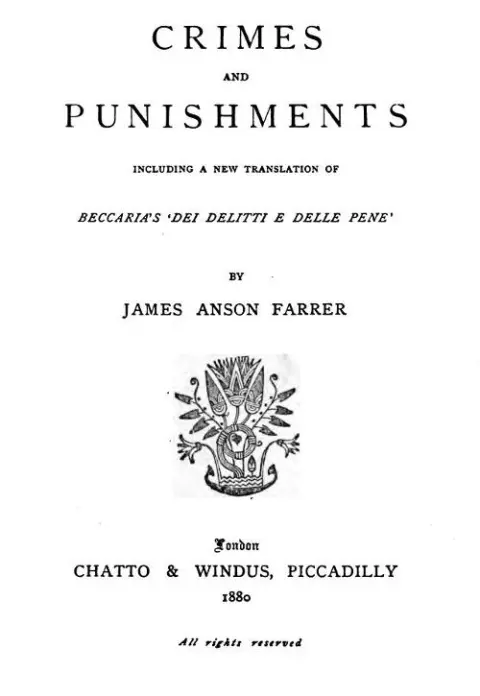
THE CLASSIC COLLECTION · 1880
"Crimes and Punishments" by James Anson Farrer is a translation and commentary on the classical work by Cesare Beccaria, written in the late 19th century. This text serves not only as a translation of Beccaria’s influential treatise on criminal law but also aims to highlight its historical significance and continuing relevance in the context of legal reform. The topics explored include the critique of torture, discussions on various forms of punishment, and the philosophical underpinnings of criminology that prioritize the rights and well-being of individuals within the justice system. At the start of the translation, Farrer provides a preface detailing Beccaria's life, the socio-political milieu of Lombardy during his time, and the lasting impact of his arguments against torture and capital punishment. He discusses how the oppressive legal practices of the time compelled Beccaria, a non-lawyer, to advocate for significant changes in criminal justice, thereby illuminating the corruption and brutality of the systems he aimed to reform. Farrer contextualizes Beccaria's work within the Enlightenment's discourse on human rights and justice, setting the stage for a deeper exploration of the philosophical and practical implications of Beccaria's theories on law and morality.
Introduction adapted from the source catalogue; source summaries may be automatically generated.
Free to read · English · 59,937 words · No account needed
MAKE TIME FOR A GOOD BOOK
On by default. Untick to stop anonymous reading totals. Each page counts after 10 seconds in view. How this works.
Anonymous counting is on unless you have switched it off.
So said also a more serious authority, Periander, tyrant of Corinth, sometimes counted among the Seven Wise Men of Greece: μὴ μόνον τοὺς ἀμαρτάνοντας άλλὰ καὶ τοὺς μέλλοντας κόλαζε. ‘Punish not only those who have done wrong, but those who are going to.’
[44] Judicial Statistics, 1878, xi.
[45] White’s Three Years in Constantinople, ii. 331.
[46] Pierson, Aus Russland’s Vergangenheit, 31, 32.
[47] See Sir G. Staunton’s Penal Code of China, lxxi. 278-9, 285, 345, 367, 381, 449, for tables apportioning punishment to different crimes according to an exact mathematical scale. There is no reason to suppose that this scale was never acted upon, even if it is not observed now, about which there is no good evidence.
[48] Farinaccius: ‘Potest pro tribus furtis, quamvis minimis, pœna mortis imponi.’ The philosophy of this was, that to do anything twice was the same as doing it frequently: ‘Quod bis fit, frequenter fieri dicitur.’
[49] The French have two words, récidive and récidiver, to signify a relapse into crime, the word being applied as a metaphor from medicine, where it means the recurrence of a disease. In English we might adopt the word reciduous to express renewed acts of crime after punishment.
[50] The figures for May 1878 are: Men, 8,983; of these only 2,064 had had no previous conviction of any kind, 4,672 had had sentences short of penal servitude, and 2,247 penal servitude sentences. Of the 1,226 women, 124 had never been convicted before, 635 had had sentences short of penal servitude, 567 penal servitude sentences.—(P.S. Report, iii. 1170. See also ii. 206, 296, 364.)
[51] Penal Servitude Acts Commission, 1879, vol. iii. 1195-6.
[52] Judicial Statistics, 1878, xvi. 45.
[53] The same seems to be also true of France. ‘Quoi de plus important que ce fait, qu’en moyenne annuelle 30,000 crimes ou délits restent impunis parce que les auteurs en sont inconnus, et 10,000 environ parce que les charges portées contre les accusés ou prévenus ont été jugées insuffisantes.’—LEGOYT, La France et l’Étranger, i. 406.
[54] Hill, Crime, 28.
[55] Memorials of Millbank, ii. 274-5.
[56] The author of Five Years’ Penal Servitude. With this testimony agrees thoroughly that of the Chaplain of Parkhurst Prison (P.S. Rep. iii. 707-8), that of the Governor of Portland Prison (ii. 164-5), and that of the Governor of Spike Island (iii. 814-5).
[57] Penal Servitude Report, i. 43.
[58] If we include offences proceeded against summarily with the indictable offences reported, about 2 per cent. of the population may be counted as dishonest.
[59] Strafgesetzbuch, c. vi. 33.
[60] Wheeler, Imperial Assemblage at Delhi, 1877, 124, 127.
[61] Congrès pénitentiaire international. Tableau xii.
[62] There is a precedent for such a law in the legislation of Leopold, Grand Duke of Tuscany: ‘Les malheureux injustement emprisonnés et reconnus innocents devaient être indemnisés au moyen d’un fonds formé par les amendes, mésure équitable et profondément humaine.’—LOISELEUR, Hist. des Peines, 336.
Your reading position is saved on this browser. Take it to another device with a library code. Reading pages adapt to text, rather than matching a printed edition.
James Anson Farrer
James Anson Farrer
James Anson Farrer
BEHIND THE BOOK
This eBook is for the use of anyone anywhere in the United States and most other parts of the world at no cost and with almost no restrictions whatsoever. You may copy it, give it away or re-use it under the terms of the Project Gutenberg License included with this eBook or online at www.gutenberg.org. If you are not located in the United States, you will have to check the laws of the country where you are located before using this eBook. Read the source licence.
The original source file, including credits and licence, is retained by this library. Request an original-format copy at no charge. Please include the book title and Project Gutenberg identifier #58700.
KEEP YOUR CURIOSITY GOING

David Patterson (Spirit) Hatch
Cécile Tormay

Moritz Busch
Coulson Kernahan
John L. Ransom

Ralph Waldo Emerson