THE CLASSIC COLLECTION✦Primitive Manners and CustomsCLASSIC FREE BOOKS
Primitive Manners and Customs
James Anson Farrer
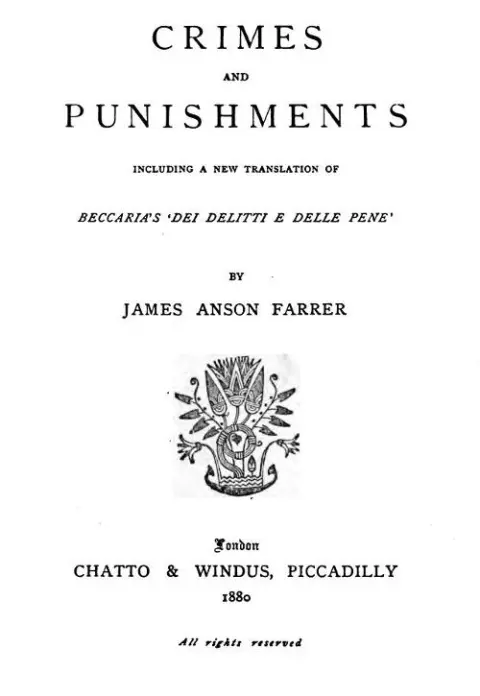
THE CLASSIC COLLECTION · 1880
"Crimes and Punishments" by James Anson Farrer is a translation and commentary on the classical work by Cesare Beccaria, written in the late 19th century. This text serves not only as a translation of Beccaria’s influential treatise on criminal law but also aims to highlight its historical significance and continuing relevance in the context of legal reform. The topics explored include the critique of torture, discussions on various forms of punishment, and the philosophical underpinnings of criminology that prioritize the rights and well-being of individuals within the justice system. At the start of the translation, Farrer provides a preface detailing Beccaria's life, the socio-political milieu of Lombardy during his time, and the lasting impact of his arguments against torture and capital punishment. He discusses how the oppressive legal practices of the time compelled Beccaria, a non-lawyer, to advocate for significant changes in criminal justice, thereby illuminating the corruption and brutality of the systems he aimed to reform. Farrer contextualizes Beccaria's work within the Enlightenment's discourse on human rights and justice, setting the stage for a deeper exploration of the philosophical and practical implications of Beccaria's theories on law and morality.
Introduction adapted from the source catalogue; source summaries may be automatically generated.
Free to read · English · 59,937 words · No account needed
MAKE TIME FOR A GOOD BOOK
On by default. Untick to stop anonymous reading totals. Each page counts after 10 seconds in view. How this works.
Anonymous counting is on unless you have switched it off.
There is a general theorem which is most useful for calculating the certainty of a fact, as, for instance, the force of the proofs in the case of a given crime:—
1. When the proofs of a fact are dependent one on another—that is to say, when each single proof rests on the weight of some other—then the more numerous the proofs are, the smaller is the probability of the fact in question, because the chances of error in the preliminary proofs would increase the probability of error in the succeeding ones.
2. When the proofs of a fact all depend equally on a single one, their number neither increases nor diminishes the probability of the fact in question, because their total value resolves itself into that of the single one on which they depend.
3. When the proofs are independent of each other—that is to say, when they do not derive their value one from the other—then the more numerous the proofs adduced, the greater is the probability of the fact in question, because the falsity of one proof affects in no way the force of another.
I speak of probability in connection with crimes, which, to deserve punishment, ought to be proved. But the paradox is only apparent, if one reflects that, strictly speaking, moral certainty is only a probability, but a probability which is called certainty, because every sensible person necessarily assents to it, by a force of habit which arises from the necessity of acting, and which is prior to all speculation. The certainty requisite for certifying that a man is a criminal is, therefore, the same that determines everyone in the most important actions of his life. The proofs of a crime may be divided into ‘perfect’ and ‘imperfect,’ the former being of such a nature as exclude the possibility of a man’s innocence, and the latter such as fall short of this certainty. Of the first kind one proof alone is sufficient for condemnation; of the second, or imperfect kind, as many are necessary as suffice to make a single perfect proof; that is to say, when, though each proof taken separately does not exclude the possibility of innocence, yet their convergence on the same point makes such innocence impossible. But let it be noted that imperfect proofs, from which an accused has it in his power to justify himself and declines to do so, become perfect. This moral certainty of proofs, however, is easier to feel than to define with exactitude: for which reason I think that the best law is one which attaches to the chief judge assessors, taken by lot, not by selection, there being in this case more safety in the ignorance which judges by sentiment than in the knowledge which judges by opinion. Where the laws are clear and precise, the function of a judge consists solely in the certification of fact. If for searching out the proofs of a crime ability and cleverness are required, and if in the presentation of the result clearness and precision are essential, all that is required to judge of the result is simple and common good sense, a faculty which is less fallacious than the learning of a judge, accustomed as he is to wish to find men guilty and to reduce everything to an artificial system borrowed from his studies. Happy the nation where the laws are not a science! It is a most useful law that everyone shall be judged by his equals, because where a citizen’s liberty and fortune are at stake those sentiments which inequality inspires should have no voice; that feeling of superiority with which the prosperous man regards the unfortunate one, and that feeling of dislike with which an inferior regards his superior, have no scope in a judgment by one’s equals. But when the crime in question is an offence against a person of a different rank from the accused, then one half of the judges should be the equals of the accused, the other half equals of the plaintiff, that so, every private interest being balanced, by which the appearances of things are involuntarily modified, only the voice of the laws and of truth may be heard. It is also in accordance with justice that an accused person should have power up to a certain point of refusing judges whom he may suspect; and if he is allowed the exercise of this power for some time without opposition, he will seem to condemn himself. Verdicts should be public, and the proofs of guilt public, in order that opinion—which is, perhaps, the only bond of society there is—may place a check on outbursts of force and passion, and that the people may say, ‘We are not slaves without defence’: a feeling which both inspires them with courage and is as good as a tribute to a sovereign who understands his real interest. I refrain from pointing out other details and precautions which require similar regulations. I should have said nothing at all, had it been necessary for me to say everything.
Your reading position is saved on this browser. Take it to another device with a library code. Reading pages adapt to text, rather than matching a printed edition.
James Anson Farrer
James Anson Farrer
James Anson Farrer
BEHIND THE BOOK
This eBook is for the use of anyone anywhere in the United States and most other parts of the world at no cost and with almost no restrictions whatsoever. You may copy it, give it away or re-use it under the terms of the Project Gutenberg License included with this eBook or online at www.gutenberg.org. If you are not located in the United States, you will have to check the laws of the country where you are located before using this eBook. Read the source licence.
The original source file, including credits and licence, is retained by this library. Request an original-format copy at no charge. Please include the book title and Project Gutenberg identifier #58700.
KEEP YOUR CURIOSITY GOING

David Patterson (Spirit) Hatch
Cécile Tormay

Moritz Busch
Coulson Kernahan
John L. Ransom

Ralph Waldo Emerson