THE CLASSIC COLLECTION✦Primitive Manners and CustomsCLASSIC FREE BOOKS
Primitive Manners and Customs
James Anson Farrer
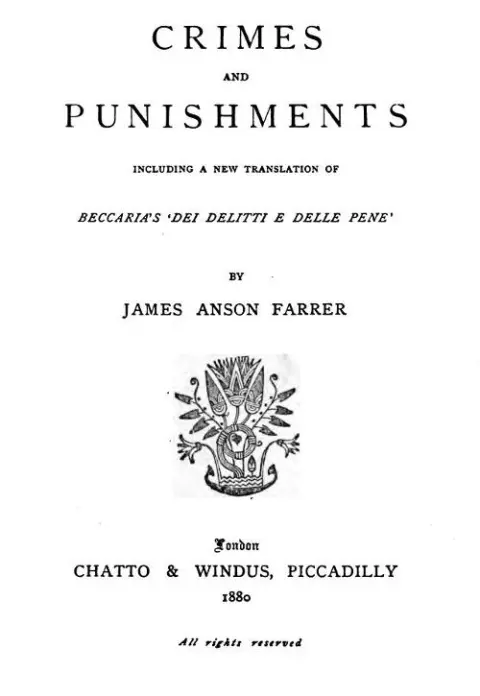
THE CLASSIC COLLECTION · 1880
"Crimes and Punishments" by James Anson Farrer is a translation and commentary on the classical work by Cesare Beccaria, written in the late 19th century. This text serves not only as a translation of Beccaria’s influential treatise on criminal law but also aims to highlight its historical significance and continuing relevance in the context of legal reform. The topics explored include the critique of torture, discussions on various forms of punishment, and the philosophical underpinnings of criminology that prioritize the rights and well-being of individuals within the justice system. At the start of the translation, Farrer provides a preface detailing Beccaria's life, the socio-political milieu of Lombardy during his time, and the lasting impact of his arguments against torture and capital punishment. He discusses how the oppressive legal practices of the time compelled Beccaria, a non-lawyer, to advocate for significant changes in criminal justice, thereby illuminating the corruption and brutality of the systems he aimed to reform. Farrer contextualizes Beccaria's work within the Enlightenment's discourse on human rights and justice, setting the stage for a deeper exploration of the philosophical and practical implications of Beccaria's theories on law and morality.
Introduction adapted from the source catalogue; source summaries may be automatically generated.
Free to read · English · 59,937 words · No account needed
MAKE TIME FOR A GOOD BOOK
On by default. Untick to stop anonymous reading totals. Each page counts after 10 seconds in view. How this works.
Anonymous counting is on unless you have switched it off.
[16] Morellet, Mémoires, i. 167: ‘Revenu à Milan il a fait peu de chose, et sa fin n’a pas répondu à son début, phénomène commun parmi les gens de lettres d’Italie, qui ont un premier feu bien vif, mais qui, à 25 et 30 ans, se désabusent comme Salomon et reconnaissent que la science est vanité, sans avoir attendu d’être aussi savant que lui.’
[17] Cantù, Beccaria, 42.
[18] In a book called Cautio Criminalis, published in 1718.
[19] Jardine’s Reading on Torture.
[20] Tooke’s Catharine II., 441-8. Rambaud’s Russie, 476. ‘Dans l’instruction pour la confection du nouveau Code, Catharine II., suivant sa propre expression, avait pillé les philosophes d’Occident, mais surtout Montesquieu et Beccaria.’
[21] Morellet, Mémoires, i. 165.
[22] General C. Lee’s Memoirs.
[23] This fact rests on the authority of a gentleman of Pisa, who told it to Dr. Rush, the so-called ‘American Æsculapius,’ who wrote against capital punishment towards the end of the last century.
[24] By Gustavus III. It had, however, been discontinued long before, as Beccaria speaks of it as non-existent when he wrote.
[25] Turnbull’s Visit to Philadelphia Prison, 1797.
[26] Times, March 1, 1880.
[27] For most of the above facts the writer is indebted to the papers published by the Howard Association, kindly sent to him by the Secretary, Mr. Tallack.
[28] Diodorus Siculus, i. 65: ἀντὶ γὰρ τοῦ θανάτου τοὺς καταδικασθέντας ἠνάγκαζε λειτουργεῖν ταῖς πόλεσι δεδεμένους.
[29] Gibbon, c. 48: ‘During his government of twenty-five years the penalty of death was abolished in the Roman Empire.’ A.D. 1118-1143.
[30] Beccaria doubtless got the expression from Helvetius, who used it in his L’Esprit, i. 228, 291.
[31] Vicar of Wakefield, c. 27; and Citizen of the World, letter 79. Johnson was more outspoken in the Rambler, No. 114 (1751), in which he advocated the restriction of capital punishment to cases of murder.
[32] Lord Kames’ Historical Law Tracts. Criminal Law. 1776.
[33] Enquiry into the Late Increase of Robbers (1751).
[34] Meredith’s speech of May 13, 1777, in Parl. Deb., xix. 239.
[35] Lecky’s England, i. 506.
[36] Speech, May 11, 1810.
[37] Romilly’s Memoirs, ii. 322.
[38] Hansard, and Campbell’s Chief Justices, iii. 233. The arguments are almost Paley’s word for word.
[39] Stephen’s English Criminal Law, 156, 178.
[40] Sir G. Staunton’s Penal Code of China, 347, 416.
[41] See several instances in Baring Gould’s Curiosities of Olden Times, in the chapter on Queer Culprits.
[42] So Seneca, De Ira., i. 16: ‘Nemo prudens punit quia peccatum est, sed ne peccetur. Revocari enim præterita non possunt, futura prohibentur.’ Compare ibid., ii. 31, and Plato, Laws, xi. 934 A.
[43] The same is the philosophy of the nursery-rhyme book:—
‘That’s Jack. Lay a stick on his back.
What’s he done? I cannot say.
We’ll find out to-morrow, and beat him to-day.’
Your reading position is saved on this browser. Take it to another device with a library code. Reading pages adapt to text, rather than matching a printed edition.
James Anson Farrer
James Anson Farrer
James Anson Farrer
BEHIND THE BOOK
This eBook is for the use of anyone anywhere in the United States and most other parts of the world at no cost and with almost no restrictions whatsoever. You may copy it, give it away or re-use it under the terms of the Project Gutenberg License included with this eBook or online at www.gutenberg.org. If you are not located in the United States, you will have to check the laws of the country where you are located before using this eBook. Read the source licence.
The original source file, including credits and licence, is retained by this library. Request an original-format copy at no charge. Please include the book title and Project Gutenberg identifier #58700.
KEEP YOUR CURIOSITY GOING

David Patterson (Spirit) Hatch
Cécile Tormay

Moritz Busch
Coulson Kernahan
John L. Ransom

Ralph Waldo Emerson