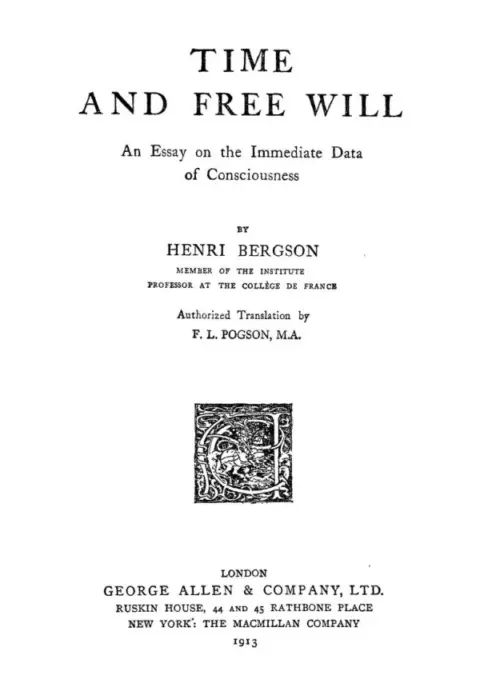
Time and Free Will: An Essay on the Immediate Data of Consciousness
Henri Bergson
THE CLASSIC COLLECTION · 1911
"Creative Evolution" by Henri Bergson is a philosophical work published in 1907. The book challenges Darwin's theory of natural selection, proposing instead that evolution is driven by élan vital—a vital creative impulse within life itself. Bergson explores concepts of subjective time and "duration," suggesting these can only be grasped through intuition rather than rational analysis. His ideas profoundly influenced modernist writers and thinkers, making the book enormously popular in the early twentieth century.
Introduction adapted from the source catalogue; source summaries may be automatically generated.
Free to read · English · 134,128 words · No account needed
MAKE TIME FOR A GOOD BOOK
On by default. Untick to stop anonymous reading totals. Each page counts after 10 seconds in view. How this works.
Anonymous counting is on unless you have switched it off.
Immobility of extension, 155
and plants, 108-13, 118, 119, 130
of primitive and torpid animals, 130-1
relative and apparent; mobility real, 155
Impatience, duration as, 10, 339-40
Impelling cause, 73
Impetus, vital, divergence of, 26-7, 51-5, 97-105, 110, 118-9, 126-7,
131, 134-6, 257, 258, 266, 270
vital, limitedness of, 126, 141, 148-9, 254
vital, loaded with matter, 239
vital, as necessity for creation, 252, 261
vital, transmission of, through organisms, 25, 27, 79, 85, 87, 88,
230, 231, 250, 251
vital, See Impulse of life
Implement, the animal, is natural: the human, artificial, 139-43
artificial, 137-40, 150-1
constructing, function of intelligence, 159, 182-3
life known to intelligence only as, 162
matter known to intelligence only as, 161, 198
natural, 141, 145, 150
organized, 141, 145, 150
unorganized, 137-9, 141, 150-1
Implicit knowledge, 148
Impotence of intellect and perception to grasp life, 176-8
Imprisonment of consciousness, 180-3, 264-6
Impulse of life, divergence of, 26, 27, 51-5, 97-105, 110, 118-9,
126-7, 131, 134-6, 257, 258, 266, 270
limitedness of, 126, 141, 148-9, 254
loaded with matter, 239
tendency to mobility, 131, 132
as necessity for creation, 252, 261
negates itself, 247, 248
prolonged in evolution, 246
prolonged in our will, 239
transmitted through generations of organisms, 25, 26, 79, 85, 87,
230, 231
unity of, 202, 250, 270
Impulsion and attraction in Greek philosophy, 323-4
release and unwinding, the three kinds of cause, 73
given to mind by matter, 202
Inadequacy of act to representation, consciousness as, 143
Inadequate and adequate in Spinoza, 353
Inanition, illustrating primacy of nervous system, 124 note
Incoherence, 236.
See Absence of order, Chance, Chaos
in nature, 104
Incommensurability of free act with conceptual idea, 47, 201 of instinct and intelligence, 167-8, 175
Incompatibility of developed tendencies, 104, 168
Independent variable, time as, 20, 335-6
Indetermination, 86, 114, 126, 252, 253, 326.
See Accident in evolution
Indeterminism in Descartes, 345
Individual, viewed by intelligence as aggregate of molecules and of
facts, 250-1
and division of labor, 140
in evolutionist biology, 169, 171, 246 note
and genus, 226-9
mind in philosophy, 191
aesthetic intuition only attains the, 177
and society, 260, 265
transmits the vital impetus, 250, 259, 270
Individuality never absolute, x, 12, 13, 16, 19, 42, 260
and age, 15-23, 27, 43
corporeal, physics tends to deny, 188, 189, 208.
See Interpenetration, Obliteration of outlines, Solidarity
of the parts of matter
and generality, 226-8
the many and the one in the idea of, x, 258
as plan of possible influence, 11
Individuation never absolute, x, 12-16, 43, 260
as a cosmic principle in contrast with association, 259-60
property of life, 12-5
partly the work of matter, 257-8, 259, 270
Indivisibility of action, 94, 95
of duration, 6, 308
of invention, 164
of life, 225, 270-1.
See Unity
of life of motion, 307-11
Induction in animals, 214
certainty of, approached as factors approach pure magnitudes, 222, 223
and duration, 216
and expectation, 214-6
geometry the ideal limit of, 214-8, 361.
See Space, Geometry, Reasoning, "Descending" movement of matter, etc.
and magnitude, 215, 216
repetition the characteristic function of intellect, 164, 199, 205-16
and space, 216.
See Space as the ideal limit, Systems, etc.
Industry, ix, 161, 162, 164
Your reading position is saved on this browser. Take it to another device with a library code. Reading pages adapt to text, rather than matching a printed edition.
Henri Bergson
Henri Bergson
Henri Bergson
BEHIND THE BOOK
This eBook is for the use of anyone anywhere in the United States and most other parts of the world at no cost and with almost no restrictions whatsoever. You may copy it, give it away or re-use it under the terms of the Project Gutenberg License included with this eBook or online at www.gutenberg.org. If you are not located in the United States, you will have to check the laws of the country where you are located before using this eBook. Read the source licence.
The original source file, including credits and licence, is retained by this library. Request an original-format copy at no charge. Please include the book title and Project Gutenberg identifier #26163.
KEEP YOUR CURIOSITY GOING

David Patterson (Spirit) Hatch
Coulson Kernahan

Ralph Waldo Emerson
Frances Wright

Edwin Abbott Abbott

Joseph Droz