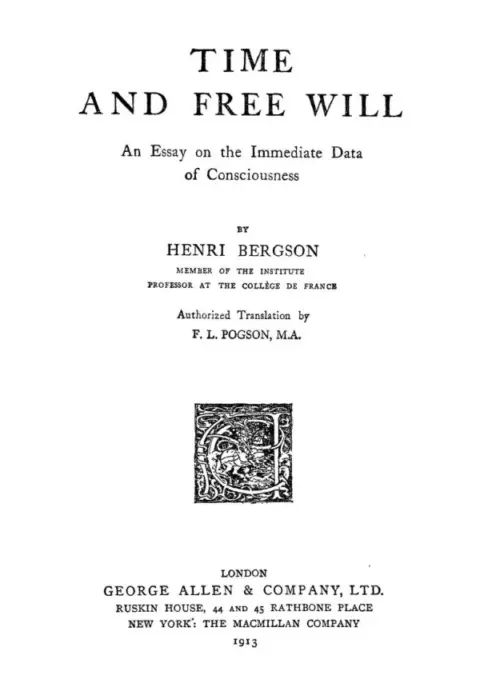
Time and Free Will: An Essay on the Immediate Data of Consciousness
Henri Bergson
THE CLASSIC COLLECTION · 1911
"Creative Evolution" by Henri Bergson is a philosophical work published in 1907. The book challenges Darwin's theory of natural selection, proposing instead that evolution is driven by élan vital—a vital creative impulse within life itself. Bergson explores concepts of subjective time and "duration," suggesting these can only be grasped through intuition rather than rational analysis. His ideas profoundly influenced modernist writers and thinkers, making the book enormously popular in the early twentieth century.
Introduction adapted from the source catalogue; source summaries may be automatically generated.
Free to read · English · 134,128 words · No account needed
MAKE TIME FOR A GOOD BOOK
On by default. Untick to stop anonymous reading totals. Each page counts after 10 seconds in view. How this works.
Anonymous counting is on unless you have switched it off.
God, as activity, 249
of Aristotle, 196, 322, 325, 349, 353, 356-7
ascent toward, in Aristotle's philosophy, 322-3
circularity of God's thought, in Aristotle's philosophy, 324, 325
in Descartes's philosophy, 346, 347
as efficient cause in Aristotle's philosophy, 324
as hypostasis of the unity of nature, 196, 322, 357
in Leibniz's philosophy, 352, 353, 356-7
as eternal matter, 196-7
as pure form, 196-7, 322
in Spinoza's philosophy, 351, 357
Greek philosophy. See Ancient philosophy
Green parts of plants, 107-9, 114, 117, 246, 247, 254
Growing old, 15
Growth, creation is, 240-1, 275
and novelty, 231
of the powers of life, 132, 134-5
reality is, 237
of the universe, 343, 345
Guérin, P., 59 note
Guinea-pig, in illustration of hereditary transmission, 80, 81
Habit and consciousness annulled, 143
form of knowledge a habit or bent of attention, 148
and heredity, 78, 93, 169, 170, 173.
See Acquired characters, inheritance of
instinct as an intelligent, 173-4
and invention in animals, 264
and invention in man, 265
tendency of freedom to self-negation in, 127-8
Harmony between instinct and life, and between intelligence and the
inert, 187, 194-5, 198
of the organic world is complementarity due to a common original
impulse 50, 51, 103, 116, 118
pre-established, 205, 206
in radical finalism, 127-8.
See Discord
Hartog, 60 note
Hatchets, ancient flint, and human intellect, 137
Heliocentric radius-vector in Kepler's laws, 333-4
Hereditary transmission, 76-83, 87, 168-9, 170, 173, 225-6, 230
domestication of animals and, 80-1
habit and, 79, 83, 169, 170, 173
Hesitation or choice, consciousness as, 143, 144
Heteroblastia and identical structures on divergent lines of evolution, 75
Heymons, 72 note
History as creative evolution, 6, 15, 21, 26, 29, 36, 37, 65-6, 103-4,
105, 163, 264, 269
of philosophy, 238
Hive as an organism, 166
Homo faber, designation of human species, 139
Homogeneity of space, 156, 212
the sphere of intellect, 163
of time in Galileo, 332
Horse-fly illustrating the object of instinct, 146
Houssay, 109 note
Human and animal attention, 184
and animal brain, 184, 263-5
and animal consciousness, 139-43, 180, 183, 184, 187, 188, 191,
212, 263-8
and animal instruments of action, 139-43, 150
and animal intelligence, 138, 187, 188, 191, 192, 212
and animal invention, relation of, to habit, 264, 265
intellect and language, 157-8
intellect and manufacture, 137, 138
Humanity in evolution, 134, 137-9, 142, 147, 158, 181, 184, 185, 264-71.
See Culminating points, etc.
goal of evolution, 266, 267
Huxley, 38
Hydra and individuality, 13
[Greek: Hylê] of Aristotle, 353
Hymenoptera, the culmination of arthropod and instinctive evolution,
134, 173-4
as entomologists, 146, 172-3
organization and instinct in, 140
paralyzing instinct of, 146, 172, 173-4
social instincts of, 101, 171
Hypostasis of the unity of nature, God as, 196-7, 322, 356
Hypothetical propositions characteristic of intellectual knowledge, 149-50
Idea or form in ancient philosophy, 49, 314, 316-7, 318, 329-30
in ancient philosophy, [Greek: eidos], 314-5
in ancient philosophy, Platonic, 48
and image in Descartes, 280
Idealism, 232
Idealists and realists alike assume the possibility of an absence of
order, 220, 232
Identical structures in divergent lines of evolution, 55, 60-1, 62, 69,
74-7, 86, 119
Illumination of action the function of perception, 5, 206, 307
Image and idea in Descartes, 280
distinguished from concept, 160-1, 280
Imitation of being in Greek philosophy, 324, 327
of instinct by science, 168-9, 173-4
of life in intellectual representation, 4, 33, 88-9, 101, 176, 208,
209, 213, 226, 259, 341, 365
of life by the unorganized, 33, 35, 36
of motion by intelligence, 305, 307-8, 312, 313, 329.
See Imitation of the real, etc.
of the physical order by the vital, 230
of the real by intelligence, 258, 270, 307
Your reading position is saved on this browser. Take it to another device with a library code. Reading pages adapt to text, rather than matching a printed edition.
Henri Bergson
Henri Bergson
Henri Bergson
BEHIND THE BOOK
This eBook is for the use of anyone anywhere in the United States and most other parts of the world at no cost and with almost no restrictions whatsoever. You may copy it, give it away or re-use it under the terms of the Project Gutenberg License included with this eBook or online at www.gutenberg.org. If you are not located in the United States, you will have to check the laws of the country where you are located before using this eBook. Read the source licence.
The original source file, including credits and licence, is retained by this library. Request an original-format copy at no charge. Please include the book title and Project Gutenberg identifier #26163.
KEEP YOUR CURIOSITY GOING

David Patterson (Spirit) Hatch
Coulson Kernahan

Ralph Waldo Emerson
Frances Wright

Edwin Abbott Abbott

Joseph Droz