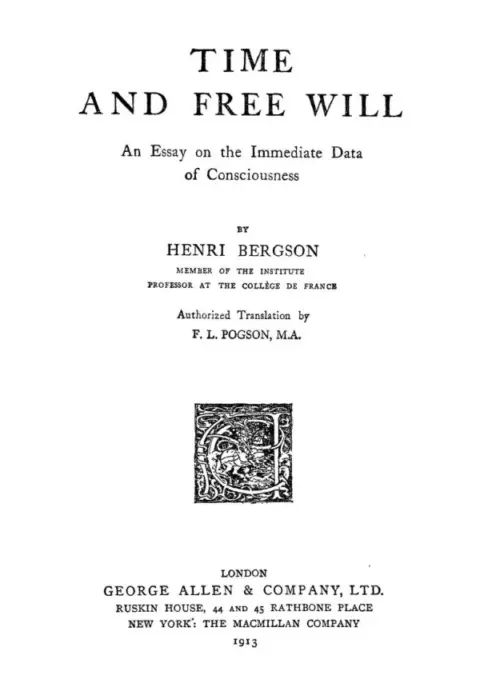
Time and Free Will: An Essay on the Immediate Data of Consciousness
Henri Bergson
THE CLASSIC COLLECTION · 1911
"Creative Evolution" by Henri Bergson is a philosophical work published in 1907. The book challenges Darwin's theory of natural selection, proposing instead that evolution is driven by élan vital—a vital creative impulse within life itself. Bergson explores concepts of subjective time and "duration," suggesting these can only be grasped through intuition rather than rational analysis. His ideas profoundly influenced modernist writers and thinkers, making the book enormously popular in the early twentieth century.
Introduction adapted from the source catalogue; source summaries may be automatically generated.
Free to read · English · 134,128 words · No account needed
MAKE TIME FOR A GOOD BOOK
On by default. Untick to stop anonymous reading totals. Each page counts after 10 seconds in view. How this works.
Anonymous counting is on unless you have switched it off.
Inert matter and action, 96, 136, 141, 155, 187, 198, 225, 367 in Aristotle, 316, 327, 353 bodies, 7, 8, 12, 14, 20, 21, 156, 159, 174, 186, 188, 189, 204, 213, 215, 228, 240, 241, 298, 300, 341, 342, 346-8, 360 Creation of. See Inert matter the inversion of life flux of, 186, 265, 273, 369 and form, 148, 149, 157, 239, 250 genesis of, 188 homogeneity of, 156 imitation of living matter by, 33, 35, 36 imitation of physical order by vital, 230 instantaneity of, 10, 201 and intellect, ix, 31, 141, 159-62, 164, 165, 167-8, 175, 179, 181, 186, 187, 195, 196, 197, 198, 205-12, 216-9, 224, 264, 270, 319, 369 the inversion or interruption of life, 93, 94, 98, 99, 128-9, 153, 177, 186, 189, 190, 196, 197, 201, 203, 208, 216-9, 231, 235, 236, 239, 240, 245-50, 252, 254, 256, 258, 259, 261, 264, 267, 272, 276, 319, 339-40, 343. See Inert matter, order inherent in knowledge of, approximate but not relative, 206 the metaphysics and the physics of, 195-6 as necessity, 252, 264 the order inherent in, 40, 103, 153, 201, 207-12, 216, 226-7, 230-6, 245, 251, 263, 274, 319-20. See Inert matter, inversion of life penetration of, by life, 25, 26, 51, 179, 181, 237, 239, 266, 270, 271 and perception, 12, 206, 226 and the psychical, 201, 202, 205, 269, 270, 350, 367 solidarity of the parts of, 188, 202, 207, 241, 257-9, 270, 271, 352 and space, 10, 153, 189, 204-11, 214, 244, 250, 251, 257 in Spencer's philosophy, 365
Inertia, 176, 224
Infant, intelligence in, 147, 148
Inference a beginning of invention, 138
Inferiority in evolutionary rank, 174-5
Influence, possible, 11, 189
Infusoria, conjugation of, 15
development of the eye from its stage in, 60-1, 72, 78, 84
and individuation, 260
and mechanical explanations, 34, 35
vegetable function in, 116
Inheritance of acquired characters. See Hereditary transmission
Innate knowledge, 146-7, 150-1
Innateness of the categories, 148, 149-50
Inorganic matter. See Inert matter
Insectivorous plants, 107-9
Insects, 19, 101, 107, 126, 131, 134, 135, 140-1, 146, 147, 157, 166,
169, 171-5, 188
apogee of instinct in hymenoptera, 134, 173-4
consciousness and instinct, 145, 167, 173
continuity of instinct with organization, 139, 145
fallibility of instinct in, 172-3
instinct in general in, 169, 173-4
language of ants, 157-8
object of instinct in, 146
paralyzing instinct in, 146, 171, 172-3
social instinct in, 101, 157-8, 171
special instincts as variations on a theme, 167.
See Arthropods in evolution
Insensible variation, 63, 66
Inspiration of a poem an undivided intuitive act, contrasted with its
intellectual imitation in words, 209, 210, 258.
See Sympathy
Instantaneity of the intellectual view, 31, 70, 84, 89, 199, 201-2, 207, 226, 249, 258, 273, 300-6, 311, 314, 331-3, 342, 351, 352
Instinct and action on inert matter, 136, 141
in animals as distinguished from plants, 170
in cells, 166
and consciousness, 143-5, 166, 167, 173, 174, 175, 186
culmination of, in evolution, 133, 174-5.
See Arthropods in evolution, Evolutionary superiority
fallibility of, 173-4
in insects in general, 169, 173-4
and intelligence, xii, 51, 100, 103, 113, 116-8, 132-7, 141-3, 145, 150,
152, 159, 168-70, 173-9, 184-5, 186, 197-8, 238, 246, 254, 255, 259,
267, 268, 343, 345, 366
and intuition, 177, 178-9, 181
object of, 146-52, 165, 168, 172-9, 186, 189, 195, 234, 254
and organization, 23-4, 138-40, 145, 166-8, 171-2, 173, 176, 193,
194, 264
paralyzing, in certain hymenoptera, 146, 171, 172-3
in plants, 170, 171
social, of insects, 101, 157-8, 171
Instinctive knowledge, 148, 167, 168, 173-4
learning, 193
metaphysics, 192, 269, 270, 277
Instrument, action as, of consciousness, 180
animal, is natural; human artificial, 139-43
automatic activity as instrument of voluntary, 252
consciousness as, of action, 180
intelligence: the function of intelligence is to construct
instruments, 159, 192-3
intelligence transforms life into an, 162
intelligence transforms matter into an, 161, 198
intelligence: the instruments of intelligence are artificial, ix, 137-9,
140-1, 150-1
natural or organized instruments of instinct, 140-1, 145, 150
Your reading position is saved on this browser. Take it to another device with a library code. Reading pages adapt to text, rather than matching a printed edition.
Henri Bergson
Henri Bergson
Henri Bergson
BEHIND THE BOOK
This eBook is for the use of anyone anywhere in the United States and most other parts of the world at no cost and with almost no restrictions whatsoever. You may copy it, give it away or re-use it under the terms of the Project Gutenberg License included with this eBook or online at www.gutenberg.org. If you are not located in the United States, you will have to check the laws of the country where you are located before using this eBook. Read the source licence.
The original source file, including credits and licence, is retained by this library. Request an original-format copy at no charge. Please include the book title and Project Gutenberg identifier #26163.
KEEP YOUR CURIOSITY GOING

David Patterson (Spirit) Hatch
Coulson Kernahan

Ralph Waldo Emerson
Frances Wright

Edwin Abbott Abbott

Joseph Droz