The clammer
William John Hopkins
THE CLASSIC COLLECTION · 1912
"Concerning Sally" by William John Hopkins is a novel written in the early 20th century. The story revolves around Sally, a ten-year-old girl, and her family dynamics, particularly focusing on her relationship with her father, Professor Ladue, who struggles with his own demons as he balances his ambitions and family responsibilities. The book paints a tender portrait of childhood innocence amidst the complexities of adult failures and the emotional challenges in Sally's life. The opening of the book introduces us to Professor Ladue, who is portrayed as both a dedicated academic and an emotionally distant father. As he prepares to leave for a college meeting, he interacts with Sally, who demonstrates a mixture of seriousness and concern for her family, especially her mother, who suffers from frequent headaches. This initial scene sets up a backdrop of tension, as Sally exhibits an awareness of her family's troubles, highlighting the themes of innocence against adult struggles. The narrative captures Sally's resilience as she assumes roles that highlight her maturity, despite her young age, hinting at the deeper emotional journey she will face as the story unfolds.
Introduction adapted from the source catalogue; source summaries may be automatically generated.
Free to read · English · 123,390 words · No account needed
MAKE TIME FOR A GOOD BOOK
On by default. Untick to stop anonymous reading totals. Each page counts after 10 seconds in view. How this works.
Anonymous counting is on unless you have switched it off.
"I think," said Sally, "that I don't like anything to-day, so what does it matter?" Surely Jane should have taken warning and run. "We'll go out if you like."
Jane looked at her doubtfully, but said nothing, which was probably the best thing he could have said; and they went out, walking side by side, in silence, until they came to a little stream which was dignified by the name of "The River." There was a path along the bank. That path by the river was much frequented at other seasons, but now the trees that overhung it were bare and the wind sighed mournfully through the branches, after its journey across the desolate marsh beyond. On such a day it was not a place to cheer drooping spirits. It did not cheer Sally's.
Jane's spirit began to be affected. He looked at Sally anxiously, but she gave no sign of ever meaning to say another word.
"Sally!" he said.
She glanced at him and tried to smile, but she made no great success
of it.
"Well?"
"Now, what is the matter, Sally? Won't you tell me?"
"There's nothing the matter, Jane. I'm simply not in very good
spirits."
"Sally," said poor Jane softly, "please cheer up and be light-hearted. This isn't like you at all."
"I can't help it," Sally answered, sighing. "I've tried. It doesn't happen to me often. I'm not good company, am I?"
"You're always good company for me," Jane said simply. Sally did not seem to hear. "Try a pleasant expression," he continued, after a pause, "and see what that does to your spirits."
"Thank you," said she coldly, "for nothing." Then she changed suddenly. "I beg your pardon again, Eugene. I was getting ill-tempered. Would you have me put on a pleasant expression when I don't feel like it?"
He nodded, smiling. "To see the effect upon your spirits."
"As if I were having my photograph taken?" Sally went on, "A sort of 'keep smiling' expression? Think how absurd people would look if they went about grinning."
"There is a certain difference between grinning and smiling," Jane replied, "although I can't define it. And you would not look absurd, Sally, whatever you did."
"Oh, yes, I would," Sally said, more cheerfully than she had spoken yet, "and so would you. No doubt I am absurd very often; as absurd as you are now."
Jane sighed heavily. "I've never seen it, Sally, although I should like to see you absurd in the same way that I am now. I long to. You couldn't be, I suppose."
Your reading position is saved on this browser. Take it to another device with a library code. Reading pages adapt to text, rather than matching a printed edition.
William John Hopkins
William John Hopkins
William John Hopkins
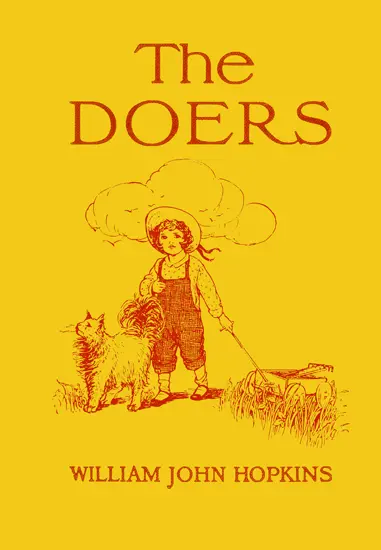
William John Hopkins
BEHIND THE BOOK
This eBook is for the use of anyone anywhere in the United States and most other parts of the world at no cost and with almost no restrictions whatsoever. You may copy it, give it away or re-use it under the terms of the Project Gutenberg License included with this eBook or online at www.gutenberg.org. If you are not located in the United States, you will have to check the laws of the country where you are located before using this eBook. Read the source licence.
The original source file, including credits and licence, is retained by this library. Request an original-format copy at no charge. Please include the book title and Project Gutenberg identifier #37118.
KEEP YOUR CURIOSITY GOING
Coulson Kernahan

Maurice Baring
Frances Wright
Cécile Tormay

Frederic Jesup Stimson

W. H. P. (William Henry Pope) Jarvis