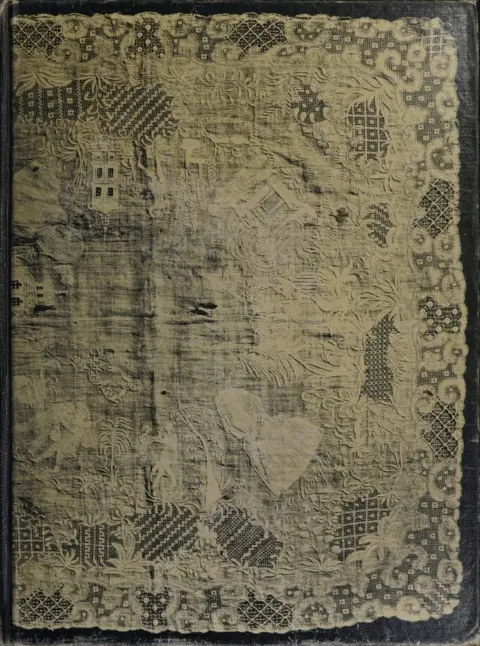
American lace & lace-makers
Emily Noyes Vanderpoel
THE CLASSIC COLLECTION · 1901
Color Problems by Emily Noyes Vanderpoel is a practical manual on color theory and design written in the early 20th century. It translates scientific and artistic insights into usable guidance for decorators, designers, artisans, and general readers. Expect concise explanations paired with extensive color plates, practical rules for combining hues, and analyses drawn from history and nature.
The opening of the manual states its purpose: to bridge rigorous color science and studio practice with brief text and many plates so lay readers can apply what they learn. An introduction praises its usefulness for arranging contrasts, quantities, and subdued tones, and for its clear “historic color” diagrams. The first chapter addresses color-blindness—its forms, detection with simple wool tests, causes, prevalence, and practical aids such as colored lenses. It then outlines how the eye and light produce color, surveying major theories (Young–Helmholtz and Hering), before defining hue, purity, and luminosity, warm/cool behavior, and the making of tints, shades, and broken tones, including how pigments and lighting (daylight, gas, electric, and colored light) shift appearances. Next, it explains simultaneous, successive, and mixed contrast, how to find complementary pairs (via Maxwell disks), and offers practical rules for balancing quality and quantity of color—illustrated by examples like a scarlet accent against blue-green—before beginning a framework of wider harmonies based on Chevreul’s schemes of analogy and contrast.
Introduction adapted from the source catalogue; source summaries may be automatically generated.
Free to read · English · 31,193 words · No account needed
MAKE TIME FOR A GOOD BOOK
On by default. Untick to stop anonymous reading totals. Each page counts after 10 seconds in view. How this works.
Anonymous counting is on unless you have switched it off.
As whatever may be of value in this little work on a theme so large and complex as color must of necessity be drawn largely from what has been written before, the following list of books and authors is given, partly as having been referred to during its preparation, and partly as a suggestion for further reading to any student of color who can afford the time and labor necessary to the acquisition of a larger and wider comprehension of a subject which can be treated only scantily enough within the scope of a single small volume.
Although no pretence is here made to completeness as bibliography, yet it is believed that the fifty works enumerated below fairly cover the history of color and of its ever-growing relation to Art and Manufacture. For the sake of convenience the list is chronologically arranged.
A TREATISE ON PAINTING. By Leonardo da Vinci. (London, 1835: Nichols & Sons.) (Translation.)
COLOUR. By M. E. Chevreul. (London, 1839: Geo. Bell & Sons.)
(Translation.)
THEORY OF COLOUR. By J. W. von Goethe. (London, 1840: J. Murray.) (Translation, with notes, by Sir Chas. Eastlake.)
RUDIMENTS OF THE PAINTER’S ART; OR A GRAMMAR OF COLOURING. By George Field. (London, 1850: Weale.)
DARSTELLUNG DER FARBENLEHRE UND OPTISCHE STUDIEN. By W. H. Dove.
(Berlin, 1853.)
RESEARCHES ON COLOUR-BLINDNESS. By G. Wilson. (Edinb., 1855:
Sutherland & Knox.)
GRAMMAR OF ORNAMENT. By Owen Jones. (London, 1856.)
ON COLOUR (ETC.). By Sir J. S. Wilkinson. (London, 1858: J. Murray.)
DIE FARBENHARMONIE IN IHRER ANWENDUNG AUF DIE DAMENTOILETTE. By R. Adams. (Leipzig, 1862: J. J. Weber.)
PRACTICAL HINTS ON COLOUR IN PAINTING. By John Burnet. (London, 1865:
J. & J. Leighton.)
DES COULEURS AU POINT DE VUE PHYSIQUE, PHYSIOLOGIQUE ARTISTIQUE ET INDUSTRIEL. By Ernst Bruecke. (Paris, 1866: J. B. Baillière & fils.)
THE PRINCIPLES OF THE SCIENCE OF COLOUR. By William Benson. (London, 1868: Chapman & Hall.)
COLOR. By M. É. Cavé. (New York, 1869.) (Translation.)
MANUAL OF THE SCIENCE OF COLOUR. By W. Benson. (London, 1871: Chapman
& Hall.)
THE THEORY OF COLOURING. By J. Bacon. (London, 1872: G. Rowney &
Company.)
L’ORNEMENT POLYCHROME. By A. Racinet. 2 vols. F^o. (Paris, 1873–86:
Firmin Didot.)
A GRAMMAR OF COLOURING APPLIED TO DECORATIVE PAINTING AND THE ARTS. By George Field. (London, 1875: Lockwood & Company.)
THEORY OF COLOR. By Dr. Wilhelm von Bezold. (Boston, 1876: L. Prang & Company.) (Translation.)
DIE GESCHICHTLICHE ENTWICKELUNG DES FARBENSINNES. By Hugo Magnus.
(Leipzig, 1877: Veit.)
THE PRINCIPLES OF LIGHT AND COLOR. By E. D. Babbitt. (New York, 1878:
Babbitt & Company.)
COMPLÉMENT DES ÉTUDES SUR LA VISION DES COULEURS PAR E. CHEVREUL. By M. E. Chevreul. (In Institut de France. Académie des Sciences—Memoires. T. 41, partie 2.) (Paris, 1879.) (English translations exist.)
MODERN CHROMATICS, WITH APPLICATION TO ART AND INDUSTRY. By O. N. Rood. (New York, 1879: D. Appleton.)
Your reading position is saved on this browser. Take it to another device with a library code. Reading pages adapt to text, rather than matching a printed edition.
Emily Noyes Vanderpoel
BEHIND THE BOOK
This eBook is for the use of anyone anywhere in the United States and most other parts of the world at no cost and with almost no restrictions whatsoever. You may copy it, give it away or re-use it under the terms of the Project Gutenberg License included with this eBook or online at www.gutenberg.org. If you are not located in the United States, you will have to check the laws of the country where you are located before using this eBook. Read the source licence.
The original source file, including credits and licence, is retained by this library. Request an original-format copy at no charge. Please include the book title and Project Gutenberg identifier #77736.
KEEP YOUR CURIOSITY GOING

Charles G. (Charles Griffith) Ross
Hannah Webster Foster

Emily Lawless
Edwin Hamlin Carr

Charles De Lano Hine
Andrew Ure