
Charles Sumner: his complete works, volume 20 (of 20)
Charles Sumner
THE CLASSIC COLLECTION · 1873
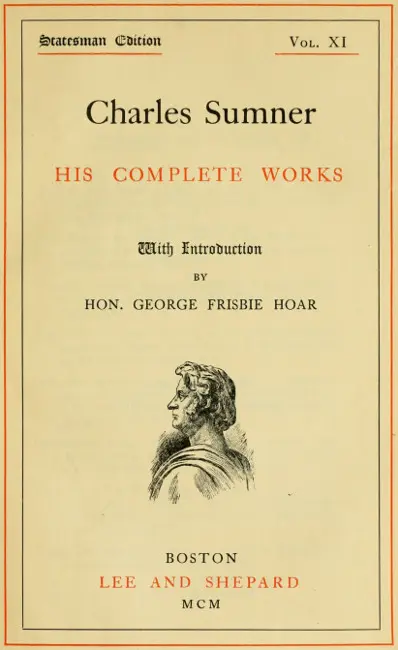
"Charles Sumner: His Complete Works, Volume 11 (of 20)" by Charles Sumner is a historical collection written in the late 19th century. The volume features a series of speeches and reports that reflect Sumner's strong advocacy for equality, civil rights, and the abolition of slavery. These works encapsulate significant political debates and legislative matters from the era of the Civil War through Reconstruction, offering insight into the social and legal struggles faced in the United States during this tumultuous period. The opening of this volume introduces several key issues addressed by Sumner, particularly the exclusion of colored witnesses in judicial proceedings. He highlights the historical injustices that arise from discriminatory laws allowing states to deny people of color their rights as witnesses based on their race. Sumner's opening remarks present a thorough examination of various state statutes that enforced these exclusions, showing how such legal frameworks contributed to the systemic oppression of African Americans. He passionately argues for legislative changes to rectify these injustices, drawing comparisons to historical injustices and advocating for an equitable legal system.
Introduction adapted from the source catalogue; source summaries may be automatically generated.
Free to read · English · 136,786 words · No account needed
MAKE TIME FOR A GOOD BOOK
On by default. Untick to stop anonymous reading totals. Each page counts after 10 seconds in view. How this works.
Anonymous counting is on unless you have switched it off.
A new French minister was at hand, accredited to President Washington, with fresh instructions. Differences on the obligations of the guaranty appeared in the Cabinet,--some holding that no necessity for decision existed, as France had made no demand,--and others, that, the Treaty of Alliance being plainly defensive, the guaranty did not apply to a war begun by France. After ample discussion, the Proclamation of Neutrality was adopted, April 22, 1793, destined to become a turning-point in our history. Chief Justice Marshall, whose opportunities of information were unquestionable, lets us know that the Proclamation “was intended to prevent the French minister from demanding the performance of the guaranty contained in the Treaty of Alliance.”[160] But before the Proclamation reached France, orders were issued there for the capture and confiscation of enemy goods on board neutral vessels; whereas it was stipulated with the United States that free ships should make free goods; so that, even if the denial of the guaranty was wrong, and the Proclamation, according to French accusation, “insidious,” the United States were not the first to offend.
On the day of the Proclamation came news by the journals that Genet, the new French minister, had landed in South Carolina, where, amid the darkest days of the Revolution, Lafayette had also first landed. Full of conviction that France had only to make herself heard in order to be sustained, Genet exalted himself conspicuously above the Government. By instructions from the Executive Council of the French Republic, dated 17th of January, 1793, he was enjoined “to penetrate profoundly the sense of the treaties of 1778, and to watch over the articles favorable to the commerce and navigation of the United States, and to make the Americans consider engagements which might appear onerous as the just price of the independence which the French nation had secured to them.” Not content with existing safeguards, the new minister was to negotiate a supplementary treaty, to fix more surely “the reciprocal guaranty of the possessions of the two powers.”[161] In this spirit he commenced a turbulent career, charging offensively that the President, before knowing what the minister had to communicate from the French Republic, was in a hurry “to proclaim sentiments on which decency and friendship should at least have drawn a veil,”--that he “took on himself to give to our treaties arbitrary interpretations absolutely contrary to their true sense,” and that “he left no other indemnification to France for the blood she spilt, for the treasure she dissipated, in fighting for the independence of the United States, but the illusory advantage of bringing into their ports the prizes made on their enemies without being able to sell them,”--and that the Secretary of War, on his communication of the wish of the Windward Islands “to receive promptly some fire-arms and some cannon, which might put into a state of defence possessions guarantied by the United States, had the front to answer, with an ironical carelessness, that the principles established by the President did not permit him to lend so much as a pistol.”[162] In another letter, the French minister, under date of June 8, 1793, requires that “the Federal Government should observe the public engagements contracted, and give to the world the example of a true neutrality, which does not consist in the cowardly abandonment of friends at the moment when danger menaces.”[163] And in still another letter, dated June 22, 1793, he declares that “it is in the conventional compacts, collectively, that we ought to seek contracts of alliance and of commerce simultaneously made, if we wish to take their sense and interpret faithfully the intentions of the people who cemented them, and of the men of genius who dictated them.”[164] All of which was followed by another letter, dated November 14, 1793, in which the minister says categorically: “I beg you to lay before the President of the United States, as soon as possible, the decree and the inclosed note, and to obtain from him the earliest decision, either as to the guaranty I have claimed the fulfilment of for our colonies, or upon the mode of negotiation of the new treaty I was charged to propose to the United States, and which would make of the two nations but one family.”[165] At last Genet was recalled, but the question of our engagements with France could not be dismissed. It was more menacing than any minister. Without it all the turbulence of Genet would have been as the idle wind.
Your reading position is saved on this browser. Take it to another device with a library code. Reading pages adapt to text, rather than matching a printed edition.
Charles Sumner

Charles Sumner

Charles Sumner

Charles Sumner
BEHIND THE BOOK
This eBook is for the use of anyone anywhere in the United States and most other parts of the world at no cost and with almost no restrictions whatsoever. You may copy it, give it away or re-use it under the terms of the Project Gutenberg License included with this eBook or online at www.gutenberg.org. If you are not located in the United States, you will have to check the laws of the country where you are located before using this eBook. Read the source licence.
The original source file, including credits and licence, is retained by this library. Request an original-format copy at no charge. Please include the book title and Project Gutenberg identifier #48376.
KEEP YOUR CURIOSITY GOING

David Patterson (Spirit) Hatch

David Patterson (Spirit) Hatch

David Patterson (Spirit) Hatch
Cécile Tormay

Moritz Busch
John L. Ransom