
Charles Sumner: his complete works, volume 20 (of 20)
Charles Sumner
THE CLASSIC COLLECTION · 1873
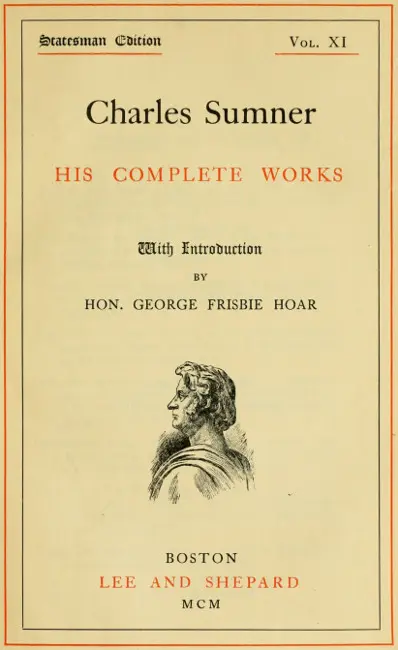
"Charles Sumner: His Complete Works, Volume 11 (of 20)" by Charles Sumner is a historical collection written in the late 19th century. The volume features a series of speeches and reports that reflect Sumner's strong advocacy for equality, civil rights, and the abolition of slavery. These works encapsulate significant political debates and legislative matters from the era of the Civil War through Reconstruction, offering insight into the social and legal struggles faced in the United States during this tumultuous period. The opening of this volume introduces several key issues addressed by Sumner, particularly the exclusion of colored witnesses in judicial proceedings. He highlights the historical injustices that arise from discriminatory laws allowing states to deny people of color their rights as witnesses based on their race. Sumner's opening remarks present a thorough examination of various state statutes that enforced these exclusions, showing how such legal frameworks contributed to the systemic oppression of African Americans. He passionately argues for legislative changes to rectify these injustices, drawing comparisons to historical injustices and advocating for an equitable legal system.
Introduction adapted from the source catalogue; source summaries may be automatically generated.
Free to read · English · 136,786 words · No account needed
MAKE TIME FOR A GOOD BOOK
On by default. Untick to stop anonymous reading totals. Each page counts after 10 seconds in view. How this works.
Anonymous counting is on unless you have switched it off.
[365] Speeches, Vol. I. p. 25.
[366] See, especially, Resolutions entitled “State Rebellion, State Suicide; Emancipation and Reconstruction,” February 11, 1862,--ante, Vol. VI. pp. 301-305.
[367] Mr. Hale and Mr. Sumner sat next to each other.
[368] Mr. Everett was one of the Republican Electors at Large.
[369] Note in reference to Peace Overtures at Niagara Falls, July 18, 1864. See Raymond’s Life of Lincoln, p. 580.
[370] Speech at Cleveland, May 20, 1863: Comments on the Policy inaugurated by the President, p. 11.
[371] This Introduction, by the Committee of the Young Men’s Republican Union, appeared as a “Prefatory Note” to the New York pamphlet edition.
[372] House Journal, 37th Cong. 1st Sess., July 22, 1861, p. 123; Senate Journal, July 25, 1861, p. 92. See, also, ante, Vol. V. p. 499.
[373] Duyckinck’s History of the War for the Union, Vol. I. p. 118. See also Stephens’s Constitutional View of the late War between the States, Vol. II. p. 415.
[374] Carlyle, Chartism, Ch. VIII.: New Eras, Fifth Excerpt from “History of the Teuton Kindred,” by Herr Professor Sauerteig.
[375] Bradford’s History of Plymouth Plantation: Coll. Mass. Hist. Soc., 4th Ser., Vol. III. pp. 89, 90.
[376] Letter of John Robinson and William Brewster to Sir Edwin Sandys, Leyden, December 15, 1617; Ibid., pp. 32, 33.
[377] Records of the Governor and Company of the Massachusetts Bay, Vol. II. p. 136, October 1, 1645.
[378] Capital Laws, 1649: General Laws and Liberties of the Massachusetts Colony, revised and reprinted by order of the General Court, 1672, p. 15.
[379] History of England (London, 1786), Vol. V. p. 183, Ch. XL.
[380] “We are the gentlemen of this country,” said Mr. Toombs in 1860. He had already threatened to call the roll of his slaves on Bunker Hill.
[381] History of South Carolina, p. 60.
[382] Historical Account, Vol. II. p. 272.
[383] Martin, History of North Carolina, Vol. I. p. 218, et passim.
[384] I should not have deemed it necessary to make this inquiry, had I seen the thorough pamphlet of Mr. William H. Whitmore, entitled “The Cavalier Dismounted: an Essay on the Origin of the Founders of the Thirteen Colonies,” which appeared contemporaneously with this speech.
[385] Divers Voyages touching the Discovery of America, and the Islands adjacent unto the same, made first of all by our Englishmen, and afterward by the Frenchmen and Britons, etc. [By Richard Hakluyt.] Imprinted at London for Thomas Woodcock, 1582.
[386] Strachey’s History of Travel into Virginia Britannia:
Introduction, p. xxxii.
[387] Stith’s History of Virginia, p. 167.
[388] New England’s Trials, p. 16: Force’s Tracts, Vol. II.
[389] Nova Britannia, p. 19: Ibid., Vol. I.
[390] Sermon CLVI.: Works (London, 1839), Vol. VI. p. 232.
[391] A New Discourse of Trade (5th edit.), p. 138, Ch. X., Concerning
Plantations.
[392] Summary, Historical and Political, of the First Planting, etc., of the British Settlements in North America, (Boston, 1749,) Vol. I. Part 1, p. 115.
[393] Ibid., Vol. I., Part 2, p. 490, note.
[394] History of the United States (Boston, 1845), Vol. I. pp. 53, 54.
Your reading position is saved on this browser. Take it to another device with a library code. Reading pages adapt to text, rather than matching a printed edition.
Charles Sumner

Charles Sumner

Charles Sumner

Charles Sumner
BEHIND THE BOOK
This eBook is for the use of anyone anywhere in the United States and most other parts of the world at no cost and with almost no restrictions whatsoever. You may copy it, give it away or re-use it under the terms of the Project Gutenberg License included with this eBook or online at www.gutenberg.org. If you are not located in the United States, you will have to check the laws of the country where you are located before using this eBook. Read the source licence.
The original source file, including credits and licence, is retained by this library. Request an original-format copy at no charge. Please include the book title and Project Gutenberg identifier #48376.
KEEP YOUR CURIOSITY GOING

David Patterson (Spirit) Hatch

David Patterson (Spirit) Hatch

David Patterson (Spirit) Hatch
Cécile Tormay

Moritz Busch
John L. Ransom