
Charles Sumner: his complete works, volume 20 (of 20)
Charles Sumner
THE CLASSIC COLLECTION · 1873
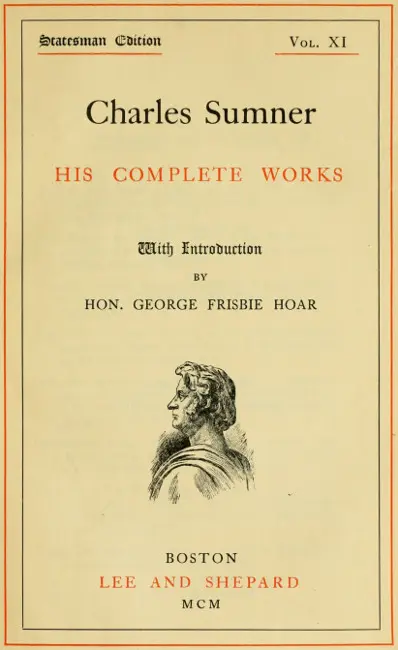
"Charles Sumner: His Complete Works, Volume 11 (of 20)" by Charles Sumner is a historical collection written in the late 19th century. The volume features a series of speeches and reports that reflect Sumner's strong advocacy for equality, civil rights, and the abolition of slavery. These works encapsulate significant political debates and legislative matters from the era of the Civil War through Reconstruction, offering insight into the social and legal struggles faced in the United States during this tumultuous period. The opening of this volume introduces several key issues addressed by Sumner, particularly the exclusion of colored witnesses in judicial proceedings. He highlights the historical injustices that arise from discriminatory laws allowing states to deny people of color their rights as witnesses based on their race. Sumner's opening remarks present a thorough examination of various state statutes that enforced these exclusions, showing how such legal frameworks contributed to the systemic oppression of African Americans. He passionately argues for legislative changes to rectify these injustices, drawing comparisons to historical injustices and advocating for an equitable legal system.
Introduction adapted from the source catalogue; source summaries may be automatically generated.
Free to read · English · 136,786 words · No account needed
MAKE TIME FOR A GOOD BOOK
On by default. Untick to stop anonymous reading totals. Each page counts after 10 seconds in view. How this works.
Anonymous counting is on unless you have switched it off.
no Chicago platform proposed “a cessation of hostilities, with a view to a convention or other peaceable means”; nor was there any attempt to save the traitors from Divine vengeance. Personal injuries we may forgive; but Government cannot always forgive. There are cases where pardon is out of place. Society that has been outraged must be protected. That beautiful land now degraded by Slavery must be redeemed, while a generous statesmanship fixes forever its immutable condition. If the chiefs of the Rebellion are compelled to abdicate in favor of emigrants from the North and from Europe, swelling population, creating new values, and opening new commerce,--if “poor whites” are reïnstated in rights,--if a whole race is lifted to manhood and womanhood,--if roads are extended,--if schools are planted,--there will be nothing inconsistent with that just clemency which I rejoice to consider a public duty. Liberty is the best cultivator, the truest teacher, and the most enterprising merchant. The whole country will confess the new-born power, and those commercial cities now sympathizing so perversely with belligerent Slavery will be among the earliest to enjoy the quickening change. Beyond all question, the overthrow of this portentous crime, besides immeasurable contributions to civilization everywhere, will accomplish two things of direct material advantage: first, it will raise the fee-simple of the whole South; and, secondly, it will enlarge the commerce of the whole North.
In this faith I turn in humble gratitude to God, as I behold my country at last redeemed and fixed in history, the Columbus of Nations, once in chains, now hailed as benefactor and discoverer, who gave a New Liberty to mankind. Foreign powers watch the scene with awe; saints and patriots from their home in the skies look down with delight; and Washington, who set free his own slaves, exults that the Republic, which revered him as Father, now follows his example.
[1] Ante, Vol. VI. pp. 442, 502; Vol. VII. p. 152.
[2] Ante, Vol. IX. pp. 39-46.
[3] Acts 37th Cong. 2d Sess., Ch. CLXXXIX. Sec. 1: Statutes at Large,
Vol. XII. p. 588.
[4] Acts 1st Cong., Ch. XX. Sec. 29, 34: Ibid., Vol. I. pp. 88, 92.
[5] State v. Whitaker, 3 Harrington, R., 550.
[6] Ch. 52, § 12.
[7] Ch. 107, § 4.
[8] Ch. 52, § 12.
[9] Elliott v. Morgan, 3 Harrington, R., 317.
[10] State v. Whitaker, 3 Harrington, R., 549.
[11] State v. Cooper, Ibid., 571.
[12] State v. Jeans, 4 Ibid., 570.
[13] Redden v. Spruance et als., Ibid., 217.
[14] Webb v. Pindergrass, 4 Harrington, R., 439.
[15] State v. Bender, 3 Ibid., 572, note.
[16] Collins v. Hall, Ibid., 574, note.
[17] State v. Fisher, 1 Harris and Johnson, R., 750.
[18] Rusk v. Sowerwine, 3 Ibid., 97.
[19] Sprigg v. Negro Mary, Ibid., 491.
[20] Ch. 176, § 20.
[21] Winn v. Jones, 6 Leigh, R., 74.
[22] Johnson v. The Commonwealth, 2 Grattan, R., 581.
[23] Code of Virginia (1849), Ch. 215, § 9.
[24] Ch. 107, § 1. See Tumey v. Knox, 7 T. B. Monroe, R., 91.
[25] Page v. Carter, 8 B. Monroe, R., 192.
Your reading position is saved on this browser. Take it to another device with a library code. Reading pages adapt to text, rather than matching a printed edition.
Charles Sumner

Charles Sumner

Charles Sumner

Charles Sumner
BEHIND THE BOOK
This eBook is for the use of anyone anywhere in the United States and most other parts of the world at no cost and with almost no restrictions whatsoever. You may copy it, give it away or re-use it under the terms of the Project Gutenberg License included with this eBook or online at www.gutenberg.org. If you are not located in the United States, you will have to check the laws of the country where you are located before using this eBook. Read the source licence.
The original source file, including credits and licence, is retained by this library. Request an original-format copy at no charge. Please include the book title and Project Gutenberg identifier #48376.
KEEP YOUR CURIOSITY GOING

David Patterson (Spirit) Hatch

David Patterson (Spirit) Hatch

David Patterson (Spirit) Hatch
Cécile Tormay

Moritz Busch
John L. Ransom