
Charles Sumner: his complete works, volume 20 (of 20)
Charles Sumner
THE CLASSIC COLLECTION · 1873
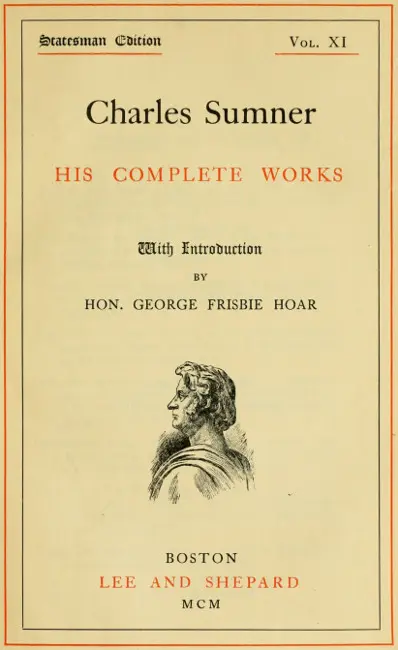
"Charles Sumner: His Complete Works, Volume 11 (of 20)" by Charles Sumner is a historical collection written in the late 19th century. The volume features a series of speeches and reports that reflect Sumner's strong advocacy for equality, civil rights, and the abolition of slavery. These works encapsulate significant political debates and legislative matters from the era of the Civil War through Reconstruction, offering insight into the social and legal struggles faced in the United States during this tumultuous period. The opening of this volume introduces several key issues addressed by Sumner, particularly the exclusion of colored witnesses in judicial proceedings. He highlights the historical injustices that arise from discriminatory laws allowing states to deny people of color their rights as witnesses based on their race. Sumner's opening remarks present a thorough examination of various state statutes that enforced these exclusions, showing how such legal frameworks contributed to the systemic oppression of African Americans. He passionately argues for legislative changes to rectify these injustices, drawing comparisons to historical injustices and advocating for an equitable legal system.
Introduction adapted from the source catalogue; source summaries may be automatically generated.
Free to read · English · 136,786 words · No account needed
MAKE TIME FOR A GOOD BOOK
On by default. Untick to stop anonymous reading totals. Each page counts after 10 seconds in view. How this works.
Anonymous counting is on unless you have switched it off.
The author of the “Dictionary of Commerce,” quoted often in courts, confirms the testimony of Moll Flanders, when he says: “Even your transported felons, sent to Virginia instead of Tyburn, thousands of them, if we are not misinformed, have, by turning their hands to industry and improvement, and, which is best of all, to honesty, become rich, substantial planters and merchants, settled large families, and been famous in the country; nay, we have seen many of them made magistrates, officers of militia, captains of good ships, and masters of good estates.”[400] Here, again, is nothing said of “cavaliers.”
Another writer, who travelled through the colonies in 1742-3, says, in the same vein, that “several of the best planters, or their ancestors, have in the two colonies [Virginia and Maryland] been originally of the convict class, and therefore are much to be praised and esteemed for forsaking their old courses.”[401]
While all this cumulative evidence shows that the settlers did better in Virginia than in England, it fails to support the Rebel pretension of to-day.
I have referred to Massinger. Here is a curious bit from a grave comedy
of that poet dramatist.
“Luke. It is but to Virginia.
“Lady Frugal. How? Virginia?
High Heaven forbid! Remember, Sir, I beseech you,
What creatures are shipped thither.
“Anne. Condemned wretches,
Forfeited to the law.
“Mary. For the abomination of their life,
Spewed out of their own country.”[402]
Thus from every quarter the testimony accumulates. And yet, in face of these impartial and unimpeachable authorities, we are constantly told that Virginia was settled by “cavaliers.”
The territory now occupied by South Carolina originally constituted part of Virginia. Out of Virginia it was carved into a separate colony. Although differing in some respects, the populations seem to have been kindred in character. Ramsay, the historian of the State, in a work published at Charleston in 1809, says that “the emigrants were a medley of different nations and principles,” and that among them were persons “who took refuge from the frowns of Fortune and the rigor of creditors,” “young men reduced to misery by folly and excess,” and “restless spirits, fond of roving.” To these were added Huguenots from France.[403] But Grahame tells us that “not a trace of the existence of an order of clergymen is to be found in the laws of Carolina during the first twenty years of its history.”[404] And another historian says that “the inhabitants, far from living in friendship and harmony among themselves, have been seditious and ungovernable.”[405] Such a people were naturally insensible to moral distinctions, so that, according to Hewit, pirates “were treated with great civility and friendship,” and “by bribery and corruption they often found favor with the provincial juries, and by this means escaped the hands of justice.” All of which is declared by the historian to be “evidences of the licentious spirit which prevailed in the colony.”[406] Grahame uses still stronger language, when he says, “The governor, the proprietary deputies, and the principal inhabitants degraded themselves to a level with the vilest of mankind by abetting the crimes of pirates, and willingly purchasing their nefarious acquisitions.”[407] Such is the testimony with regard to South Carolina. To call such a people “cavaliers” is an abuse of terms.
Your reading position is saved on this browser. Take it to another device with a library code. Reading pages adapt to text, rather than matching a printed edition.
Charles Sumner

Charles Sumner

Charles Sumner

Charles Sumner
BEHIND THE BOOK
This eBook is for the use of anyone anywhere in the United States and most other parts of the world at no cost and with almost no restrictions whatsoever. You may copy it, give it away or re-use it under the terms of the Project Gutenberg License included with this eBook or online at www.gutenberg.org. If you are not located in the United States, you will have to check the laws of the country where you are located before using this eBook. Read the source licence.
The original source file, including credits and licence, is retained by this library. Request an original-format copy at no charge. Please include the book title and Project Gutenberg identifier #48376.
KEEP YOUR CURIOSITY GOING

David Patterson (Spirit) Hatch

David Patterson (Spirit) Hatch

David Patterson (Spirit) Hatch
Cécile Tormay

Moritz Busch
John L. Ransom