
Charles Sumner: his complete works, volume 20 (of 20)
Charles Sumner
THE CLASSIC COLLECTION · 1873
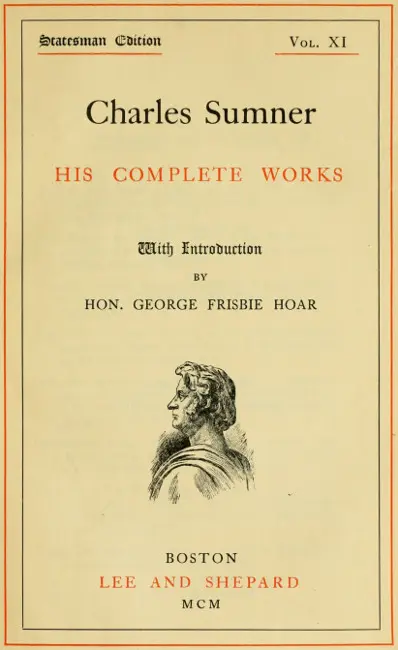
"Charles Sumner: His Complete Works, Volume 11 (of 20)" by Charles Sumner is a historical collection written in the late 19th century. The volume features a series of speeches and reports that reflect Sumner's strong advocacy for equality, civil rights, and the abolition of slavery. These works encapsulate significant political debates and legislative matters from the era of the Civil War through Reconstruction, offering insight into the social and legal struggles faced in the United States during this tumultuous period. The opening of this volume introduces several key issues addressed by Sumner, particularly the exclusion of colored witnesses in judicial proceedings. He highlights the historical injustices that arise from discriminatory laws allowing states to deny people of color their rights as witnesses based on their race. Sumner's opening remarks present a thorough examination of various state statutes that enforced these exclusions, showing how such legal frameworks contributed to the systemic oppression of African Americans. He passionately argues for legislative changes to rectify these injustices, drawing comparisons to historical injustices and advocating for an equitable legal system.
Introduction adapted from the source catalogue; source summaries may be automatically generated.
Free to read · English · 136,786 words · No account needed
MAKE TIME FOR A GOOD BOOK
On by default. Untick to stop anonymous reading totals. Each page counts after 10 seconds in view. How this works.
Anonymous counting is on unless you have switched it off.
June 30th, Mr. Sumner asked, and by unanimous consent obtained, leave to bring in the following bill, which was read the first and second times by unanimous consent, and ordered to be printed.
A Bill to incorporate the National Academy of Literature and Art, and also to incorporate the National Academy of Moral and Political Sciences.
Be it enacted by the Senate and House of Representatives of the United States of America in Congress assembled, That S. Austin Allibone, Pennsylvania, William C. Bryant, New York, Frederick E. Church, New York, George W. Curtis, New York, Richard H. Dana, Massachusetts, John S. Dwight, Massachusetts, Ralph W. Emerson, Massachusetts, Fitz-Greene Halleck, Connecticut, Oliver W. Holmes, Massachusetts, Henry W. Longfellow, Massachusetts, James R. Lowell, Massachusetts, George P. Marsh, Vermont, Hiram Powers, Ohio, William W. Story, Massachusetts, George Ticknor, Massachusetts, Henry T. Tuckerman, New York, Gulian C. Verplanck, New York, William D. Whitney, Connecticut, John G. Whittier, Massachusetts, Joseph E. Worcester, Massachusetts, their associates and successors, duly chosen, are hereby declared to be a body corporate for the study and cultivation of the ancient and modern languages, letters, and the fine arts, by the name of the National Academy of Literature and Art.
SEC. 2. And be it further enacted, That George Bancroft, New York, Henry Ward Beecher, New York, Horace Binney, Pennsylvania, Robert J. Breckinridge, Kentucky, Edward Everett, Massachusetts, Thomas Ewing, Ohio, Henry W. Halleck, Army of the United States, California, Samuel G. Howe, Massachusetts, Charles King, New York, Francis Lieber, New York, J. Lothrop Motley, Massachusetts, John G. Palfrey, Massachusetts, Wendell Phillips, Massachusetts, Alonzo Potter, Pennsylvania, Josiah Quincy, Massachusetts, Henry B. Smith, New York, Jared Sparks, Massachusetts, Robert J. Walker, District of Columbia, Francis Wayland, Rhode Island, Theodore D. Woolsey, Connecticut, their associates and successors, duly chosen, are hereby declared to be a body corporate for the study and cultivation of history, and the sciences which concern morals and government, by the name of the National Academy of Moral and Political Sciences.
SEC. 3. And be it further enacted, That each of these National Academies shall consist of not more than fifty ordinary members, of whom not more than ten shall be elected in any one year; that nominations shall be made and elections held at the regular annual meeting only, and that no nomination for any kind of membership shall be acted upon until it shall have been before the Academy for one year, and shall have been considered by a committee.
Your reading position is saved on this browser. Take it to another device with a library code. Reading pages adapt to text, rather than matching a printed edition.
Charles Sumner

Charles Sumner

Charles Sumner

Charles Sumner
BEHIND THE BOOK
This eBook is for the use of anyone anywhere in the United States and most other parts of the world at no cost and with almost no restrictions whatsoever. You may copy it, give it away or re-use it under the terms of the Project Gutenberg License included with this eBook or online at www.gutenberg.org. If you are not located in the United States, you will have to check the laws of the country where you are located before using this eBook. Read the source licence.
The original source file, including credits and licence, is retained by this library. Request an original-format copy at no charge. Please include the book title and Project Gutenberg identifier #48376.
KEEP YOUR CURIOSITY GOING

David Patterson (Spirit) Hatch

David Patterson (Spirit) Hatch

David Patterson (Spirit) Hatch
Cécile Tormay

Moritz Busch
John L. Ransom