
Charles Sumner: his complete works, volume 20 (of 20)
Charles Sumner
THE CLASSIC COLLECTION · 1873
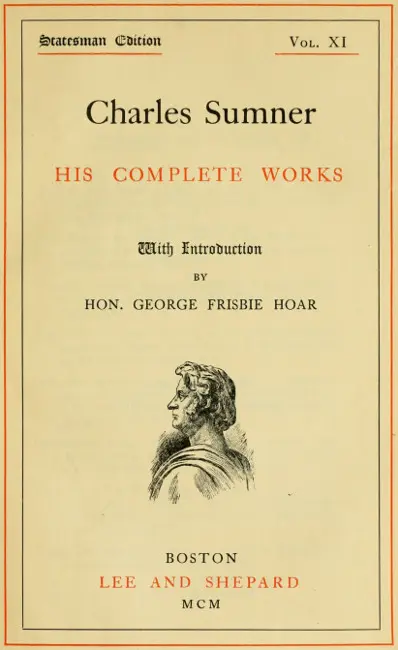
"Charles Sumner: His Complete Works, Volume 11 (of 20)" by Charles Sumner is a historical collection written in the late 19th century. The volume features a series of speeches and reports that reflect Sumner's strong advocacy for equality, civil rights, and the abolition of slavery. These works encapsulate significant political debates and legislative matters from the era of the Civil War through Reconstruction, offering insight into the social and legal struggles faced in the United States during this tumultuous period. The opening of this volume introduces several key issues addressed by Sumner, particularly the exclusion of colored witnesses in judicial proceedings. He highlights the historical injustices that arise from discriminatory laws allowing states to deny people of color their rights as witnesses based on their race. Sumner's opening remarks present a thorough examination of various state statutes that enforced these exclusions, showing how such legal frameworks contributed to the systemic oppression of African Americans. He passionately argues for legislative changes to rectify these injustices, drawing comparisons to historical injustices and advocating for an equitable legal system.
Introduction adapted from the source catalogue; source summaries may be automatically generated.
Free to read · English · 136,786 words · No account needed
MAKE TIME FOR A GOOD BOOK
On by default. Untick to stop anonymous reading totals. Each page counts after 10 seconds in view. How this works.
Anonymous counting is on unless you have switched it off.
February 22d, the debate was resumed by Mr. Hale, of New Hampshire, in opposition to the report, who was followed on the same side by Mr. Lane, of Indiana, Mr. Davis, of Kentucky, and Mr. Reverdy Johnson, of Maryland. Mr. Conness, of California, spoke in favor of it. Mr. Sumner, in reply, after answering the criticisms on the bill, and adducing testimony to its importance, said:--
I have read these opinions merely to bring home to the Senate, on authoritative grounds, the importance of providing some protection for this large body of freedmen, now justly looking to the National Government as their guardian. That Government has given them the great boon of Freedom. It is for us to go further, and see that Freedom is something more than a barren letter. We must see that it is a fruitful thing, of which they can avail themselves always, and which will be to them everywhere prolific of good.
Mr. President, I did not intend to enter into this discussion this morning. I hoped that a vote might be taken without further debate. I have no desire to discuss it. To my mind the question is perfectly clear. If you reject the pending measure, you voluntarily refuse to carry forward that great act of Emancipation which you have already sanctioned. I say, therefore, for the sake of Emancipation, let the report of this Committee be adopted; and I appeal to you, Senators, do not be afraid to be just.
The vote on the report of the Conference Committee stood,--Yeas 14, Nays 24; so that, though accepted in the House, it was lost in the Senate. On motion of Mr. Wilson, of Massachusetts, another Conference Committee was ordered, consisting of himself, Mr. Harlan, of Iowa, and Mr. Willey, of West Virginia. The House, on their part, appointed Mr. Schenck, of Ohio, Mr. Boutwell, of Massachusetts, and Mr. Rollins, of Missouri. The Committee reported still another bill, placing the bureau in the War Department.
March 3d, the Senate agreed to the report without a division. In the House, after an ineffectual effort to lay it on the table, it was agreed to without a division, and the same day was approved by the President.
June 10th, Mr. Lane, of Kansas, asked, and by unanimous consent obtained, leave to bring in a joint resolution for the recognition of the Free State Government of the State of Arkansas, which was read, passed to a second reading, and ordered to be printed.
June 13th, he called it up for consideration, when Mr. Sumner
made the following speech.
Your reading position is saved on this browser. Take it to another device with a library code. Reading pages adapt to text, rather than matching a printed edition.
Charles Sumner

Charles Sumner

Charles Sumner

Charles Sumner
BEHIND THE BOOK
This eBook is for the use of anyone anywhere in the United States and most other parts of the world at no cost and with almost no restrictions whatsoever. You may copy it, give it away or re-use it under the terms of the Project Gutenberg License included with this eBook or online at www.gutenberg.org. If you are not located in the United States, you will have to check the laws of the country where you are located before using this eBook. Read the source licence.
The original source file, including credits and licence, is retained by this library. Request an original-format copy at no charge. Please include the book title and Project Gutenberg identifier #48376.
KEEP YOUR CURIOSITY GOING

David Patterson (Spirit) Hatch

David Patterson (Spirit) Hatch

David Patterson (Spirit) Hatch
Cécile Tormay

Moritz Busch
John L. Ransom