
Charles Sumner: his complete works, volume 20 (of 20)
Charles Sumner
THE CLASSIC COLLECTION · 1873
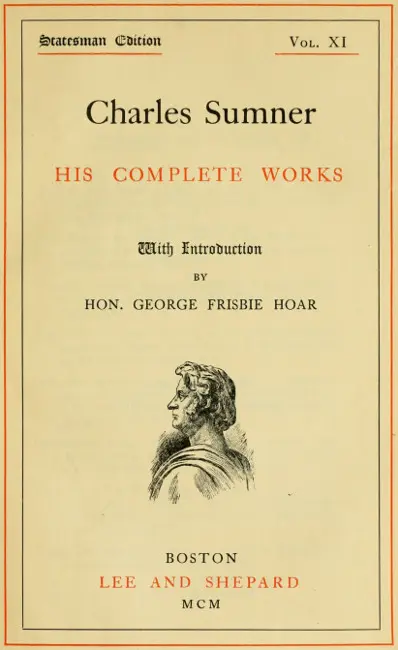
"Charles Sumner: His Complete Works, Volume 11 (of 20)" by Charles Sumner is a historical collection written in the late 19th century. The volume features a series of speeches and reports that reflect Sumner's strong advocacy for equality, civil rights, and the abolition of slavery. These works encapsulate significant political debates and legislative matters from the era of the Civil War through Reconstruction, offering insight into the social and legal struggles faced in the United States during this tumultuous period. The opening of this volume introduces several key issues addressed by Sumner, particularly the exclusion of colored witnesses in judicial proceedings. He highlights the historical injustices that arise from discriminatory laws allowing states to deny people of color their rights as witnesses based on their race. Sumner's opening remarks present a thorough examination of various state statutes that enforced these exclusions, showing how such legal frameworks contributed to the systemic oppression of African Americans. He passionately argues for legislative changes to rectify these injustices, drawing comparisons to historical injustices and advocating for an equitable legal system.
Introduction adapted from the source catalogue; source summaries may be automatically generated.
Free to read · English · 136,786 words · No account needed
MAKE TIME FOR A GOOD BOOK
On by default. Untick to stop anonymous reading totals. Each page counts after 10 seconds in view. How this works.
Anonymous counting is on unless you have switched it off.
The next step was by Hon. Thomas A. Jenckes, of Rhode Island, who introduced into the House of Representatives, December 20, 1865, a bill “To regulate the Civil Service of the United States,” which was referred to the Committee on the Judiciary. Subsequently a special committee was appointed on the Civil Service of the United States, with Mr. Jenckes as Chairman, and June 13, 1866, he reported his bill to the House. Then again, at the next session, he reported another bill, “To regulate the Civil Service of the United States, and promote the efficiency thereof,” which he sustained by a forcible and elaborate speech; but the bill was laid on the table,--Yeas 72, Nays 66. Other efforts followed at subsequent sessions, but without success.
Meanwhile, in the Senate, on motion of Mr. Trumbull, of Illinois, March 3, 1871, the following section was attached to the General Appropriation Bill, then pending:--
“That the President of the United States be, and he is hereby, authorized to prescribe such rules and regulations for the admission of persons into the Civil Service of the United States as will best promote the efficiency thereof, and ascertain the fitness of each candidate, in respect to age, health, character, knowledge, and ability, for the branch of service into which he seeks to enter; and for this purpose the President is authorized to employ suitable persons to conduct said inquiries, to prescribe their duties, and to establish regulations for the conduct of persons who may receive appointments in the Civil Service.”[341]
Under this provision President Grant appointed the following Commissioners: George William Curtis, of New York; Alexander G. Cattell, of New Jersey; Joseph Medill, of Illinois; and Dawson A. Walker, E. B. Elliott, Joseph H. Blackfan, and David C. Cox, of the District of Columbia: who, after careful consideration during the summer and autumn, submitted a report December 18, 1871, with a schedule of rules and regulations, all of which was promptly communicated to Congress by the President.
February 13th, Mr. Harlan, of Iowa, asked, and by unanimous consent obtained, leave to bring in a bill to amend section five of an Act entitled “An Act to continue, alter, and amend the charter of the city of Washington,” approved May 17, 1848, and further to preserve the purity of elections and guard against the abuse of the elective franchise, by a registration of electors for the city of Washington, in the District of Columbia; which was read the first and second time, and referred to the Committee on the District of Columbia.
March 8th, Mr. Dixon, from the Committee, reported the bill
without amendment.
Your reading position is saved on this browser. Take it to another device with a library code. Reading pages adapt to text, rather than matching a printed edition.
Charles Sumner

Charles Sumner

Charles Sumner

Charles Sumner
BEHIND THE BOOK
This eBook is for the use of anyone anywhere in the United States and most other parts of the world at no cost and with almost no restrictions whatsoever. You may copy it, give it away or re-use it under the terms of the Project Gutenberg License included with this eBook or online at www.gutenberg.org. If you are not located in the United States, you will have to check the laws of the country where you are located before using this eBook. Read the source licence.
The original source file, including credits and licence, is retained by this library. Request an original-format copy at no charge. Please include the book title and Project Gutenberg identifier #48376.
KEEP YOUR CURIOSITY GOING

David Patterson (Spirit) Hatch

David Patterson (Spirit) Hatch

David Patterson (Spirit) Hatch
Cécile Tormay

Moritz Busch
John L. Ransom