
Charles Sumner: his complete works, volume 20 (of 20)
Charles Sumner
THE CLASSIC COLLECTION · 1873
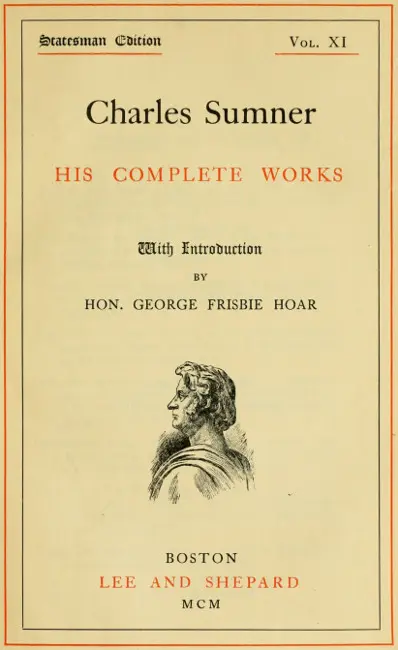
"Charles Sumner: His Complete Works, Volume 11 (of 20)" by Charles Sumner is a historical collection written in the late 19th century. The volume features a series of speeches and reports that reflect Sumner's strong advocacy for equality, civil rights, and the abolition of slavery. These works encapsulate significant political debates and legislative matters from the era of the Civil War through Reconstruction, offering insight into the social and legal struggles faced in the United States during this tumultuous period. The opening of this volume introduces several key issues addressed by Sumner, particularly the exclusion of colored witnesses in judicial proceedings. He highlights the historical injustices that arise from discriminatory laws allowing states to deny people of color their rights as witnesses based on their race. Sumner's opening remarks present a thorough examination of various state statutes that enforced these exclusions, showing how such legal frameworks contributed to the systemic oppression of African Americans. He passionately argues for legislative changes to rectify these injustices, drawing comparisons to historical injustices and advocating for an equitable legal system.
Introduction adapted from the source catalogue; source summaries may be automatically generated.
Free to read · English · 136,786 words · No account needed
MAKE TIME FOR A GOOD BOOK
On by default. Untick to stop anonymous reading totals. Each page counts after 10 seconds in view. How this works.
Anonymous counting is on unless you have switched it off.
After some skirmishing, the bill was ordered to be engrossed and read a third time. It was then vehemently denounced, and a series of motions was made to delay or stave off its passage. At last Mr. Morris allowed its postponement to June 13th, on which day, after further denunciation, it passed the House,--Yeas 90, Nays 62.
June 15th, the House bill was laid before the Senate, when Mr. Sumner said: “I am instructed by the Committee on Slavery and Freedmen to move the immediate passage of that bill. The Senate understands it; the House of Representatives has acted on it; there is no need of debate; and I ask to have it voted on at once.” Mr. Hale, of New Hampshire, objected, as he wanted the morning hour for morning business. Mr. Powell, of Kentucky, moved its reference to the Committee on the Judiciary. Mr. Sumner wished it referred to the Committee on Slavery and Freedmen. The Senate refused to order the reference to the Committee on the Judiciary,--Yeas 14, Nays 21. Then, on motion of Mr. Sumner, it was referred to the other Committee. Mr. Sumner, anticipating such a reference, had already obtained from the Committee authority to report it promptly, without amendment, which he did at once, and asked for immediate action. Objection being made, the bill was not considered at that time.
June 21st, Mr. Sumner moved that the Senate proceed with the House bill, which, after earnest debate, was ordered,--Yeas 25, Nays 17. The Senate then took a recess till evening, when other business was considered, including the question of opening the street cars.
June 22d, Mr. Sumner moved to proceed with the House bill. Mr. Hale, of New Hampshire, opposed the motion, as he desired the Senate to take up some naval bills. The motion was lost,--Yeas 14, Nays 22. In the evening session, Mr. Sumner moved again to proceed with the House bill. Mr. Chandler said: “I will spend to-night with great pleasure with the Senator from Massachusetts on his bill; but to-morrow I shall demand the day for the Committee on Commerce.” Mr. Saulsbury moved to adjourn, saying, “Let us have one day without the nigger.” The motion was lost,--Yeas 8, Nays 28. Mr. Reverdy Johnson wished to secure an opportunity for Mr. Davis to speak, and he was now absent. Mr. Sumner replied: “The Senator from Kentucky has had ample notice. He knew that this bill would be moved as soon as I could get the floor.” Mr. Johnson insisted, when Mr. Sumner said: “The public business cannot wait. Again and again has this measure been postponed in deference to the Senator from Kentucky.” The motion to proceed with the bill was adopted,--Yeas 26, Nays 12. Mr. Lane, of Indiana, then moved to proceed with executive business. Mr. Powell said: “You cannot get a vote to-night.” Mr. Sumner: “Let us try.” Mr. McDougall: “It is not possible to take a vote to-night.” Mr. Howard and Mr. Wade: “We can get it by morning.” Mr. McDougall: “It cannot be done.” The motion for an executive session was lost,--Yeas 15, Nays 22. Mr. Saulsbury then moved that the bill be indefinitely postponed, and the question resulted, Yeas 11, Nays 25. Mr. Lane again moved an executive session, which motion was lost,--Yeas 16, Nays 22. Mr. Powell then moved that the bill be postponed until the first Monday of December next. Pending this motion, Mr. Riddle, of Delaware, moved an adjournment, which was lost,--Yeas 12, Nays 22. In the course of these dilatory motions, Mr. Sherman remarked that he was willing to give Mr. Davis an opportunity to be heard, and then said: “If Senators propose to resort to these parliamentary tactics, these interminable propositions for delay, merely to defeat a vote upon a bill which the majority have a right to pass, I am perfectly willing now to go into a contest of physical endurance.” At last the bill was reported to the Senate without amendment, with the understanding that Mr. Davis should be heard upon it the next day, when Mr. Powell withdrew his motion, and, after the consideration of executive business, the Senate adjourned.
Your reading position is saved on this browser. Take it to another device with a library code. Reading pages adapt to text, rather than matching a printed edition.
Charles Sumner

Charles Sumner

Charles Sumner

Charles Sumner
BEHIND THE BOOK
This eBook is for the use of anyone anywhere in the United States and most other parts of the world at no cost and with almost no restrictions whatsoever. You may copy it, give it away or re-use it under the terms of the Project Gutenberg License included with this eBook or online at www.gutenberg.org. If you are not located in the United States, you will have to check the laws of the country where you are located before using this eBook. Read the source licence.
The original source file, including credits and licence, is retained by this library. Request an original-format copy at no charge. Please include the book title and Project Gutenberg identifier #48376.
KEEP YOUR CURIOSITY GOING

David Patterson (Spirit) Hatch

David Patterson (Spirit) Hatch

David Patterson (Spirit) Hatch
Cécile Tormay

Moritz Busch
John L. Ransom