
Charles Sumner: his complete works, volume 20 (of 20)
Charles Sumner
THE CLASSIC COLLECTION · 1872
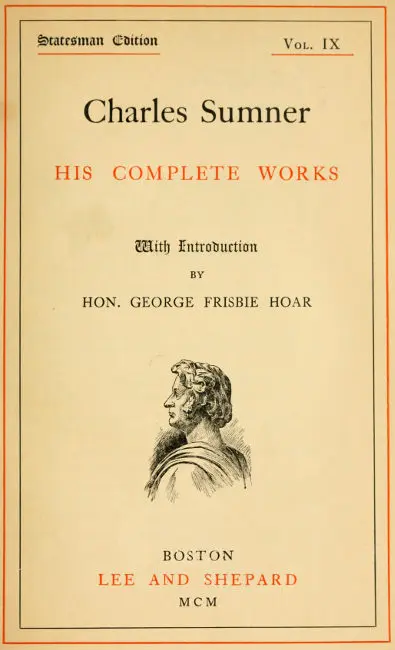
"Charles Sumner: His Complete Works, Volume 09" by Charles Sumner is a historical account written in the late 19th century. This volume focuses on a selection of speeches and writings by Sumner, a prominent abolitionist and U.S. Senator, addressing themes of civil rights, the powers of Congress during the Civil War, and the complexities of legality surrounding slavery and rebellion. The content showcases Sumner's efforts to intertwine legal, moral, and political arguments in his quest for justice and equality. The opening of this volume introduces a pivotal speech delivered by Sumner on May 19, 1862, which advocates for the confiscation of property owned by rebels and the emancipation of slaves held by those in rebellion against the United States. Sumner employs historical and legal references to assert that the ongoing Civil War is both rebellion and war, thus justifying Congress’s powers to act against traitors, both as criminals and enemies. He emphasizes the importance of remaining aligned with constitutional principles while arguing for decisive action to secure the nation’s unity and freedom for enslaved individuals. His compelling rhetoric and the historical context set the stage for a broader discussion on civil rights and governmental authority during a time of national crisis.
Introduction adapted from the source catalogue; source summaries may be automatically generated.
Free to read · English · 90,113 words · No account needed
MAKE TIME FOR A GOOD BOOK
On by default. Untick to stop anonymous reading totals. Each page counts after 10 seconds in view. How this works.
Anonymous counting is on unless you have switched it off.
[21] Mr. Jefferson to Mr. Hammond, May 29, 1792: American State Papers, Foreign Relations, Vol. I. p. 201.
[22] Speech on International Maritime Law, March 17, 1862: Hansard’s Parliamentary Debates, 3d Ser., Vol. CLXV. col. 1608.
[23] Manning, Commentaries on the Law of Nations, p. 127.
[24] Vattel, Book III. ch. 5, sec. 76.
[25] 8 Cranch, S. C. R., 110.
[26] Wheaton, Elements of International Law, Part IV. ch. 1, § 11.
[27] Law of Nations, p. 136.
[28] Halleck, International Law, p. 460.
[29] “Washington, dans la guerre de l’Amérique, inventa l’expression et la chose.”--KLÜBER, Droit des Gens Moderne de l’Europe, (Paris, 1831,) Tom. II. p. 33, sec. 251, note.
[30] Page 410.
[31] Q. Curtius, Lib. VII. cap. 8.
[32] Law of Nations, Book III. Ch. 13, § 203.
[33] 8 Cranch, S. C. R., 110.
[34] Le Caux v. Eden, Douglas, R., 594; Faith et al. v. Pearson,
Holt, N. P. Cases, 113.
[35] Elphinstone v. Bedreechund, 1 Knapp, Privy Council R., 337.
[36] Elphinstone v. Bedreechund, 1 Knapp, Privy Council R., 360, 361.
[37] Merlin, Répertoire de Jurisprudence, art. CONFISCATION, § I.
[38] History of the Reformation (Oxford, 1829), Vol. I. p. 538.
[39] Alison, History of Europe, (5th edit.,) Vol. IV. pp. 708, 709,
note.
[40] Ibid., p. 705, note.
[41] Alison, History of Europe, Vol. IV. p. 706, note.
[42] Austin’s Life of Elbridge Gerry, Vol. I. p. 207.
[43] American State Papers, Foreign Relations, Vol. I. pp. 198, 199.
[44] Letter to United States Commissioners: American State Papers, Foreign Relations, Vol. I. p. 219.
[45] American State Papers, Foreign Relations, Vol. I. p. 219.
[46] Extract from Mr. Adams’s Journal respecting Peace, November 29,
1782: Ibid., p. 220.
[47] American State Papers, Foreign Relations, Vol. I. p. 221.
[48] Definitive Treaty of Peace, Art. V.: United States Statutes at
Large, Vol. VIII. p. 82.
[49] American State Papers, Foreign Relations, Vol. I. p. 201.
[50] Ibid., p. 205.
[51] Ware v. Hylton et al., 3 Dallas, R., 222.
[52] Ibid., p. 282.
[53] Ibid., p. 227.
[54] Ibid., p. 264.
[55] Ware v. Hylton et al., 3 Dallas, R., 210.
[56] How completely this early prophecy has been fulfilled appears in
our history.
[57] Law of Nations, Book III. ch. 9.
[58] Count Portalis, at the installation of the Council of Prizes in 1800: Cussy, Phases et Causes Célèbres du Droit Maritime des Nations, Tom. I. pp. 179, 206, 264. Montesquieu had previously enunciated the same principle, with a limitation: L’Esprit des Lois, Liv. I. ch. 3.
[59] “Impius et crudelis judicandus est, qui libertati non favet.”--FORTESCUE, De Laudibus Legum Angliæ, Cap. XLII.
[60] Executive Documents, 37th Cong. 2d Sess., Senate, No. 67.
[61] This prophecy, like so many others with regard to Slavery, has failed, as appears from a Comparative Statement of the Cotton Crops of the United States for the three years last preceding the War (which years had the largest crops ever produced), and for the three years last past, prepared by Mr. B. F. Nourse, of Boston, December, 1871.
Your reading position is saved on this browser. Take it to another device with a library code. Reading pages adapt to text, rather than matching a printed edition.
Charles Sumner

Charles Sumner

Charles Sumner

Charles Sumner
BEHIND THE BOOK
This eBook is for the use of anyone anywhere in the United States and most other parts of the world at no cost and with almost no restrictions whatsoever. You may copy it, give it away or re-use it under the terms of the Project Gutenberg License included with this eBook or online at www.gutenberg.org. If you are not located in the United States, you will have to check the laws of the country where you are located before using this eBook. Read the source licence.
The original source file, including credits and licence, is retained by this library. Request an original-format copy at no charge. Please include the book title and Project Gutenberg identifier #48266.
KEEP YOUR CURIOSITY GOING

David Patterson (Spirit) Hatch

David Patterson (Spirit) Hatch

David Patterson (Spirit) Hatch
Cécile Tormay

Moritz Busch
John L. Ransom