
Charles Sumner: his complete works, volume 20 (of 20)
Charles Sumner
THE CLASSIC COLLECTION · 1872
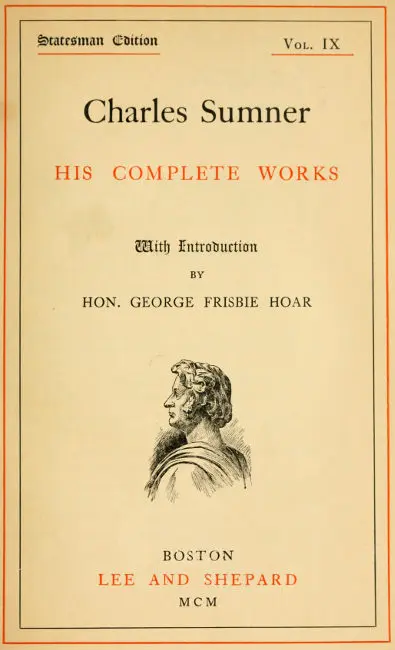
"Charles Sumner: His Complete Works, Volume 09" by Charles Sumner is a historical account written in the late 19th century. This volume focuses on a selection of speeches and writings by Sumner, a prominent abolitionist and U.S. Senator, addressing themes of civil rights, the powers of Congress during the Civil War, and the complexities of legality surrounding slavery and rebellion. The content showcases Sumner's efforts to intertwine legal, moral, and political arguments in his quest for justice and equality. The opening of this volume introduces a pivotal speech delivered by Sumner on May 19, 1862, which advocates for the confiscation of property owned by rebels and the emancipation of slaves held by those in rebellion against the United States. Sumner employs historical and legal references to assert that the ongoing Civil War is both rebellion and war, thus justifying Congress’s powers to act against traitors, both as criminals and enemies. He emphasizes the importance of remaining aligned with constitutional principles while arguing for decisive action to secure the nation’s unity and freedom for enslaved individuals. His compelling rhetoric and the historical context set the stage for a broader discussion on civil rights and governmental authority during a time of national crisis.
Introduction adapted from the source catalogue; source summaries may be automatically generated.
Free to read · English · 90,113 words · No account needed
MAKE TIME FOR A GOOD BOOK
On by default. Untick to stop anonymous reading totals. Each page counts after 10 seconds in view. How this works.
Anonymous counting is on unless you have switched it off.
BOSTON, July 13, 1863.
DEAR SIR,--It will not be in my power to take part in the proposed meeting at Poughkeepsie. But I am glad it has been called, and I trust it will be successful.
To me it has been clear from the beginning that the colored men would be needed in this war. I never for a moment doubted that they would render good service. And thus far the evidence in their favor is triumphant. Nobody now questions their bravery or capacity for discipline. All that can be said against them is that they are not “white.”
But they have a special interest in the suppression of the Rebellion. The enemies of the Union are the enemies of their race. Therefore, in defending the Union, they defend themselves even more than other citizens; and in saving the Union, they save themselves.
I doubt if in times past our country could have justly expected from colored men any patriotic service. Such service is the return for protection. But now that protection has begun, the service should begin also. Nor should relative rights and duties be weighed with nicety. It is enough that our country, aroused at last to a sense of justice, seeks to enroll colored men among its defenders.
If my counsels could reach such persons, I would say, Enlist at once. Now is the day, and now the fortunate hour. Help to overcome your cruel enemies battling against your country, and in this way you will surely overcome those other enemies, hardly less cruel, here at home, who still seek to degrade you. This is not the time to hesitate or to higgle. Do your duty to our common country, and you will set an example of generous self-sacrifice which must conquer prejudice and open all hearts.
Accept my thanks for the invitation with which you have honored
me, and believe me, dear Sir,
Very faithfully yours,
EDWARD GILBERT, Esq.
[1] See, ante, Vol. VI. p. 379.
[2] May 6, 1862, pp. 1957, 1958.
[3] Congressional Globe, 37th Cong. 2d Sess., May 20, 1862, p. 2223.
[4] Post, p. 128.
[5] Statutes at Large, Vol. XII. p. 591.
[6] 12 Juin, 1862.
[7] The Crime against Kansas, May 19 and 20, 1856: ante, Vol. IV. p.
125.
[8] Sonnet XVI. 9-11: To the Lord General Cromwell.
[9] Rose v. Himely, 4 Cranch, S. C. R., pp. 272, 273.
[10] Ibid., pp. 288, 289.
[11] Cheriot v. Foussat, 3 Binney, R., pp. 252, 253.
[12] Upton, The Law of Nations affecting Commerce during War, pp. 211,
212.
[13] Law Reporter, Vol. XXIV. p. 345, April, 1862.
[14] Lib. I. cap. 3, § 1.
[15] Oratio de Chersoneso, p. 97: Grotius, De Jure Belli ac Pacis,
Prolegom. § 25.
[16] Story, Commentaries on the Constitution, Vol. II. § 1344.
[17] Commentaries, Vol. IV. p. 381.
[18] Introduction to the Literature of Europe, 3d edit., (London,
1847,) Vol. II. p. 568, note.
[19] 12 Wheaton, R., 14, 15.
[20] Bynkershoek, Questiones Juris Publici, Lib. I. cap. 7.
Your reading position is saved on this browser. Take it to another device with a library code. Reading pages adapt to text, rather than matching a printed edition.
Charles Sumner

Charles Sumner

Charles Sumner

Charles Sumner
BEHIND THE BOOK
This eBook is for the use of anyone anywhere in the United States and most other parts of the world at no cost and with almost no restrictions whatsoever. You may copy it, give it away or re-use it under the terms of the Project Gutenberg License included with this eBook or online at www.gutenberg.org. If you are not located in the United States, you will have to check the laws of the country where you are located before using this eBook. Read the source licence.
The original source file, including credits and licence, is retained by this library. Request an original-format copy at no charge. Please include the book title and Project Gutenberg identifier #48266.
KEEP YOUR CURIOSITY GOING

David Patterson (Spirit) Hatch

David Patterson (Spirit) Hatch

David Patterson (Spirit) Hatch
Cécile Tormay

Moritz Busch
John L. Ransom