
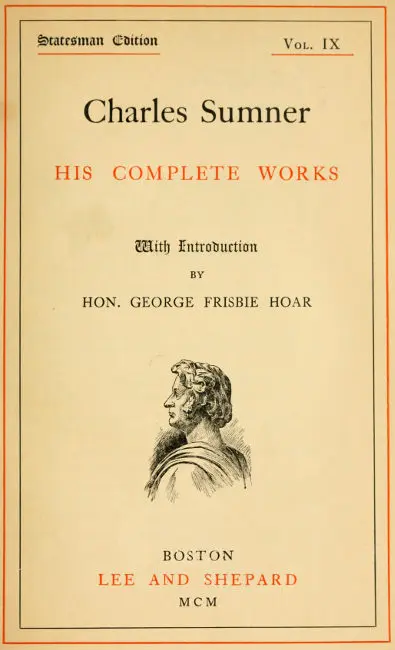
Charles Sumner: his complete works, volume 20 (of 20)
Charles Sumner
THE CLASSIC COLLECTION · 1872
"Charles Sumner: His Complete Works, Volume 09" by Charles Sumner is a historical account written in the late 19th century. This volume focuses on a selection of speeches and writings by Sumner, a prominent abolitionist and U.S. Senator, addressing themes of civil rights, the powers of Congress during the Civil War, and the complexities of legality surrounding slavery and rebellion. The content showcases Sumner's efforts to intertwine legal, moral, and political arguments in his quest for justice and equality. The opening of this volume introduces a pivotal speech delivered by Sumner on May 19, 1862, which advocates for the confiscation of property owned by rebels and the emancipation of slaves held by those in rebellion against the United States. Sumner employs historical and legal references to assert that the ongoing Civil War is both rebellion and war, thus justifying Congress’s powers to act against traitors, both as criminals and enemies. He emphasizes the importance of remaining aligned with constitutional principles while arguing for decisive action to secure the nation’s unity and freedom for enslaved individuals. His compelling rhetoric and the historical context set the stage for a broader discussion on civil rights and governmental authority during a time of national crisis.
Introduction adapted from the source catalogue; source summaries may be automatically generated.
Free to read · English · 90,113 words · No account needed
MAKE TIME FOR A GOOD BOOK
On by default. Untick to stop anonymous reading totals. Each page counts after 10 seconds in view. How this works.
Anonymous counting is on unless you have switched it off.
79. To vest land, late property of James Holmes, in certain
persons in trust for the benefit of a public school. August 15,
1783.
80. For restoring to certain persons their estates, and for permitting the said persons to return, &c. March 26, 1784.
81. For amending and explaining the Confiscation Act. March 26,
1784.
82. To amend the Confiscation Act, and for other purposes
therein mentioned. March 22, 1786.
83. Georgia.--For inflicting penalties on, and confiscating the estates of, such persons as are therein declared guilty of treason, &c. May 4, 1782.
84. To point out the mode for the recovery of property unlawfully acquired under the British usurpation, and withheld from the rightful owners, &c. February 17, 1783.
85. Releasing certain persons from their bargains, &c. July 29,
1783.
86. For ascertaining the rights of aliens, and pointing out a mode for the admission of citizens. February 7, 1785.
87. To authorize the auditor to liquidate the demands of
such persons as have claims against the confiscated estates.
February 22, 1785.
88. To compel the settlement of public accounts, for inflicting penalties, and for vesting auditor with certain powers. February 10, 1787.[43]
Such is the array which illustrates the terrible earnestness of those times. In their struggle for National Independence, our fathers did not hesitate to employ all the acknowledged Rights of War; nor did they higgle over questions of form with regard to enemies in arms against them. To this extent, at least, we may be instructed by their example, even if we discard their precedents.
In the negotiations for the acknowledgment of National Independence these Acts were much considered. It does not appear, however, that their legality was drawn into question, although, as is seen, they exercised the double rights of sovereignty and of war. The British Commissioner, Mr. Oswald, expresses himself, under date of November 4, 1782, as follows.
“You may remember, that, from the very first beginning of our negotiation for settling a peace between Great Britain and America, I insisted that you should positively stipulate for the restoration of the property of all those persons, under the denomination of the Loyalists or Refugees, who have taken part with Great Britain in the present war: or, if the property had been resold, and passed into such a variety of hands as to render the restoration impracticable, (which you asserted to be the case in many instances,) you should stipulate for a compensation or indemnification to those persons adequate to their losses.”[44]
Your reading position is saved on this browser. Take it to another device with a library code. Reading pages adapt to text, rather than matching a printed edition.
Charles Sumner

Charles Sumner

Charles Sumner

Charles Sumner
BEHIND THE BOOK
This eBook is for the use of anyone anywhere in the United States and most other parts of the world at no cost and with almost no restrictions whatsoever. You may copy it, give it away or re-use it under the terms of the Project Gutenberg License included with this eBook or online at www.gutenberg.org. If you are not located in the United States, you will have to check the laws of the country where you are located before using this eBook. Read the source licence.
The original source file, including credits and licence, is retained by this library. Request an original-format copy at no charge. Please include the book title and Project Gutenberg identifier #48266.
KEEP YOUR CURIOSITY GOING

David Patterson (Spirit) Hatch

David Patterson (Spirit) Hatch

David Patterson (Spirit) Hatch
Cécile Tormay

Moritz Busch
John L. Ransom