American nights entertainment
Grant M. (Grant Martin) Overton
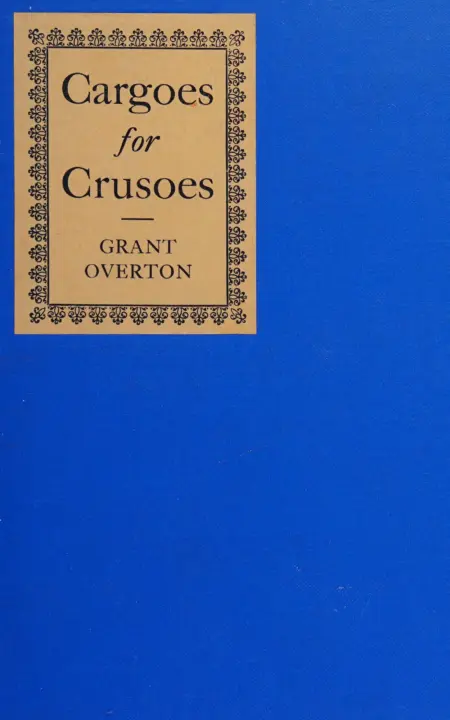
THE CLASSIC COLLECTION · 1924
"Cargoes for Crusoes" by Grant M. Overton is a collection of literary essays written in the early 20th century. The book explores a range of topics related to literature and the authors of the time, mixing both analytical reviews and insights into the works of contemporary writers. In this volume, Overton reflects on the joys of reading and the impact of literature on personal experience and growth, emphasizing the adventures found within the pages of books." The opening of "Cargoes for Crusoes" introduces a fascinating premise: the fictional Robinson Crusoe recounts how he survived his island loneliness through the unexpected arrival of a shipwrecked cargo of books. Expressing joy at discovering this literary treasure, he immerses himself in reading, claiming it has saved him from boredom. The narrator emphasizes the profound effect that literature has had on his life, engaging with various characters and authors as companions in his solitude. The preface sets the tone for an exploration of the value of books and their ability to offer both instruction and entertainment, leading into the following essays that delve into the works of various authors he admires.
Introduction adapted from the source catalogue; source summaries may be automatically generated.
Free to read · English · 116,221 words · No account needed
MAKE TIME FOR A GOOD BOOK
On by default. Untick to stop anonymous reading totals. Each page counts after 10 seconds in view. How this works.
Anonymous counting is on unless you have switched it off.
[28] “An Attic Salt-Shaker,” by W. Orton Tewson in The Public Ledger, Philadelphia, 3 November 1923.
[29] Interviews in The Evening Telegram, New York, 21 October 1923, page 20; in The New York Tribune, 19 October 1923; in The Boston Herald, 18 October 1923. The Definite Object (1917) is laid in New York.
[30] Interview by Fay Stevenson in The Evening World, New York, 24
October 1923.
[31] “Jeffery Farnol at Home,” by Henry Keats, The Book News Monthly,
September, 1911.
[32] Several of the prime favorites among authors of books for boys and girls are discussed in Chapter 14.
[33] See Chapter 2.
[34] See On the Margin, page 32, bottom, et seq. and page 150 et
seq.
[35] On the Margin, page 166 et seq.
[36] See Antic Hay, page 8.
[37] See Crome Yellow, page 121 et seq.
[38] See When Winter Comes to Main Street (Grant Overton), page 34 et
seq.
[39] Antic Hay, page 305.
[40] Letter of Samuel Roth, 500 Fifth Avenue, New York, 28 June 1922.
[41] American Nights Entertainment (Grant Overton), pages 34 and 35.
[42] Mr. F. Scott Fitzgerald.
[43] Mr. Henry L. Mencken.
[44] The New Republic.
[45] Mr. John V. A. Weaver.
[46] The London Times, 3 May 1923.
[47] Literary news note in The Indianapolis Star, 20 March 1922.
[48] Gods of Modern Grub Street, by A. St. John Adcock. (Stokes.) Page
267.
[49] Interview in The Evening Post, New York, 1922 (3 March?)
[50] “E. Phillips Oppenheim,” by Himself. Brentano’s Book Chat, April,
1921.
[51] The New York Times, New York Herald, and The World, New York, 5 March 1922, reporting a Lotos Club dinner to Mr. Oppenheim.
[52] Page 266.
[53] “E. Phillips Oppenheim,” by Himself. Brentano’s Book Chat, April,
1921.
[54] In Boston Evening Transcript for 23 February 1922.
[55] “Mental Photo of E. Phillips Oppenheim,” in The New York American
for 6 March 1922.
[56] “E. Philips Oppenheim,” by Himself, in Brentano’s Book Chat for
April, 1921.
[57] “Fiction and Prophecy,” by E. Phillips Oppenheim, in The New York Times, Sunday book or magazine section (March, 1922?)
[58] “E. Phillips Oppenheim,” by Himself, in Brentano’s Book Chat, April,
1921.
[59] Dr. Hall married twice.
[60] “The Foremost Woman Novelist in Spain,” in The Boston Evening Transcript for 12 April 1924.
[61] Pages 153-154.
[62] “In a spirit of youthful independence, I had lopped off my father’s patronymic.”—Unwritten History, by Cosmo Hamilton, page 8. The father, Mr. Gibbs, had opposed Cosmo’s literary ambitions. See also the chapter on Philip Gibbs in this book.
[63] Unwritten History, by Cosmo Hamilton, page 89.
[64] As long ago as 1916, writing of Lucas’s work, Mr. Llewellyn Jones, literary editor of The Chicago Evening Post, said: “It sounds incredible, but Mr. Lucas has put his name—as author, editor or introducer—on about 108 titlepages.” See pamphlet, “E. V. Lucas: Novelist, Essayist, Friendly Wanderer,” published at the time by George H. Doran Company, New York.
[65] See pamphlet, “E. V. Lucas: Novelist, Essayist, Friendly Wanderer,” published in 1916, the excerpt being taken from Mr. Llewellyn Jones’s article therein.
Your reading position is saved on this browser. Take it to another device with a library code. Reading pages adapt to text, rather than matching a printed edition.
Grant M. (Grant Martin) Overton
Grant M. (Grant Martin) Overton
Grant M. (Grant Martin) Overton
Grant M. (Grant Martin) Overton
BEHIND THE BOOK
This eBook is for the use of anyone anywhere in the United States and most other parts of the world at no cost and with almost no restrictions whatsoever. You may copy it, give it away or re-use it under the terms of the Project Gutenberg License included with this eBook or online at www.gutenberg.org. If you are not located in the United States, you will have to check the laws of the country where you are located before using this eBook. Read the source licence.
The original source file, including credits and licence, is retained by this library. Request an original-format copy at no charge. Please include the book title and Project Gutenberg identifier #68092.
KEEP YOUR CURIOSITY GOING

David Patterson (Spirit) Hatch

David Patterson (Spirit) Hatch

David Patterson (Spirit) Hatch
Cécile Tormay

Moritz Busch
John L. Ransom