
American nights entertainment
Grant M. (Grant Martin) Overton
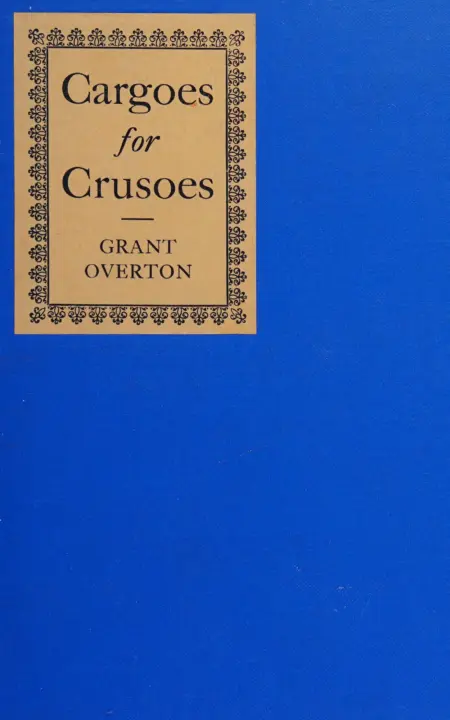
THE CLASSIC COLLECTION · 1924
"Cargoes for Crusoes" by Grant M. Overton is a collection of literary essays written in the early 20th century. The book explores a range of topics related to literature and the authors of the time, mixing both analytical reviews and insights into the works of contemporary writers. In this volume, Overton reflects on the joys of reading and the impact of literature on personal experience and growth, emphasizing the adventures found within the pages of books." The opening of "Cargoes for Crusoes" introduces a fascinating premise: the fictional Robinson Crusoe recounts how he survived his island loneliness through the unexpected arrival of a shipwrecked cargo of books. Expressing joy at discovering this literary treasure, he immerses himself in reading, claiming it has saved him from boredom. The narrator emphasizes the profound effect that literature has had on his life, engaging with various characters and authors as companions in his solitude. The preface sets the tone for an exploration of the value of books and their ability to offer both instruction and entertainment, leading into the following essays that delve into the works of various authors he admires.
Introduction adapted from the source catalogue; source summaries may be automatically generated.
Free to read · English · 116,221 words · No account needed
MAKE TIME FOR A GOOD BOOK
On by default. Untick to stop anonymous reading totals. Each page counts after 10 seconds in view. How this works.
Anonymous counting is on unless you have switched it off.
[66] “The metal bar, cold or lukewarm, will do anywhere, but heat it to melting-point and you must confine it within the rigid limits of the mold or see it at length but an amorphous splash at your feet.” This vivid metaphor of Mr. Pritchard’s is surely one of the most inspired explanations and justifications of poetic form ever set down. It can hardly be cited except by the supporters of traditional verse forms, as in a preceding sentence of his eloquent passage Mr. Pritchard speaks of “rime” and “metre” as well as of rhythm.
[67] Books and Persons, page 153. The notice first appeared in The New Age, London, 7 October 1909.
[68] See pamphlet, “E. V. Lucas: Novelist, Essayist, Friendly Wanderer.”
[69] “Of Slang—English and American,” in Cloud and Silver.
[70] “The True Wizard of the North,” in Adventures and Enthusiasms.
[71] “Thackeray’s Schoolfellow,” in Adventures and Enthusiasms.
[72] In Adventures and Enthusiasms.
[73] Men and Books and Cities, by Robert Cortes Holliday, pages 196-197.
[74] See also “Stories and Humorists,” in Roving East and Roving West, page 136 et seq., and also “Chicago,” in the same volume. Mr. Holliday’s full account is in Men and Books and Cities, pages 196-203, inclusive, and also page 206.
[75] Books and Persons, pages 153-154. First appeared as a notice of Mr. Lucas’s One Day and Another in The New Age, London, 7 October 1909.
[76] A writer in John o’ London’s Weekly, London. Reprinted in the Boston Evening Transcript of 3 March 1923.
[77] Article by Anne Carroll Moore in The Bookman for November, 1918. Reprinted in her Roads to Childhood.
[78] See Chapter 12 for an account of Clyde Fitch and His Letters, by Mr. Moses and Miss Gerson.
[79] See Chapter 11.
[80] See Chapter 12.
[81] Yes, in These Charming People; but it is a remarkable coincidence that the identical mot appeared conspicuously in Donald Ogden Stewart’s Perfect Behavior, published in America in autumn, 1922. (These Charming People appeared in England in early summer, 1923.)
[82] See Chapter 14.
[83] “Animals Love, Hate and Become Angry, Just Like Human Beings, Says Expert.” Interview by Jane Dixon in The Evening Telegram, New York, 23 January 1922.
[84] W. T. Hornaday, curator of the New York Zoölogical Gardens, is quoted in Lions ’n’ Tigers ’n’ Everything as saying: “Casey was a mystery. I am frank to say that I could not put my finger on his exact classification. Of course, he was an ape. But just what kind—that is the question.”
[85] “He’d Make a Man of a Monkey—and in Four Generations.” Feature article in The Gazette Times, Pittsburgh, Pennsylvania, 7 May 1922.
[86] See the chapter on Mrs. Wharton either in Authors of the Day or American Nights Entertainment (both Grant Overton).
[87] The quotations are from the first two pages of The Old Maid.
[88] The Age of Innocence.
Your reading position is saved on this browser. Take it to another device with a library code. Reading pages adapt to text, rather than matching a printed edition.
Grant M. (Grant Martin) Overton
Grant M. (Grant Martin) Overton
Grant M. (Grant Martin) Overton
Grant M. (Grant Martin) Overton
BEHIND THE BOOK
This eBook is for the use of anyone anywhere in the United States and most other parts of the world at no cost and with almost no restrictions whatsoever. You may copy it, give it away or re-use it under the terms of the Project Gutenberg License included with this eBook or online at www.gutenberg.org. If you are not located in the United States, you will have to check the laws of the country where you are located before using this eBook. Read the source licence.
The original source file, including credits and licence, is retained by this library. Request an original-format copy at no charge. Please include the book title and Project Gutenberg identifier #68092.
KEEP YOUR CURIOSITY GOING

David Patterson (Spirit) Hatch

David Patterson (Spirit) Hatch

David Patterson (Spirit) Hatch
Cécile Tormay

Moritz Busch
John L. Ransom