
American nights entertainment
Grant M. (Grant Martin) Overton
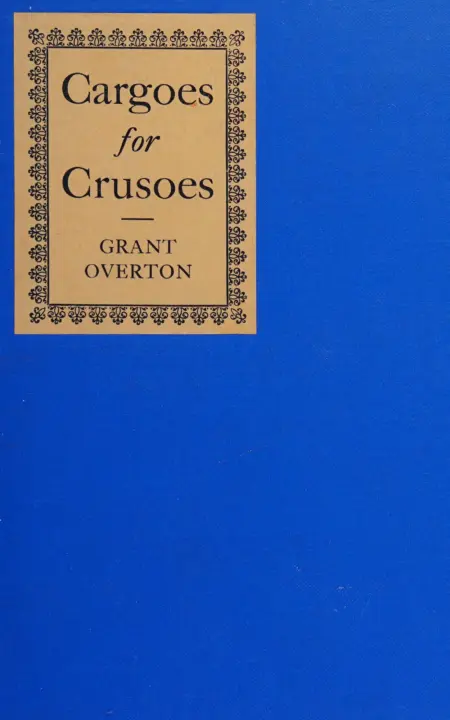
THE CLASSIC COLLECTION · 1924
"Cargoes for Crusoes" by Grant M. Overton is a collection of literary essays written in the early 20th century. The book explores a range of topics related to literature and the authors of the time, mixing both analytical reviews and insights into the works of contemporary writers. In this volume, Overton reflects on the joys of reading and the impact of literature on personal experience and growth, emphasizing the adventures found within the pages of books." The opening of "Cargoes for Crusoes" introduces a fascinating premise: the fictional Robinson Crusoe recounts how he survived his island loneliness through the unexpected arrival of a shipwrecked cargo of books. Expressing joy at discovering this literary treasure, he immerses himself in reading, claiming it has saved him from boredom. The narrator emphasizes the profound effect that literature has had on his life, engaging with various characters and authors as companions in his solitude. The preface sets the tone for an exploration of the value of books and their ability to offer both instruction and entertainment, leading into the following essays that delve into the works of various authors he admires.
Introduction adapted from the source catalogue; source summaries may be automatically generated.
Free to read · English · 116,221 words · No account needed
MAKE TIME FOR A GOOD BOOK
On by default. Untick to stop anonymous reading totals. Each page counts after 10 seconds in view. How this works.
Anonymous counting is on unless you have switched it off.
[13] “Tammany ruled through the corner saloon,” Farnol is quoted as saying, in an interview appearing in the New York Tribune, 19 October 1923. “Dear me, yes, we used to vote ever so many times. I always went out with my Hell’s Kitchen gang, and we voted for Tammany as often as we were told, changing our coats and going in time and time again. That was when we were voting against Jerome.
“I’ve surprised my American friends by saying I thought prohibition was a good thing. I’ve seen too much tragedy and sordidness, too many babies born of drunken parents. I used to love my cups as well as anybody, and I used to say that regeneration could not be forced on a drunkard by law, but now I think the law will help give him his start anyway.”
[14] Interview in Boston Herald, 18 October 1923.
[15] Interview in The Sun, New York, 21 October 1911, page 16.
[16] “‘B’gad, no!’ Yes, Mr. Farnol talks that way. He has had his characters do it for so long that it comes to him naturally and is in nowise an affectation.”—The Evening Telegram, New York, 21 October 1923, page 20.
“Glasses are a part of his expressive equipment, as much as ‘dammit man’ is, and probably more so than a vest which seems to have acquired a habit of coming unbuttoned.”—Interview by John Anderson in The Evening Post, New York, 23 October 1923, page 12.
[17] R. L. Stevenson: A Critical Study, by Frank Swinnerton. Pages 189,
190.
[18] The Book News Monthly, Philadelphia, November, 1915.
[19] A writer in the London Times, quoted in the Boston Evening
Transcript, 24 November 1915.
[20] “The Romance of Jeffery Farnol,” by J. P. Collins. The Bookman, New
York, July, 1920.
[21] Quoted by Henry C. Shelley in his article, “Jeffery Farnol and ‘The Broad Highway,’” in The Independent, New York, 7 September 1911.
[22] Rudyard Kipling was 23 when Plain Tales from the Hills was brought out in Calcutta; recognition came a few years later. Mr. F. Scott Fitzgerald wrote This Side of Paradise at 23. William De Morgan was well past sixty when Joseph Vance made its success.
[23] Interview in the Boston Sunday Globe, 28 May 1912 (London correspondence printed without a date line).
[24] The Honourable Mr. Tawnish (1913).
[25] “A better selection than Mr. Farnol the Daily Mail could not have made,” said W. B. (“Bat”) Masterson, in The Morning Telegraph, New York, 24 July 1921. “Mr. Farnol’s narrative was not only interesting, but for the most part extremely thrilling. I would like to give the whole story as Mr. Farnol wrote it.” He does, however, quote the salient passages of Farnol’s story.
[26] Interview by John Anderson in The Evening Post, New York, 23 October
1923, page 12.
[27] Interview in The Evening Telegram, New York, 21 October 1923, page
20.
Your reading position is saved on this browser. Take it to another device with a library code. Reading pages adapt to text, rather than matching a printed edition.
Grant M. (Grant Martin) Overton
Grant M. (Grant Martin) Overton
Grant M. (Grant Martin) Overton
Grant M. (Grant Martin) Overton
BEHIND THE BOOK
This eBook is for the use of anyone anywhere in the United States and most other parts of the world at no cost and with almost no restrictions whatsoever. You may copy it, give it away or re-use it under the terms of the Project Gutenberg License included with this eBook or online at www.gutenberg.org. If you are not located in the United States, you will have to check the laws of the country where you are located before using this eBook. Read the source licence.
The original source file, including credits and licence, is retained by this library. Request an original-format copy at no charge. Please include the book title and Project Gutenberg identifier #68092.
KEEP YOUR CURIOSITY GOING

David Patterson (Spirit) Hatch

David Patterson (Spirit) Hatch

David Patterson (Spirit) Hatch
Cécile Tormay

Moritz Busch
John L. Ransom