Modern daughters
Alexander Black
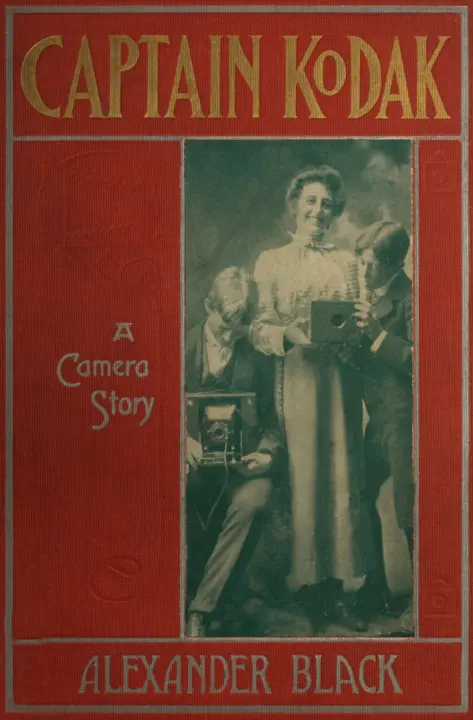
THE CLASSIC COLLECTION · 1899
"Captain Kodak: A Camera Story" by Alexander Black is a fictional narrative written in the late 19th century. The story revolves around an amateur photographer, Allan Hartel, and his adventures alongside his friends, particularly in relation to the excitement and challenges that come from their shared interest in photography. The plot begins with Allan receiving a camera, which ignites a series of events involving friendships, mishaps, and community interactions centered around photography. At the start of the narrative, readers are introduced to Allan and his friend McConnell amidst an amusing chaos after a circus elephant escapes and creates havoc in their town, Hazenfield. Allan expresses a desire to have documented the incident with a photograph, hinting at his budding passion for photography. Shortly afterward, he reveals to McConnell that he won a camera as a prize from a composition contest. This revelation sparks their enthusiasm for setting up a darkroom and experimenting with photography, leading them to a night filled with events surrounding a factory fire that they eagerly attempt to photograph. The opening sets the tone for a blend of adventure, friendship, and the exploratory nature of youth as they dive into the world of photography.
Introduction adapted from the source catalogue; source summaries may be automatically generated.
Free to read · English · 50,307 words · No account needed
MAKE TIME FOR A GOOD BOOK
On by default. Untick to stop anonymous reading totals. Each page counts after 10 seconds in view. How this works.
Anonymous counting is on unless you have switched it off.
“If we are to make a ‘farthest north’ to-night,” said Allan, who had read “Nansen” with enthusiasm, “and do our dallying to-morrow, I think we should keep going for half an hour yet.”
“Suppose we try for that cove up beyond Rodlongs,” suggested Owen. “There is a spring there, and a good place to anchor.”
“I remember that,” said Allan; “the Canoe Club landed there one night. But I think it will take an hour yet.”
Owen thought they could do it in thirty or forty minutes, at the rate they were then going; and they would have done so had not the wind fallen slightly. As it was, the Arabella reached the cove in three-quarters of an hour, just as the twilight began to deepen.
The boys lifted the centre-board, and pulled the bow of the boat into the mouth of a little stream that trickled from the near-by hill, and that was reënforced by the spring, to which McConnell presently started with their tin bucket.
Owen built a fire while Allan lowered and stowed the sail, braced the boom, and set about preparing for the night.
All three boys were prodigiously hungry, and Owen worked with great zeal over his coffee, the smell of which was simply thrilling; over the bouillon, which was to be warmed; over the unpacking of the stores.
A flat stone was selected for a supper table, and in the last of the twilight, and side gleams from the fire, the boys attacked the spread with which Owen, assisted by the others, had decorated the paper covering of the stone.
“This is entirely too nice for sailors,” said Owen. “We are dudes. Think of a spotless—I mean a spotted—table-cloth like this, bouillon, cold roast beef, biscuits, sweet crackers, coffee, and fresh water.”
“You are spoiling us, Owen,” admitted Allan. “This is too good. And to think that there is lots more left.”
“Are you saving the pies for to-morrow?” asked McConnell.
“Sure,” declared Owen. “Do you mean to say you want pie after all this? Pretty soon, McConnell, you’ll be asking for the hard-boiled eggs we’ve got for breakfast.”
“It seems to me I never was so hungry,” said McConnell.
“Wait till the morning,” said Allan. “That’s when real hunger gets in
its fine work.”
“That’s so, McConnell,” said Owen. “In the morning you could eat boiled
dog.”
“When are we going to get up?” demanded McConnell. “Can’t we have a swim, then, if it isn’t too cold?”
“Of course,” answered Owen, “though it’s not quite correct. Sailors
never swim.”
“They don’t?” asked McConnell.
Your reading position is saved on this browser. Take it to another device with a library code. Reading pages adapt to text, rather than matching a printed edition.
Alexander Black
Alexander Black
BEHIND THE BOOK
This eBook is for the use of anyone anywhere in the United States and most other parts of the world at no cost and with almost no restrictions whatsoever. You may copy it, give it away or re-use it under the terms of the Project Gutenberg License included with this eBook or online at www.gutenberg.org. If you are not located in the United States, you will have to check the laws of the country where you are located before using this eBook. Read the source licence.
The original source file, including credits and licence, is retained by this library. Request an original-format copy at no charge. Please include the book title and Project Gutenberg identifier #70197.
KEEP YOUR CURIOSITY GOING
Coulson Kernahan

Maurice Baring
Frances Wright
Cécile Tormay

Frederic Jesup Stimson

W. H. P. (William Henry Pope) Jarvis