Modern daughters
Alexander Black
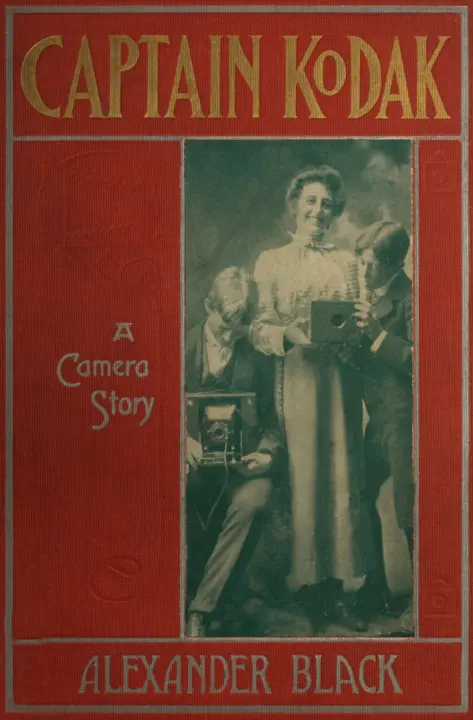
THE CLASSIC COLLECTION · 1899
"Captain Kodak: A Camera Story" by Alexander Black is a fictional narrative written in the late 19th century. The story revolves around an amateur photographer, Allan Hartel, and his adventures alongside his friends, particularly in relation to the excitement and challenges that come from their shared interest in photography. The plot begins with Allan receiving a camera, which ignites a series of events involving friendships, mishaps, and community interactions centered around photography. At the start of the narrative, readers are introduced to Allan and his friend McConnell amidst an amusing chaos after a circus elephant escapes and creates havoc in their town, Hazenfield. Allan expresses a desire to have documented the incident with a photograph, hinting at his budding passion for photography. Shortly afterward, he reveals to McConnell that he won a camera as a prize from a composition contest. This revelation sparks their enthusiasm for setting up a darkroom and experimenting with photography, leading them to a night filled with events surrounding a factory fire that they eagerly attempt to photograph. The opening sets the tone for a blend of adventure, friendship, and the exploratory nature of youth as they dive into the world of photography.
Introduction adapted from the source catalogue; source summaries may be automatically generated.
Free to read · English · 50,307 words · No account needed
MAKE TIME FOR A GOOD BOOK
On by default. Untick to stop anonymous reading totals. Each page counts after 10 seconds in view. How this works.
Anonymous counting is on unless you have switched it off.
The wind drew a little stronger, and Allan began to think that the fog was lifting. It had grown sufficiently thin to justify him in running straight for shore.
“Go to the bow,” Allan said to McConnell, “and yell when you see
anything.”
They both watched eagerly for the shore, but it was nearly ten minutes later that McConnell shouted, “A dock!”
They would have crashed into it in a few moments. Allan swung the Arabella and ran the boat up under the lee of the dock.
It was a small private dock adjoining a boat-house. Making fast to one of the rings, the boys climbed out.
Allan looked down at his clothes. “I wonder what any one would think of
this?”
McConnell laughed. “You’ll have to explain,” he said.
The boys turned up the dock, and they had scarcely done so when a man stepped from behind the boat-house and caught Allan by the shoulder.
“No, you don’t!” said the man, “no convicts here, please. If this don’t beat all! Mike!” And the man shouted again, until another man came strolling from beyond the boat-house. At the sight of Allan, Mike stopped, and his jaw dropped. “Holy saints!”
“I don’t mind yer gettin’ away,” said the first man; “but makin’ use of us is too much—too much, I say.”
“I’m not a convict,” said Allan, “I—”
“Of course not,” said Allan’s custodian, “of course yer innocent. You
all are.”
“You don’t understand,” said Allan; “a man escaped and I—”
“Yes, and you couldn’t resist keeping him company. Right you are, my boy, and I suppose I’d do it myself if I was in your shoes; but I’m not, and I’m goin’ to keep my conscience clear. I’ll hand you over and save all trouble. And yer only a kind of kid, after all.”
“You’re making a break,” spoke up McConnell; “he’s no convict. He had a fight with one, and he—”
“Now you keep quiet, young feller,” said Mike. “Don’t complain to us. You don’t suppose we’re goin’ to git ourselves in a scrape, do yer?”
“What’s this?” demanded a voice.
“An escaped Sing Sing man, sir,” said Mike.
“A what?—dear me!” said the voice.
Allan and McConnell had started at the first sound of the voice. When
they saw its owner, their suspicions were confirmed. It was Mr.
Prenwood.
“Dear me! a convict!” continued Mr. Prenwood. “Why, it’s not a man at all; it’s only a boy—”
“Mr. Prenwood!” cried Allan, “don’t you know us?”
“Know you?” stammered Mr. Prenwood, stepping closer.
Your reading position is saved on this browser. Take it to another device with a library code. Reading pages adapt to text, rather than matching a printed edition.
Alexander Black
Alexander Black
BEHIND THE BOOK
This eBook is for the use of anyone anywhere in the United States and most other parts of the world at no cost and with almost no restrictions whatsoever. You may copy it, give it away or re-use it under the terms of the Project Gutenberg License included with this eBook or online at www.gutenberg.org. If you are not located in the United States, you will have to check the laws of the country where you are located before using this eBook. Read the source licence.
The original source file, including credits and licence, is retained by this library. Request an original-format copy at no charge. Please include the book title and Project Gutenberg identifier #70197.
KEEP YOUR CURIOSITY GOING
Coulson Kernahan

Maurice Baring
Frances Wright
Cécile Tormay

Frederic Jesup Stimson

W. H. P. (William Henry Pope) Jarvis