Nova Scotia
Beckles Willson
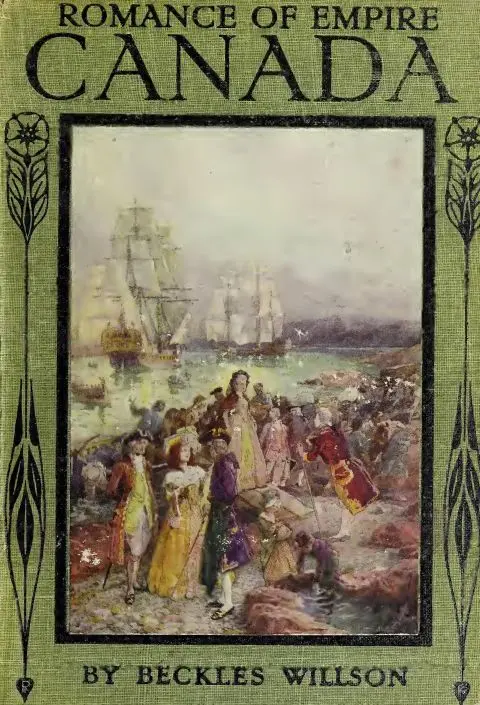
THE CLASSIC COLLECTION · 1907
"Canada" by Beckles Willson is a historical account written in the early 20th century. The work delves into the rich history and legends of Canada, portraying the valiant heroes and pivotal events that shaped the nation as a saga might be recounted around a tribal fire. It aims to make this history accessible and engaging, particularly for a younger audience, while also appealing to readers of all ages through its compelling narrative. The opening of the book introduces the context of Jacques Cartier's historic voyage in the early 16th century, marking the beginning of French exploration in New France. As Cartier sets sail from St. Malo in 1534 under the commission of King Francis of France, the text contrasts the royal festivities in England with Cartier's perilous journey across the Atlantic. The narrative vividly describes Cartier's encounters with the Indigenous peoples and the landscape of Canada, emphasizing the discoveries and challenges he faced, ultimately establishing the French flag in what is now Canadian territory and laying the groundwork for future expeditions.
Introduction adapted from the source catalogue; source summaries may be automatically generated.
Free to read · English · 79,094 words · No account needed
MAKE TIME FOR A GOOD BOOK
On by default. Untick to stop anonymous reading totals. Each page counts after 10 seconds in view. How this works.
Anonymous counting is on unless you have switched it off.
Vaudreuil entered with spirit upon the duties of his office. He needed all his faculties, for stirring times were in prospect. General Braddock and his Englishmen were in the north awaiting soldiers who were crossing the Atlantic. The French were also resolved to maintain what their Canadian advance guard had won. Field-Marshal Baron Dieskau was appointed to command six regiments of French {197} soldiers who left their native shores in a squadron of fourteen battleships, four frigates, and many transports.
You must remember that during all this time there had been no war. If you had asked any of the French courtiers or ambassadors they would have told you that perfect peace existed between the two nations. But that was only a diplomatic fiction. At all events, whatever was happening in Europe between Old France and Old England, on the other side of the great ocean New France and New England were engaged in a life-and-death conflict. It was not strange that the hand of both mother-countries was extended to help them. Only if England could have looked into the future five-and-twenty years and seen her ungrateful American children tearing down her noble old flag with taunts and insults, perhaps she might not have given her help or spilt her blood so freely to protect America from the French. After all, it may be as well that nations do not know all the evils that are to happen. Their course is to do their duty manfully and honestly for the present; posterity can take care of itself. Moreover, the separation of America from England was no real evil, because that separation was to build the foundation of Canada's greatness in the British Empire and loyalty to the British crown and flag.
On the arrival of General Braddock the various colonial Governors held a consultation. They decided that the three forts, Duquesne, Niagara, and Crown Point, at the head of Lake Champlain, should be captured. We have already seen that another {198} French fort, Beauséjour, was doomed to destruction. It was while Beauséjour was being surrounded by Monckton and his New Englanders that the other expeditions were setting out for their destinations. Braddock decided to take Fort Duquesne himself. Governor Shirley led the expedition against Niagara, and Colonel William Johnson was ordered to take Crown Point. Braddock took 1000 English veterans and 1200 Virginian Militia into the heart of the wilderness. The commander of Fort Duquesne was Contrecoeur. When he was told the size of Braddock's army he saw little hope of standing a siege, but he might intercept the English soldiers in the woods. It was a splendid opportunity for the kind of warfare Indians loved. Two hundred Frenchmen and 500 redskins were sent to lie in ambush on the trail which Braddock would take with drums beating and fifes playing. On a beautiful July day the scarlet-coated regiments of Braddock moved on unconscious to their doom. Every moment they looked to see the great walls of the Fort Duquesne burst upon their gaze. Through the forest they came to the river, the Monongahela, and forded it. Hardly had they crossed, when a strange apparition sprang into the middle of the wide woodland path. He wore war-paint and flaming feathers, but in spite of this dress he was really a French officer. He flung his right arm into the air as a signal, and instantly the forest rang with savage yells. A shower of bullets, fired by unseen hands, fell upon the advancing English. Astonished and taken at such a disadvantage, they yet did not hesitate to return the fire. The intrepid French leader who had given the {199} signal so openly, paid for that act with his life; but it was not easy to fight, however valiantly, against a hidden foe. Braddock and his officers thought it cowardly to fight behind trees; they charged hither and thither in pursuit of the enemy, and were mowed down like grass. The troops became at length huddled together in a panic, shooting, if they shot at all, blindly and without aim. In vain did the General's aide-de-camp, Washington, urge him to scatter his men singly under cover. Braddock, on horseback, galloped fearlessly in every direction ordering the ranks to advance. Not until four horses had been shot dead beneath him did he order a retreat. The command had scarcely passed his lips ere a bullet pierced his body, and he fell, to rise no more. His last words were, "We shall know better how to deal with them another time." The retreat soon became a disgraceful flight. Arms, baggage, and artillery were abandoned. Yelling Indians pursued them, only stopping in order to scalp the helpless wounded. Had it not been for the hope of plunder, very few of the British forces would have escaped death or captivity. Cannons, stores, arms, and papers fell into the hands of the victorious French. Upwards of sixty British officers had been killed, and of all Braddock's army less than half took refuge in the English Fort Cumberland.
Your reading position is saved on this browser. Take it to another device with a library code. Reading pages adapt to text, rather than matching a printed edition.
Beckles Willson
Beckles Willson
BEHIND THE BOOK
This eBook is for the use of anyone anywhere in the United States and most other parts of the world at no cost and with almost no restrictions whatsoever. You may copy it, give it away or re-use it under the terms of the Project Gutenberg License included with this eBook or online at www.gutenberg.org. If you are not located in the United States, you will have to check the laws of the country where you are located before using this eBook. Read the source licence.
The original source file, including credits and licence, is retained by this library. Request an original-format copy at no charge. Please include the book title and Project Gutenberg identifier #62154.
KEEP YOUR CURIOSITY GOING
Cécile Tormay

Moritz Busch
John L. Ransom

Maurice Baring
Frances Wright
Cécile Tormay