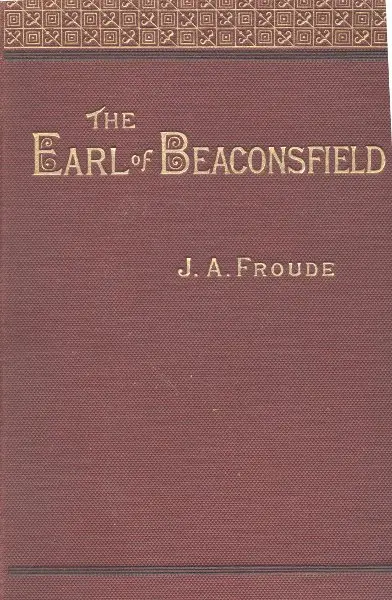
The Earl of Beaconsfield
James Anthony Froude
THE CLASSIC COLLECTION · 1879
"Caesar: A Sketch" by James Anthony Froude is a historical account written in the late 19th century. This work examines the life and historical significance of Julius Caesar, exploring the transition of the Roman Republic into a military empire and the complex political climate of the era. Froude's analysis delves into the societal structures, key figures, and significant events that shaped Rome during Caesar's time, providing insights into both Caesar's character and the broader implications of his leadership. The opening of "Caesar: A Sketch" presents a thorough prelude to the study of Julius Caesar and the fall of the Roman Republic, establishing key themes of political power and moral decay within Roman society. Froude discusses the limited historical resources available for a complete portrait of Caesar, emphasizing the reliance on ancient accounts by figures like Suetonius and Cicero. The text describes how the early Romans had a unique capability for self-governance, contrasting with the later corruption and decline of civic virtue, which ultimately paved the way for Caesar's rise to power. Through an analysis of the institutions and character of the era, Froude underscores the inevitable trends leading to the transformation of Rome from a republic into an autocratic rule, setting the stage for Caesar's historical narrative.
Introduction adapted from the source catalogue; source summaries may be automatically generated.
Free to read · English · 160,700 words · No account needed
MAKE TIME FOR A GOOD BOOK
On by default. Untick to stop anonymous reading totals. Each page counts after 10 seconds in view. How this works.
Anonymous counting is on unless you have switched it off.
The Gauls paid the expenses of their conquest in the prisoners taken in battle, who were sold to the slave merchants; and this is the real blot on Caesar's career. But the blot was not personally upon Caesar, but upon the age in which he lived. The great Pomponius Atticus himself was a dealer in human chattels. That prisoners of war should be sold as slaves was the law of the time, accepted alike by victors and vanquished; and the crowds of libertini who assisted at Caesar's funeral proved that he was not regarded as the enemy of these unfortunates, but as their special friend.
His leniency to the Pompeian faction has already been spoken of sufficiently. It may have been politic, but it arose also from the disposition of the man. Cruelty originates in fear, and Caesar was too indifferent to death to fear anything. So far as his public action was concerned, he betrayed no passion save hatred of injustice; and he moved through life calm and irresistible, like a force of nature.
Cicero has said of Caesar's oratory that he surpassed those who had practised no other art. His praise of him as a man of letters is yet more delicately and gracefully emphatic. Most of his writings are lost; but there remain seven books of commentaries on the wars in Gaul (the eighth was added by another hand), and three books upon the civil war, containing an account of its causes and history. Of these it was that Cicero said, in an admirable image, that fools might think to improve on them, but that no wise man would try it; they were nudi omni ornatu orationis, tanquam veste detractâ--bare of ornament, the dress of style dispensed with, like an undraped human figure perfect in all its lines as nature made it. In his composition, as in his actions, Caesar is entirely simple. He indulges in no images, no labored descriptions, no conventional reflections. His art is unconscious, as the highest art always is. The actual fact of things stands out as it really was, not as mechanically photographed, but interpreted by the calmest intelligence, and described with unexaggerated feeling. No military narrative has approached the excellence of the history of the war in Gaul. Nothing is written down which could be dispensed with; nothing important is left untold; while the incidents themselves are set off by delicate and just observations on human character. The story is rendered attractive by complimentary anecdotes of persons; while details of the character and customs of an unknown and remarkable people show the attention which Caesar was always at leisure to bestow on anything which was worthy of interest, even when he was surrounded with danger and difficulty. The books on the civil war have the same simplicity and clearness, but a vein runs through them of strong if subdued emotion. They contain the history of a great revolution related by the principal actor in it; but no effort can be traced to set his own side in a favorable light, or to abuse or depreciate his adversaries. The coarse invectives which Cicero poured so freely upon those who differed from him are conspicuously absent. Caesar does not exult over his triumphs or parade the honesty of his motives. The facts are left to tell their own story; and the gallantry and endurance of his own troops are not related with more feeling than the contrast between the confident hopes of the patrician leaders at Pharsalia and the luxury of their camp with the overwhelming disaster which fell upon them. About himself and his own exploits there is not one word of self-complacency or self-admiration. In his writings, as in his life, Caesar is always the same--direct, straightforward, unmoved save by occasional tenderness, describing with unconscious simplicity how the work which had been forced upon him was accomplished. He wrote with extreme rapidity in the intervals of other labor; yet there is not a word misplaced, not a sign of haste anywhere, save that the conclusion of the Gallic war was left to be supplied by a weaker hand. The Commentaries, as an historical narrative, are as far superior to any other Latin composition of the kind as the person of Caesar himself stands out among the rest of his contemporaries.
Your reading position is saved on this browser. Take it to another device with a library code. Reading pages adapt to text, rather than matching a printed edition.
James Anthony Froude
James Anthony Froude
James Anthony Froude
James Anthony Froude
BEHIND THE BOOK
This eBook is for the use of anyone anywhere in the United States and most other parts of the world at no cost and with almost no restrictions whatsoever. You may copy it, give it away or re-use it under the terms of the Project Gutenberg License included with this eBook or online at www.gutenberg.org. If you are not located in the United States, you will have to check the laws of the country where you are located before using this eBook. Read the source licence.
The original source file, including credits and licence, is retained by this library. Request an original-format copy at no charge. Please include the book title and Project Gutenberg identifier #8425.
KEEP YOUR CURIOSITY GOING
Cécile Tormay

Moritz Busch
John L. Ransom
Frances Wright
Cécile Tormay

Mabel Potter Daggett