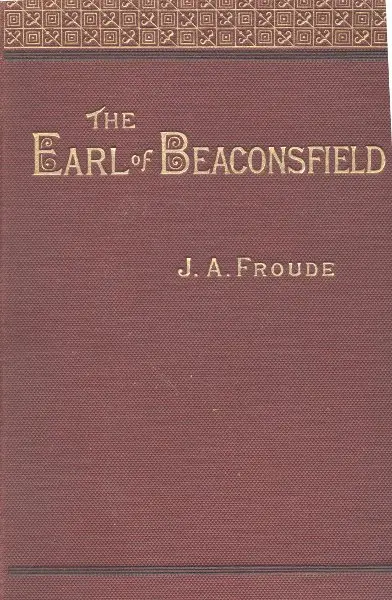
The Earl of Beaconsfield
James Anthony Froude
THE CLASSIC COLLECTION · 1879
"Caesar: A Sketch" by James Anthony Froude is a historical account written in the late 19th century. This work examines the life and historical significance of Julius Caesar, exploring the transition of the Roman Republic into a military empire and the complex political climate of the era. Froude's analysis delves into the societal structures, key figures, and significant events that shaped Rome during Caesar's time, providing insights into both Caesar's character and the broader implications of his leadership. The opening of "Caesar: A Sketch" presents a thorough prelude to the study of Julius Caesar and the fall of the Roman Republic, establishing key themes of political power and moral decay within Roman society. Froude discusses the limited historical resources available for a complete portrait of Caesar, emphasizing the reliance on ancient accounts by figures like Suetonius and Cicero. The text describes how the early Romans had a unique capability for self-governance, contrasting with the later corruption and decline of civic virtue, which ultimately paved the way for Caesar's rise to power. Through an analysis of the institutions and character of the era, Froude underscores the inevitable trends leading to the transformation of Rome from a republic into an autocratic rule, setting the stage for Caesar's historical narrative.
Introduction adapted from the source catalogue; source summaries may be automatically generated.
Free to read · English · 160,700 words · No account needed
MAKE TIME FOR A GOOD BOOK
On by default. Untick to stop anonymous reading totals. Each page counts after 10 seconds in view. How this works.
Anonymous counting is on unless you have switched it off.
Cicero considered that the Civil War ought to have ended with Pharsalia; and in this opinion most reasonable men among the conservatives were agreed. They had fought one battle; and it had gone against them. To continue the struggle might tear the Empire to pieces, but could not retrieve a lost cause; and prudence and patriotism alike recommended submission to the verdict of fortune. It is probable that this would have been the result, could Caesar have returned to Italy immediately after his victory. Cicero himself refused to participate in further resistance. Cato offered him a command at Corcyra, but he declined it with a shudder, and went back to Brindisi; and all but those whose consciences forbade them to hope for pardon, or who were too proud to ask for it, at first followed his example. Scipio, Cato, Labienus, Afranius, Petreius, were resolute to fight on to the last; but even they had no clear outlook, and they wandered about the Mediterranean, uncertain what to do, or whither to turn. Time went on, however, and Caesar did not appear. Rumor said at one time that he was destroyed at Alexandria. The defeat of Calvinus by Pharnaces was an ascertained fact. Spain was in confusion. The legions in Italy were disorganized, and society, or the wealthy part of society, threatened by the enemies of property, began to call for some one to save it. All was not lost. Pompey's best generals were still living. His sons, Sextus and Cnaeus, were brave and able. The fleet was devoted to them and to their father's cause, and Caesar's officers had failed, in his absence, to raise a naval force which could show upon the sea. Africa was a convenient rallying point. Since Curio's defeat, King Juba had found no one to dispute his supremacy, and between Juba and the aristocracy who were bent on persisting in the war, an alliance was easily formed. While Caesar was perilling his own interest to remain in Asia to crush Pharnaces, Metellus Scipio was offering a barbarian chief the whole of Roman Africa, as the price of his assistance, in a last effort to reverse the fortune of Pharsalia. Under these scandalous conditions, Scipio, Labienus, Cato, Afranius, Petreius, Faustus Sylla, the son of the Dictator, Lucius Caesar, and the rest of the irreconcilables, made Africa their new centre of operations. Here they gathered to themselves the inheritors of the Syllan traditions, and made raids on the Italian coasts and into Sicily and Sardinia. Seizing Caesar's officers when they could find them, they put them invariably to death without remorse. Cicero protested honorably against the employment of treacherous savages, even for so sacred a cause as the defence of the constitution;[1] but Cicero was denounced as a traitor seeking favor with the conqueror, and the desperate work went on. Caesar's long detention in the East gave the confederates time. The young Pompeys were strong at sea. From Italy there was an easy passage for adventurous disaffection. The shadow of a Pompeian Senate sat once more, passing resolutions, at Utica; while Cato was busy organizing an army, and had collected as many as thirteen legions out of the miscellaneous elements which drifted in to him. Caesar had sent orders to Cassius Longinus to pass into Africa from Spain, and break up these combinations; but Longinus had been at war with his own provincials. He had been driven out of the Peninsula, and had lost his own life in leaving it. Caesar, like Cicero, had believed that the war had ended at Pharsalia. He found that the heads of the Hydra had sprouted again, and were vomiting the old fire and fury. Little interest could it give Caesar to match his waning years against the blinded hatred of his countrymen. Ended the strife must be, however, before order could be restored in Italy, and wretched men take up again the quiet round of industry. Heavy work had to be done in Rome. Caesar was consul now--annual consul, with no ten years' interval any longer possible. Consul, dictator, whatever name the people gave him, he alone held the reins; he alone was able to hold them. Credit had to be restored; debtors had to be brought to recognize their liabilities. Property had fallen in value since the Civil Wars, and securities had to be freshly estimated. The Senate required reformation; men of fidelity and ability were wanted for the public offices. Pompey and Pompey's friends would have drowned Italy in blood. Caesar disappointed expectation by refusing to punish any one of his political opponents. He killed no one. He deprived no one of his property. He even protected the money-lenders, and made the Jews his constant friends. Debts he insisted must be paid, bonds fulfilled, the rights of property respected, no matter what wild hopes imagination might have indulged in. Something only he remitted of the severity of interest, and the poor in the city were allowed their lodgings rent free for a year.
Your reading position is saved on this browser. Take it to another device with a library code. Reading pages adapt to text, rather than matching a printed edition.
James Anthony Froude
James Anthony Froude
James Anthony Froude
James Anthony Froude
BEHIND THE BOOK
This eBook is for the use of anyone anywhere in the United States and most other parts of the world at no cost and with almost no restrictions whatsoever. You may copy it, give it away or re-use it under the terms of the Project Gutenberg License included with this eBook or online at www.gutenberg.org. If you are not located in the United States, you will have to check the laws of the country where you are located before using this eBook. Read the source licence.
The original source file, including credits and licence, is retained by this library. Request an original-format copy at no charge. Please include the book title and Project Gutenberg identifier #8425.
KEEP YOUR CURIOSITY GOING
Cécile Tormay

Moritz Busch
John L. Ransom
Frances Wright
Cécile Tormay

Mabel Potter Daggett