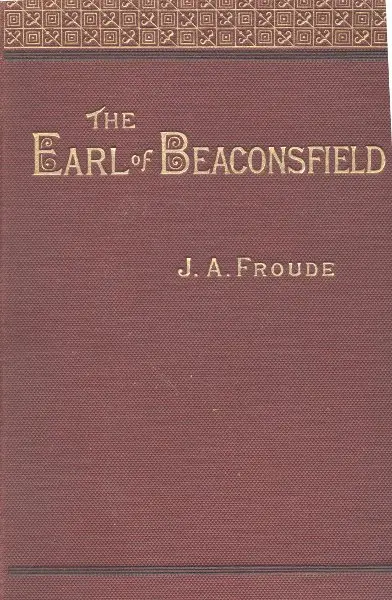
The Earl of Beaconsfield
James Anthony Froude
THE CLASSIC COLLECTION · 1879
"Caesar: A Sketch" by James Anthony Froude is a historical account written in the late 19th century. This work examines the life and historical significance of Julius Caesar, exploring the transition of the Roman Republic into a military empire and the complex political climate of the era. Froude's analysis delves into the societal structures, key figures, and significant events that shaped Rome during Caesar's time, providing insights into both Caesar's character and the broader implications of his leadership. The opening of "Caesar: A Sketch" presents a thorough prelude to the study of Julius Caesar and the fall of the Roman Republic, establishing key themes of political power and moral decay within Roman society. Froude discusses the limited historical resources available for a complete portrait of Caesar, emphasizing the reliance on ancient accounts by figures like Suetonius and Cicero. The text describes how the early Romans had a unique capability for self-governance, contrasting with the later corruption and decline of civic virtue, which ultimately paved the way for Caesar's rise to power. Through an analysis of the institutions and character of the era, Froude underscores the inevitable trends leading to the transformation of Rome from a republic into an autocratic rule, setting the stage for Caesar's historical narrative.
Introduction adapted from the source catalogue; source summaries may be automatically generated.
Free to read · English · 160,700 words · No account needed
MAKE TIME FOR A GOOD BOOK
On by default. Untick to stop anonymous reading totals. Each page counts after 10 seconds in view. How this works.
Anonymous counting is on unless you have switched it off.
[Sidenote: B.C. 64.] Among the patricians who were rising through the lower magistracies and were aspiring to the consulship was Lucius Sergius Catiline. Catiline, now in middle life, had when young been a fervent admirer of Sylla, and, as has been already said, had been an active agent in the proscription. He had murdered his brother-in-law, and perhaps his brother, under political pretences. In an age when licentiousness of the grossest kind was too common to attract attention, Catiline had achieved a notoriety for infamy. Ho had intrigued with a Vestal virgin, the sister of Cicero's wife, Terentia. If Cicero is to be believed, he had made away with his own wife, that he might marry Aurelia Orestilla, a woman as wicked as she was beautiful, and he had killed his child also because Aurelia had objected to be encumbered with a step-son. But this, too, was common in high society in those days. Adultery and incest had become familiar excitements. Boys of ten years old had learnt the art of poisoning their fathers,[1] and the story of Aurelia Orestilla and Catiline had been rehearsed a few years before by Sassia and Oppianicus at Larino.[2] Other enormities Catiline had been guilty of which Cicero declined to mention, lest he should show too openly what crimes might go unpunished under the senatorial administration. But villainy, however notorious, did not interfere with advancement in the public service. Catiline was adroit, bold, and even captivating. He made his way into high office along the usual gradations. He was praetor in B.C. 68. He went as governor to Africa in the year following, and he returned with money enough, as he reasonably hoped, to purchase the last step to the consulship. He was impeached when he came back for extortion and oppression, under one of the many laws which were made to be laughed at. Till his trial was over he was disqualified from presenting himself as a candidate, and the election for the year 65 was carried by Autronius Paetus and Cornelius Sylla. Two other patricians, Aurelius Cotta and Manlius Torquatus, had stood against them. The successful competitors were unseated for bribery; Cotta and Torquatus took their places, and, apparently as a natural resource in the existing contempt into which the constitution had fallen, the disappointed candidates formed a plot to kill their rivals and their rivals' friends in the Senate, and to make a revolution. Cneius Piso, a young nobleman of the bluest blood, joined in the conspiracy. Catiline threw himself into it as his natural element, and aristocratic tradition said in later years that Caesar and Crassus were implicated also. Some desperate scheme there certainly was, but the accounts of it are confused: one authority says that it failed because Catiline gave the signal prematurely; others that Caesar was to have given the signal, and did not do it; others that Crassus's heart failed him; others that the consuls had secret notice given to them and took precautions. Cicero, who was in Rome at the time, declares that he never heard of the conspiracy.[3] When evidence is inconclusive, probability becomes argument. Nothing can be less likely than that a cautious capitalist of vast wealth like Crassus should have connected himself with a party of dissolute adventurers. Had Caesar committed himself, jealously watched as he was by the aristocrats, some proofs of his complicity would have been forthcoming. The aristocracy under the empire revenged themselves for their ruin by charging Caesar with a share in every combination that had been formed against them, from Sylla's time downwards. Be the truth what it may, nothing came of this project. Piso went to Spain, where he was killed. The prosecution of Catiline for his African misgovernment was continued, and, strange to say, Cicero undertook his defence. He was under no uncertainty as to Catiline's general character, or his particular guilt in the charge brought against him. It was plain as the sun at midday.[4] But Cicero was about to stand himself for the consulship, the object of his most passionate desire. He had several competitors; and as he thought well of Catiline's prospects, he intended to coalesce with him.[5] Catiline was acquitted, apparently through a special selection of the judges, with the connivance of the prosecutor. The canvass was violent, and the corruption flagrant. [6]Cicero did not bribe himself, but if Catiline's voters would give him a help, he was not so scrupulous as to be above taking advantage of it. Catiline's humor or the circumstances of the time provided him with a more honorable support. He required a more manageable colleague than he could have found in Cicero. Among the candidates was one of Sylla's officers, Caius Antonius, the uncle of Marc Antony, the triumvir. This Antonius had been prosecuted by Caesar for ill-usage of the Macedonians. He had been expelled by the censors from the Senate for general worthlessness; but public disgrace seems to have had no effect whatever on the chances of a candidate for the consulship in this singular age. Antonius was weak and vicious, and Catiline could mould him as he pleased. He had made himself popular by his profusion when aedile in providing shows for the mob. The feeling against the Senate was so bitter that the aristocracy had no chance of carrying a candidate of their own, and the competition was reduced at last to Catiline, Antonius and Cicero. Antonius was certain of his election, and the contest lay between Catiline and Cicero. Each of them tried to gain the support of Antonius and his friends. Catiline promised Antonius a revolution, in which they were to share the world between them. Cicero promised his influence to obtain some lucrative province for Antonius to misgovern. Catiline would probably have succeeded, when the aristocracy, knowing what to expect if so scandalous a pair came into office, threw their weight on Cicero's side and turned the scale. Cicero was liked among the people for his prosecution of Verres, for his support of the Manilian law, and for the boldness with which he had exposed patrician delinquencies. With the Senate for him also, he was returned at the head of the poll. The proud Roman nobility had selected a self-made lawyer as their representative. Cicero was consul, and Antonius with him. Catiline had failed. It was the turning-point of Cicero's life. Before his consulship he had not irrevocably taken a side. No public speaker had more eloquently shown the necessity for reform; no one had denounced with keener sarcasm the infamies and follies of senatorial favorites. Conscience and patriotism should have alike held him to the reforming party; and political instinct, if vanity had left him the use of his perception, would have led him in the same direction. Possibly before he received the votes of the patricians and their clients he had bound himself with certain engagements to them. Possibly he held the Senate's intellect cheap, and saw the position which he could arrive at among the aristocracy if he offered them his services. The strongest intellect was with the reformers, and first on that side he could never be. First among the Conservatives[7] he could easily be; and he might prefer being at the head of a party which at heart he despised, to working at the side of persons who must stand inevitably above him. We may regret that gifted men should be influenced by personal considerations, but under party government it is a fact that they are so influenced, and will be as long as it continues. Caesar and Pompey were soldiers. The army was democratic, and the triumph of the democracy meant the rule of a popular general. Cicero was a civilian, and a man of speech. In the forum and in the Curia he knew that he could reign supreme.
Your reading position is saved on this browser. Take it to another device with a library code. Reading pages adapt to text, rather than matching a printed edition.
James Anthony Froude
James Anthony Froude
James Anthony Froude
James Anthony Froude
BEHIND THE BOOK
This eBook is for the use of anyone anywhere in the United States and most other parts of the world at no cost and with almost no restrictions whatsoever. You may copy it, give it away or re-use it under the terms of the Project Gutenberg License included with this eBook or online at www.gutenberg.org. If you are not located in the United States, you will have to check the laws of the country where you are located before using this eBook. Read the source licence.
The original source file, including credits and licence, is retained by this library. Request an original-format copy at no charge. Please include the book title and Project Gutenberg identifier #8425.
KEEP YOUR CURIOSITY GOING
Cécile Tormay

Moritz Busch
John L. Ransom
Frances Wright
Cécile Tormay

Mabel Potter Daggett