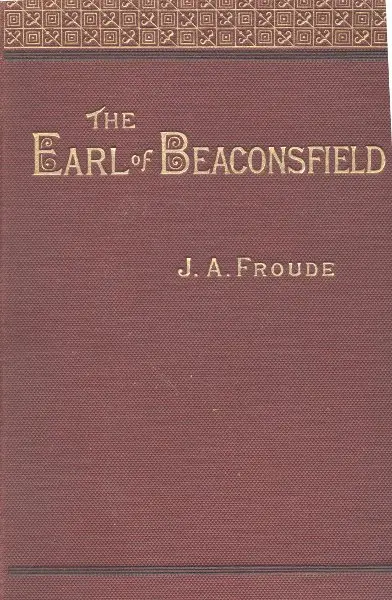
The Earl of Beaconsfield
James Anthony Froude
THE CLASSIC COLLECTION · 1879
"Caesar: A Sketch" by James Anthony Froude is a historical account written in the late 19th century. This work examines the life and historical significance of Julius Caesar, exploring the transition of the Roman Republic into a military empire and the complex political climate of the era. Froude's analysis delves into the societal structures, key figures, and significant events that shaped Rome during Caesar's time, providing insights into both Caesar's character and the broader implications of his leadership. The opening of "Caesar: A Sketch" presents a thorough prelude to the study of Julius Caesar and the fall of the Roman Republic, establishing key themes of political power and moral decay within Roman society. Froude discusses the limited historical resources available for a complete portrait of Caesar, emphasizing the reliance on ancient accounts by figures like Suetonius and Cicero. The text describes how the early Romans had a unique capability for self-governance, contrasting with the later corruption and decline of civic virtue, which ultimately paved the way for Caesar's rise to power. Through an analysis of the institutions and character of the era, Froude underscores the inevitable trends leading to the transformation of Rome from a republic into an autocratic rule, setting the stage for Caesar's historical narrative.
Introduction adapted from the source catalogue; source summaries may be automatically generated.
Free to read · English · 160,700 words · No account needed
MAKE TIME FOR A GOOD BOOK
On by default. Untick to stop anonymous reading totals. Each page counts after 10 seconds in view. How this works.
Anonymous counting is on unless you have switched it off.
When the people were in such a mood, Rome was no place for the conspirators. They scattered over the Empire; Decimus Brutus, Marcus Brutus, Cassius, Cimber, Trebonius retreated to the provinces which Caesar had assigned them, the rest clinging to the shelter of their friends. The legions--a striking tribute to Roman discipline--remained by their eagles, faithful to their immediate duties, and obedient to their officers, till it could be seen how events would turn. Lepidus joined the army in Gaul; Antony continued in Rome, holding the administration in his hands and watching the action of the Senate. Caesar was dead. But Caesar still lived. "It was not possible that the grave should hold him." The people said that he was a god, and had gone back to heaven, where his star had been seen ascending;[5] his spirit remained on earth, and the vain blows of the assassins had been but "malicious mockery." "We have killed the king," exclaimed Cicero in the bitterness of his disenchantment, "but the kingdom is with us still;" "we have taken away the tyrant: the tyranny survives." Caesar had not overthrown the oligarchy; their own incapacity, their own selfishness, their own baseness had overthrown them. Caesar had been but the reluctant instrument of the power which metes out to men the inevitable penalties of their own misdeeds. They had dreamt that the Constitution was a living force which would revive of itself as soon as its enemy was gone. They did not know that it was dead already, and that they had themselves destroyed it. The Constitution was but an agreement by which the Roman people had consented to abide for their common good. It had ceased to be for the common good. The experience of fifty miserable years had proved that it meant the supremacy of the rich, maintained by the bought votes of demoralized electors. The soil of Italy, the industry and happiness of tens of millions of mankind, from the Rhine to the Euphrates, had been the spoil of five hundred families and their relatives and dependents, of men whose occupation was luxury, and whose appetites were for monstrous pleasures. The self-respect of reasonable men could no longer tolerate such a rule in Italy or out of it. In killing Caesar the optimates had been as foolish as they were treacherous; for Caesar's efforts had been to reform the Constitution, not to abolish it. The civil war had risen from their dread of his second consulship, which they had feared would make an end of their corruptions; and that the Constitution should be purged of the poison in its veins was the sole condition on which its continuance was possible. The obstinacy, the ferocity, the treachery of the aristocracy had compelled Caesar to crush them; and the more desperate their struggles the more absolute the necessity became. But he alone could have restored as much of popular liberty as was consistent with the responsibilities of such a government as the Empire required. In Caesar alone were combined the intellect and the power necessary for such a work; and they had killed him, and in doing so had passed final sentence on themselves. Not as realities any more, but as harmless phantoms, the forms of the old Republic were henceforth to persist. In the army only remained the imperial consciousness of the honor and duty of Roman citizens. To the army, therefore, the rule was transferred. The Roman nation had grown as the oak grows, self-developed in severe morality, each citizen a law to himself, and therefore capable of political freedom in an unexampled degree. All organizations destined to endure spring from forces inherent in themselves, and must grow freely, or they will not grow at all. When the tree reaches maturity, decay sets in; if it be left standing, the disintegration of the fibre goes swiftly forward; if the stem is severed from the root, the destroying power is arrested, and the timber will endure a thousand years. So it was with Rome. The Constitution under which the Empire had sprung up was poisoned, and was brought to a violent end before it had affected materially for evil the masses of the people. The solid structure was preserved--not to grow any longer, not to produce a new Camillus or a new Regulus, a new Scipio Africanus or a new Tiberius Gracchus, but to form an endurable shelter for civilized mankind, until a fresh spiritual life was developed out of Palestine to remodel the conscience of humanity.
Your reading position is saved on this browser. Take it to another device with a library code. Reading pages adapt to text, rather than matching a printed edition.
James Anthony Froude
James Anthony Froude
James Anthony Froude
James Anthony Froude
BEHIND THE BOOK
This eBook is for the use of anyone anywhere in the United States and most other parts of the world at no cost and with almost no restrictions whatsoever. You may copy it, give it away or re-use it under the terms of the Project Gutenberg License included with this eBook or online at www.gutenberg.org. If you are not located in the United States, you will have to check the laws of the country where you are located before using this eBook. Read the source licence.
The original source file, including credits and licence, is retained by this library. Request an original-format copy at no charge. Please include the book title and Project Gutenberg identifier #8425.
KEEP YOUR CURIOSITY GOING
Cécile Tormay

Moritz Busch
John L. Ransom
Frances Wright
Cécile Tormay

Mabel Potter Daggett