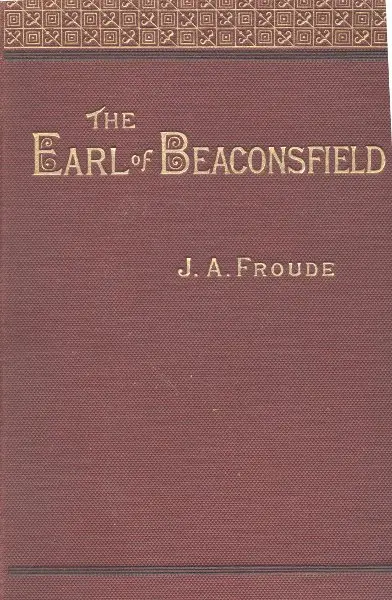
The Earl of Beaconsfield
James Anthony Froude
THE CLASSIC COLLECTION · 1879
"Caesar: A Sketch" by James Anthony Froude is a historical account written in the late 19th century. This work examines the life and historical significance of Julius Caesar, exploring the transition of the Roman Republic into a military empire and the complex political climate of the era. Froude's analysis delves into the societal structures, key figures, and significant events that shaped Rome during Caesar's time, providing insights into both Caesar's character and the broader implications of his leadership. The opening of "Caesar: A Sketch" presents a thorough prelude to the study of Julius Caesar and the fall of the Roman Republic, establishing key themes of political power and moral decay within Roman society. Froude discusses the limited historical resources available for a complete portrait of Caesar, emphasizing the reliance on ancient accounts by figures like Suetonius and Cicero. The text describes how the early Romans had a unique capability for self-governance, contrasting with the later corruption and decline of civic virtue, which ultimately paved the way for Caesar's rise to power. Through an analysis of the institutions and character of the era, Froude underscores the inevitable trends leading to the transformation of Rome from a republic into an autocratic rule, setting the stage for Caesar's historical narrative.
Introduction adapted from the source catalogue; source summaries may be automatically generated.
Free to read · English · 160,700 words · No account needed
MAKE TIME FOR A GOOD BOOK
On by default. Untick to stop anonymous reading totals. Each page counts after 10 seconds in view. How this works.
Anonymous counting is on unless you have switched it off.
"For me, I was always for peace. Caesar was for peace, so was Marcellus. There were violent men among you, whose success Marcellus dreaded. Each party had a cause. I will not compare them. I will compare rather the victory of the one with the possible victory of the other. Caesar's wars ended with the last battle. The sword is now sheathed. Those whom we have lost fell in the fury of the fight, not one by the resentment of the conqueror. Caesar, if he could, would bring back to life many who lie dead. For the others, we all feared what they might do if the day had been theirs. They not only threatened those who were in arms against them, but those who sat quietly at home."
Cicero then said that he had heard a fear of assassination expressed by Caesar. By whom, he asked, could such an attempt be made? Not by those whom he had forgiven, for none were more attached to him. Not by his comrades, for they could not be so mad as to conspire against the general to whom they owed all that they possessed. Not by his enemies, for he had no enemies. Those who had been his enemies were either dead through their own obstinacy, or were alive through his generosity. It was possible, however, he admitted, that there might be some such danger.
"Be you, therefore," he said, again speaking to Caesar,--"be you watchful, and let us be diligent. Who is so careless of his own and the common welfare as to be ignorant that on your preservation his own depends, and that all our lives are bound up in yours? I, as in duty bound, think of you by night and day; I ponder over the accidents of humanity, the uncertainty of health, the frailty of our common nature, and I grieve to think that the Commonwealth which ought to be immortal should hang on the breath of a single man. If to these perils be added a nefarious conspiracy, to what god can we turn for help? War has laid prostrate our institutions; you alone can restore them. The courts of justice need to be reconstituted, credit to be recovered, license to be repressed, the thinned ranks of the citizens to be repaired. The bonds of society are relaxed. In such a war, and with such a temper in men's hearts, the State must have lost many of its greatest ornaments, be the event what it would. These wounds need healing, and you alone can heal them. With sorrow I have heard you say that you have lived long enough. For nature it may be that you have, and perhaps for glory. But for your country you have not. Put away, I beseech you, this contempt of death. Be not wise at our expense. You repeat often, I am told, that you do not wish for longer life. I believe you mean it; nor should I blame you, if you had to think only of yourself. But by your actions you have involved the welfare of each citizen and of the whole Commonwealth in your own. Your work is unfinished: the foundations are hardly laid, and is it for you to be measuring calmly your term of days by your own desires?... If, Caesar, the result of your immortal deeds is to be no more than this, that, after defeating your enemies, you are to leave the State in the condition in which it now stands, your splendid qualities will be more admired than honored. It remains for you to rebuild the constitution. Live till this is done. Live till you see your country tranquil, and at peace. Then, when your last debt is paid, when you have filled the measure of your existence to overflowing, then say, if you will, that you have had enough of life. Your life is not the life which is bounded by the union of your soul and body, your life is that which shall continue fresh in the memory of ages to come, which posterity will cherish, and eternity itself keep guard over. Much has been done which men will admire: much remains to be done, which they can praise. They will read with wonder of empires and provinces, of the Rhine, the ocean, and the Nile, of battles without number, of amazing victories, of countless monuments and triumphs; but unless this Commonwealth be wisely re-established in institutions by you bestowed upon us, your name will travel widely over the world, but will have no stable habitation; and those who come after us will dispute about you as we have disputed. Some will extol you to the skies, others will find something wanting and the most important element of all. Remember the tribunal before which you will hereafter stand. The ages that are to be will try you, with minds, it may be, less prejudiced than ours, uninfluenced either by desire to please you or by envy of your greatness.
Your reading position is saved on this browser. Take it to another device with a library code. Reading pages adapt to text, rather than matching a printed edition.
James Anthony Froude
James Anthony Froude
James Anthony Froude
James Anthony Froude
BEHIND THE BOOK
This eBook is for the use of anyone anywhere in the United States and most other parts of the world at no cost and with almost no restrictions whatsoever. You may copy it, give it away or re-use it under the terms of the Project Gutenberg License included with this eBook or online at www.gutenberg.org. If you are not located in the United States, you will have to check the laws of the country where you are located before using this eBook. Read the source licence.
The original source file, including credits and licence, is retained by this library. Request an original-format copy at no charge. Please include the book title and Project Gutenberg identifier #8425.
KEEP YOUR CURIOSITY GOING
Cécile Tormay

Moritz Busch
John L. Ransom
Frances Wright
Cécile Tormay

Mabel Potter Daggett