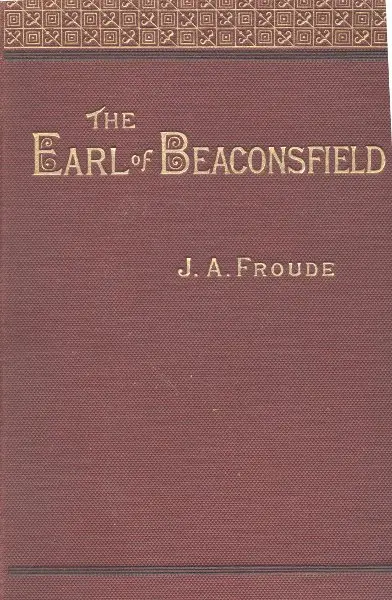
The Earl of Beaconsfield
James Anthony Froude
THE CLASSIC COLLECTION · 1879
"Caesar: A Sketch" by James Anthony Froude is a historical account written in the late 19th century. This work examines the life and historical significance of Julius Caesar, exploring the transition of the Roman Republic into a military empire and the complex political climate of the era. Froude's analysis delves into the societal structures, key figures, and significant events that shaped Rome during Caesar's time, providing insights into both Caesar's character and the broader implications of his leadership. The opening of "Caesar: A Sketch" presents a thorough prelude to the study of Julius Caesar and the fall of the Roman Republic, establishing key themes of political power and moral decay within Roman society. Froude discusses the limited historical resources available for a complete portrait of Caesar, emphasizing the reliance on ancient accounts by figures like Suetonius and Cicero. The text describes how the early Romans had a unique capability for self-governance, contrasting with the later corruption and decline of civic virtue, which ultimately paved the way for Caesar's rise to power. Through an analysis of the institutions and character of the era, Froude underscores the inevitable trends leading to the transformation of Rome from a republic into an autocratic rule, setting the stage for Caesar's historical narrative.
Introduction adapted from the source catalogue; source summaries may be automatically generated.
Free to read · English · 160,700 words · No account needed
MAKE TIME FOR A GOOD BOOK
On by default. Untick to stop anonymous reading totals. Each page counts after 10 seconds in view. How this works.
Anonymous counting is on unless you have switched it off.
Octavius accompanied Caesar into Spain. They travelled in a carriage, having as a third with them the general whom Caesar most trusted and liked, and whom he had named in his will as one of Octavius's guardians, Decimus Brutus--the same officer who had commanded his fleet for him at Quiberon and at Marseilles, and had now been selected as the future governor of Cisalpine Gaul. Once more it was midwinter when they left Rome. They travelled swiftly; and Caesar, as usual, himself brought the news that he was coming. But the winter season did not bring to him its usual advantages, for the whole Peninsula had revolted, and Pompey and Labienus were able to shelter their troops in the towns, while Caesar was obliged to keep the field. Attempts here and there to capture detached positions led to no results. On both sides now the war was carried on upon the principles which the Senate had adopted from the first. Prisoners from the revolted legions were instantly executed, and Cnaeus Pompey murdered the provincials whom he suspected of an inclination for Caesar. Attagona was at last taken. Caesar moved on Cordova; and Pompey, fearing that the important cities might seek their own security by coming separately to terms, found it necessary to risk a battle.
[Sidenote: March 17, B.C. 45.] [Sidenote: B.C. 45.] The scene of the conflict which ended the civil war was the plain of Munda. The day was the 17th of March, B.C. 45. Spanish tradition places Munda on the Mediterranean, near Gibraltar. The real Munda was on the Guadalquiver, so near to Cordova that the remains of the beaten army found shelter within its walls after the battle. Caesar had been so invariably victorious in his engagements in the open field that the result might have been thought a foregone conclusion. Legendary history reported in the next generation that the elements had been pregnant with auguries. Images had sweated; the sky had blazed with meteors; celestial armies, the spirits of the past and future, had battled among the constellations. The signs had been unfavorable to the Pompeians; the eagles of their legions had dropped the golden thunderbolts from their talons, spread their wings, and had flown away to Caesar. In reality, the eagles had remained in their places till the standards fell from the hands of their dead defenders; and the battle was one of the most desperate in which Caesar had ever been engaged. The numbers were nearly equal--the material on both sides equally good. Pompey's army was composed of revolted Roman soldiers. In arms, in discipline, in stubborn fierceness, there was no difference. The Pompeians had the advantage of situation, the village of Munda, with the hill on which it stood, being in the centre of their lines. The Moorish and Spanish auxiliaries, of whom there were large bodies on either side, stood apart when the legions closed; they having no further interest in the matter than in siding with the conqueror, when fortune had decided who the conqueror was to be. There were no manoeuvres; no scientific evolutions. The Pompeians knew that there was no hope for them if they were defeated. Caesar's men, weary and savage at the protraction of the war, were determined to make a last end of it; and the two armies fought hand to hand with their short swords, with set teeth and pressed lips, opened only with a sharp cry as an enemy fell dead. So equal was the struggle, so doubtful at one moment the issue of it, that Caesar himself sprang from his horse, seized a standard, and rallied a wavering legion. It seemed as if the men meant all to stand and kill or be killed as long as daylight lasted. The ill fate of Labienus decided the victory. He had seen, as he supposed, some movement which alarmed him among Caesar's Moorish auxiliaries, and had galloped conspicuously across the field to lead a division to check them. A shout rose, "He flies--he flies!" A panic ran along the Pompeian lines. They gave way, and Caesar's legions forced a road between their ranks. One wing broke off and made for Cordova; the rest plunged wildly within the ditch and walls of Munda, the avenging sword smiting behind into the huddled mass of fugitives. Scarcely a prisoner was taken. Thirty thousand fell on the field, among them three thousand Roman knights, the last remains of the haughty youths who had threatened Caesar with their swords in the senate-house, and had hacked Clodius's mob in the Forum. Among them was slain Labienus--his desertion of his general, his insults and his cruelties to his comrades, expiated at last in his own blood. Attius Varus was killed also, who had been with Juba when he destroyed Curio. The tragedy was being knitted up in the deaths of the last actors in it. The eagles of the thirteen legions were all taken. The two Pompeys escaped on their horses, Sextus disappearing in the mountains of Grenada or the Sierra Morena; Cnaeus flying for Gibraltar, where he hoped to find a friendly squadron.
Your reading position is saved on this browser. Take it to another device with a library code. Reading pages adapt to text, rather than matching a printed edition.
James Anthony Froude
James Anthony Froude
James Anthony Froude
James Anthony Froude
BEHIND THE BOOK
This eBook is for the use of anyone anywhere in the United States and most other parts of the world at no cost and with almost no restrictions whatsoever. You may copy it, give it away or re-use it under the terms of the Project Gutenberg License included with this eBook or online at www.gutenberg.org. If you are not located in the United States, you will have to check the laws of the country where you are located before using this eBook. Read the source licence.
The original source file, including credits and licence, is retained by this library. Request an original-format copy at no charge. Please include the book title and Project Gutenberg identifier #8425.
KEEP YOUR CURIOSITY GOING
Cécile Tormay

Moritz Busch
John L. Ransom
Frances Wright
Cécile Tormay

Mabel Potter Daggett