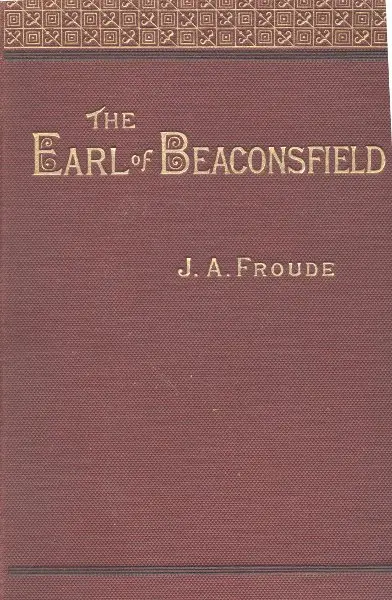
The Earl of Beaconsfield
James Anthony Froude
THE CLASSIC COLLECTION · 1879
"Caesar: A Sketch" by James Anthony Froude is a historical account written in the late 19th century. This work examines the life and historical significance of Julius Caesar, exploring the transition of the Roman Republic into a military empire and the complex political climate of the era. Froude's analysis delves into the societal structures, key figures, and significant events that shaped Rome during Caesar's time, providing insights into both Caesar's character and the broader implications of his leadership. The opening of "Caesar: A Sketch" presents a thorough prelude to the study of Julius Caesar and the fall of the Roman Republic, establishing key themes of political power and moral decay within Roman society. Froude discusses the limited historical resources available for a complete portrait of Caesar, emphasizing the reliance on ancient accounts by figures like Suetonius and Cicero. The text describes how the early Romans had a unique capability for self-governance, contrasting with the later corruption and decline of civic virtue, which ultimately paved the way for Caesar's rise to power. Through an analysis of the institutions and character of the era, Froude underscores the inevitable trends leading to the transformation of Rome from a republic into an autocratic rule, setting the stage for Caesar's historical narrative.
Introduction adapted from the source catalogue; source summaries may be automatically generated.
Free to read · English · 160,700 words · No account needed
MAKE TIME FOR A GOOD BOOK
On by default. Untick to stop anonymous reading totals. Each page counts after 10 seconds in view. How this works.
Anonymous counting is on unless you have switched it off.
"Quirites" he had called them; no longer Roman legionaries, proud of their achievements, and glorying in their great commander, but "quirites"--plain citizens. The sight of Caesar, the familiar form and voice, the words, every sentence of which they knew that he meant, cut them to the heart. They were humbled, they begged to be forgiven. They said they would go with him to Africa, or to the world's end. He did not at once accept their penitence. He told them that lands had been allotted to every soldier out of the ager publicus, or out of his own personal estates. Suetonius says that the sections had been carefully taken so as not to disturb existing occupants; and thus it appeared that he had been thinking of them and providing for them when they supposed themselves forgotten. Money, too, he had ready for each, part in hand, part in bonds bearing interest, to be redeemed when the war should be over. Again, passionately, they implored to be allowed to continue with him. He relented, but not entirely.
"Let all go who wish to go," he said; "I will have none serve with me
who serve unwillingly."
"All, all!" they cried; "not one of us will leave you"--and not one went. The mutiny was the greatest peril, perhaps, to which Caesar had ever been exposed. No more was said; but Caesar took silent notice of the officers who had encouraged the discontented spirit. In common things, Dion Cassius says, he was the kindest and most considerate of commanders. He passed lightly over small offences; but military rebellion in those who were really responsible he never forgave.
[Sidenote: B.C. 46.] The African business could now be attended to. It was again midwinter. Winter campaigns were trying, but Caesar had hitherto found them answer to him; the enemy had suffered more than himself; while, as long as an opposition Senate was sitting across the Mediterranean, intrigue and conspiracy made security impossible at home. Many a false spirit now fawning at home on Caesar was longing for his destruction. The army with which he would have to deal was less respectable than that which Pompey had commanded at Durazzo, but it was numerically as strong or stronger. Cato, assisted by Labienus, had formed into legions sixty thousand Italians. They had a hundred and twenty elephants, and African cavalry in uncounted multitudes. Caesar perhaps despised an enemy too much whom he had so often beaten. He sailed from Lilybaeum on the 19th of December, with a mere handful of men, leaving the rest of his troops to follow as they could. No rendezvous had been positively fixed, for between the weather and the enemy it was uncertain where the troops would be able to land, and the generals of the different divisions were left to their discretion. Caesar on arriving seized and fortified a defensible spot at Ruspinum.[3] The other legions dropped in slowly, and before a third of them had arrived the enemy were swarming about the camp, while the Pompeys were alert on the water to seize stray transports or provision ships. There was skirmishing every day in front of Caesar's lines. The Numidian horse surrounded his thin cohorts like swarms of hornets. Labienus himself rode up on one occasion to a battalion which was standing still under a shower of arrows, and asked in mockery who they were. A soldier of the 10th legion lifted his cap that his face might be recognized, hurled his javelin for answer, and brought Labienus's horse to the ground. But courage was of no avail in the face of overwhelming numbers. Scipio's army collected faster than Caesar's, and Caesar's young soldiers showed some uneasiness in a position so unexpected. Caesar, however, was confident and in high spirits.[4] Roman residents in the African province came gradually in to him, and some African tribes, out of respect, it was said, for the memory of Marius. A few towns declared against the Senate in indignation at Scipio's promise that the province was to be abandoned to Juba. Scipio replied with burning the Roman country houses and wasting the lands, and still killing steadily every friend of Caesar that he could lay hands on. Caesar's steady clemency had made no difference. The senatorial faction went on as they had begun till at length their ferocity was repaid upon them.
Your reading position is saved on this browser. Take it to another device with a library code. Reading pages adapt to text, rather than matching a printed edition.
James Anthony Froude
James Anthony Froude
James Anthony Froude
James Anthony Froude
BEHIND THE BOOK
This eBook is for the use of anyone anywhere in the United States and most other parts of the world at no cost and with almost no restrictions whatsoever. You may copy it, give it away or re-use it under the terms of the Project Gutenberg License included with this eBook or online at www.gutenberg.org. If you are not located in the United States, you will have to check the laws of the country where you are located before using this eBook. Read the source licence.
The original source file, including credits and licence, is retained by this library. Request an original-format copy at no charge. Please include the book title and Project Gutenberg identifier #8425.
KEEP YOUR CURIOSITY GOING
Cécile Tormay

Moritz Busch
John L. Ransom
Frances Wright
Cécile Tormay

Mabel Potter Daggett