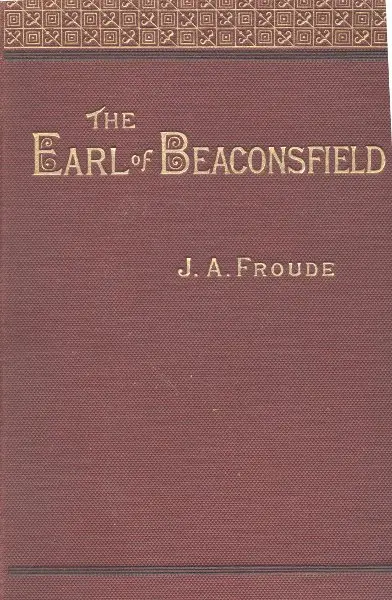
The Earl of Beaconsfield
James Anthony Froude
THE CLASSIC COLLECTION · 1879
"Caesar: A Sketch" by James Anthony Froude is a historical account written in the late 19th century. This work examines the life and historical significance of Julius Caesar, exploring the transition of the Roman Republic into a military empire and the complex political climate of the era. Froude's analysis delves into the societal structures, key figures, and significant events that shaped Rome during Caesar's time, providing insights into both Caesar's character and the broader implications of his leadership. The opening of "Caesar: A Sketch" presents a thorough prelude to the study of Julius Caesar and the fall of the Roman Republic, establishing key themes of political power and moral decay within Roman society. Froude discusses the limited historical resources available for a complete portrait of Caesar, emphasizing the reliance on ancient accounts by figures like Suetonius and Cicero. The text describes how the early Romans had a unique capability for self-governance, contrasting with the later corruption and decline of civic virtue, which ultimately paved the way for Caesar's rise to power. Through an analysis of the institutions and character of the era, Froude underscores the inevitable trends leading to the transformation of Rome from a republic into an autocratic rule, setting the stage for Caesar's historical narrative.
Introduction adapted from the source catalogue; source summaries may be automatically generated.
Free to read · English · 160,700 words · No account needed
MAKE TIME FOR A GOOD BOOK
On by default. Untick to stop anonymous reading totals. Each page counts after 10 seconds in view. How this works.
Anonymous counting is on unless you have switched it off.
"Caesar was but mortal!" The rapture with which Cicero hailed Caesar's eventual murder explains too clearly the direction in which his thoughts were already running. If the life of Caesar alone stood between his country and the resurrection of the constitution, Cicero might well think, as others have done, that it was better that one man should die rather than the whole nation perish. We read the words with sorrow, and yet with pity. That Cicero, after his past flatteries of Caesar, after the praises which he was yet to heap on him, should yet have looked on his assassination as a thing to be desired, throws a saddening light upon his inner nature. But the age was sick with a moral plague, and neither strong nor weak, wise nor unwise, bore any antidote against infection.
[1] The vision on the Rubicon, with the celebrated saying that "the die is cast," is unauthenticated, and not at all consistent with Caesar's character.
[2] Ibid., vii. 12.
[3] "Delectus ... invitorum est et pugnando ab horrentium."--To
Atticus, vii. 13.
[4] Compare Caesar's account of these conditions, De Bello Civili, i. 10, with Cicero to Atticus, vii. 17.
[5] Between the Apennines and the Adriatic, about Ancona; in the line of Caesar's march should he advance from Kimini.
[6] To Atticus, vii. 16.
[7] Ibid., vii. 21.
[8] "Balbus quidem major ad me scribit, nihil malle Caesarem, quam principe Pompeio sine metu vivere. Tu puto haec credis."--To Atticus, viii. 9.
[9] To Atticus, viii. 3.
[10] To Atticus, viii. 11.
[11] "Judicavique te bello violari, contra cujus honorem, populi Romani beneficio concessum, inimici atque invidi niterentur. Sed ut eo tempore non modo ipse fautor dignitatis tuae fui, verum etiam caeteris auctor ad te adjuvandum, sic me nunc Pompeii dignitas vehementer movet," etc.--Cicero to Caesar, enclosed in a letter to Atticus, ix. 11.
[12] Enclosed to Atticus, viii. 11.
[13] Pompey had for two years meditated on the course which he was now taking. Atticus had spoken of the intended flight from Italy as base. Cicero answers: "Hoc turpe Cnaeus noster biennio ante cogitavit: ita Sullaturit animus ejus, et diu proscripturit;" "so he apes Sylla and longs for a proscription."--To Atticus, ix. 10.
[14] To Atticus, viii. 13.
[15] Enclosed to Atticus, viii. 15.
[16] To Atticus, viii. 16.
[17] To Atticus, ix. 4.
[18] Ibid., ix. 6.
[19] To Atticus, ix. 7 and 9.
[20] Ibid.
[21] "Ita dies et noctes tanquam avis illa mare prospecto, evolare
cupio."
[22] "Hunc primum mortalem esse, deinde etiam multis modis extingui posse cogitabam."--To Atticus, ix. 10.
Your reading position is saved on this browser. Take it to another device with a library code. Reading pages adapt to text, rather than matching a printed edition.
James Anthony Froude
James Anthony Froude
James Anthony Froude
James Anthony Froude
BEHIND THE BOOK
This eBook is for the use of anyone anywhere in the United States and most other parts of the world at no cost and with almost no restrictions whatsoever. You may copy it, give it away or re-use it under the terms of the Project Gutenberg License included with this eBook or online at www.gutenberg.org. If you are not located in the United States, you will have to check the laws of the country where you are located before using this eBook. Read the source licence.
The original source file, including credits and licence, is retained by this library. Request an original-format copy at no charge. Please include the book title and Project Gutenberg identifier #8425.
KEEP YOUR CURIOSITY GOING
Cécile Tormay

Moritz Busch
John L. Ransom
Frances Wright
Cécile Tormay

Mabel Potter Daggett