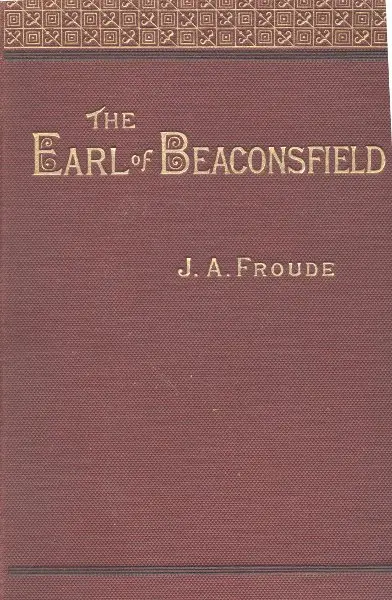
The Earl of Beaconsfield
James Anthony Froude
THE CLASSIC COLLECTION · 1879
"Caesar: A Sketch" by James Anthony Froude is a historical account written in the late 19th century. This work examines the life and historical significance of Julius Caesar, exploring the transition of the Roman Republic into a military empire and the complex political climate of the era. Froude's analysis delves into the societal structures, key figures, and significant events that shaped Rome during Caesar's time, providing insights into both Caesar's character and the broader implications of his leadership. The opening of "Caesar: A Sketch" presents a thorough prelude to the study of Julius Caesar and the fall of the Roman Republic, establishing key themes of political power and moral decay within Roman society. Froude discusses the limited historical resources available for a complete portrait of Caesar, emphasizing the reliance on ancient accounts by figures like Suetonius and Cicero. The text describes how the early Romans had a unique capability for self-governance, contrasting with the later corruption and decline of civic virtue, which ultimately paved the way for Caesar's rise to power. Through an analysis of the institutions and character of the era, Froude underscores the inevitable trends leading to the transformation of Rome from a republic into an autocratic rule, setting the stage for Caesar's historical narrative.
Introduction adapted from the source catalogue; source summaries may be automatically generated.
Free to read · English · 160,700 words · No account needed
MAKE TIME FOR A GOOD BOOK
On by default. Untick to stop anonymous reading totals. Each page counts after 10 seconds in view. How this works.
Anonymous counting is on unless you have switched it off.
The capture of Corfinium and the desertion of the garrison made an end of hesitation. Pompey and the consuls thought only of instant flight, and hurried to Brindisi, where ships were waiting for them; and Caesar, hoping that the evident feeling of Italy would have its effect with the reasonable part of the Senate, sent Cornelius Balbus, who was on intimate terms with many of them, to assure them of his eagerness for peace, and to tell Cicero especially that he would be well contented to live under Pompey's rule if he could have a guarantee for his personal safety.[8]
[Sidenote: March B.C. 49.] Cicero's trials had been great, and were not diminishing. The account given by Balbus was simply incredible to him. If Caesar was really as well disposed as Balbus represented, then the senatorial party, himself included, had acted like a set of madmen. It might be assumed, therefore, that Caesar was as meanly ambitious, as selfish, as revolutionary as their fears had represented him, and that his mildness was merely affectation. But what then? Cicero wished for himself to be on the right side, but also to be on the safe side. Pompey's was the right side, the side, that is, which, for his own sake, he would prefer to see victorious. But was Pompey's the safe side? or rather, would it be safe to go against him? The necessity for decision was drawing closer. If Pompey and the consuls went abroad, all loyal senators would be expected to follow them, and to stay behind would be held treason. Italy was with Caesar; but the East, with its treasures, its fleets, its millions of men, this was Pompey's, heart and soul. The sea was Pompey's. Caesar might win for the moment, but Pompey might win in the long run. The situation was most perplexing. Before the fall of Corfinium, Cicero had poured himself out upon it to his friend. "My connections, personal and political," he said, "attach me to Pompey. If I stay behind, I desert my noble and admirable companions, and I fall into the power of a man whom I know not how far I can trust. He shows in many ways that he wishes me well. I saw the tempest impending, and I long ago took care to secure his good-will. But suppose him to be my friend indeed, is it becoming in a good and valiant citizen, who has held the highest offices and done such distinguished things, to be in the power of any man? Ought I to expose myself to the danger, and perhaps disgrace, which would lie before me, should Pompey recover his position? This on one side; but now look at the other. Pompey has shown neither conduct nor courage, and he has acted throughout against my advice and judgment. I pass over his old errors: how he himself armed this man against the constitution; how he supported his laws by violence in the face of the auspices; how he gave him Further Gaul, married his daughter, supported Clodius, helped me back from exile indeed, but neglected me afterward; how he prolonged Caesar's command, and backed him up in everything; how in his third consulship, when he had begun to defend the constitution, he yet moved the tribunes to curry a resolution for taking Caesar's name in his absence, and himself sanctioned it by a law of his own; how he resisted Marcus Marcellus, who would have ended Caesar's government on the 1st of March. Let us forget all this: but what was ever more disgraceful than the flight from Rome? What conditions would not have been preferable? He will restore the constitution, you say, but when? by what means? Is not Picenum lost? Is not the road open to the city? Is not our money, public and private, all the enemy's? There is no cause, no rallying point for the friends of the constitution.... The rabble are all for Caesar, and many wish for revolution.... I saw from the first that Pompey only thought of flight: if I now follow him, whither are we to go? Caesar will seize my brother's property and mine, ours perhaps sooner than others', as an assault on us would be popular. If I stay, I shall do no more than many good men did in Cinna's time.--Caesar may be my friend, not certainly, but perhaps; and he may offer me a triumph which it would be dangerous to refuse, and invidious with the "good" to accept. Oh, most perplexing position!--while I write, word comes that Caesar is at Corfinium. Domitius is inside, with a strong force and eager to fight. I cannot think Pompey will desert him." [9]
Your reading position is saved on this browser. Take it to another device with a library code. Reading pages adapt to text, rather than matching a printed edition.
James Anthony Froude
James Anthony Froude
James Anthony Froude
James Anthony Froude
BEHIND THE BOOK
This eBook is for the use of anyone anywhere in the United States and most other parts of the world at no cost and with almost no restrictions whatsoever. You may copy it, give it away or re-use it under the terms of the Project Gutenberg License included with this eBook or online at www.gutenberg.org. If you are not located in the United States, you will have to check the laws of the country where you are located before using this eBook. Read the source licence.
The original source file, including credits and licence, is retained by this library. Request an original-format copy at no charge. Please include the book title and Project Gutenberg identifier #8425.
KEEP YOUR CURIOSITY GOING
Cécile Tormay

Moritz Busch
John L. Ransom
Frances Wright
Cécile Tormay

Mabel Potter Daggett