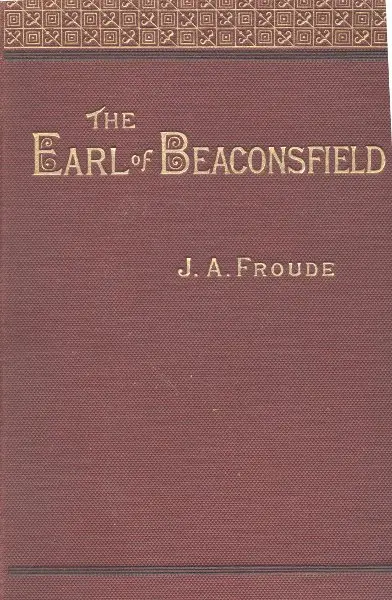
The Earl of Beaconsfield
James Anthony Froude
THE CLASSIC COLLECTION · 1879
"Caesar: A Sketch" by James Anthony Froude is a historical account written in the late 19th century. This work examines the life and historical significance of Julius Caesar, exploring the transition of the Roman Republic into a military empire and the complex political climate of the era. Froude's analysis delves into the societal structures, key figures, and significant events that shaped Rome during Caesar's time, providing insights into both Caesar's character and the broader implications of his leadership. The opening of "Caesar: A Sketch" presents a thorough prelude to the study of Julius Caesar and the fall of the Roman Republic, establishing key themes of political power and moral decay within Roman society. Froude discusses the limited historical resources available for a complete portrait of Caesar, emphasizing the reliance on ancient accounts by figures like Suetonius and Cicero. The text describes how the early Romans had a unique capability for self-governance, contrasting with the later corruption and decline of civic virtue, which ultimately paved the way for Caesar's rise to power. Through an analysis of the institutions and character of the era, Froude underscores the inevitable trends leading to the transformation of Rome from a republic into an autocratic rule, setting the stage for Caesar's historical narrative.
Introduction adapted from the source catalogue; source summaries may be automatically generated.
Free to read · English · 160,700 words · No account needed
MAKE TIME FOR A GOOD BOOK
On by default. Untick to stop anonymous reading totals. Each page counts after 10 seconds in view. How this works.
Anonymous counting is on unless you have switched it off.
"Is there hope of peace?" he wrote, in reporting what had passed. "So far as I can gather from his very full expressions to me, he does not desire it. For he thinks thus: If Caesar be made consul, even after he has parted from his army, the constitution will be at an end. He thinks also that when Caesar hears of the preparations against him, he will drop the consulship for this year, to keep his province and his troops. Should he be so insane as to try extremities, Pompey holds him in utter contempt. I thought, when he was speaking, of the uncertainties of war; but I was relieved to hear a man of courage and experience talk like a statesman of the dangers of an insincere settlement.--Not only he does not seek for peace, but he seems to fear it.--My own vexation is, that I must pay Caesar my debt, and spend thus what I had set apart for my triumph. It is indecent to owe money to a political antagonist." [13]
Events were hurrying on. Cicero entered Rome the first week in January, to find that the Senate had begun work in earnest. Curio had returned from Ravenna with a letter from Caesar. He had offered three alternatives. First, that the agreement already made might stand, and that he might be nominated, in his absence, for the consulship; or that when he left his army, Pompey should disband his Italian legions; or, lastly, that he should hand over Transalpine Gaul to his successor, with eight of his ten legions, himself keeping the north of Italy and Illyria with two, until his election. It was the first of January. The new consuls, Lentulus and Caius Marcellus, with the other magistrates, had entered on their offices, and were in their places in the Senate. Pompey was present, and the letter was introduced. The consuls objected to it being read, but they were overruled by the remonstrances of the tribunes. The reading over, the consuls forbade a debate upon it, and moved that the condition of the Commonwealth should be taken into consideration. Lentulus, the more impassioned of them, said that if the Senate would be firm, he would do his duty; if they hesitated and tried conciliation, he should take care of himself, and go over to Caesar's side. Metellus Scipio, Pompey's father-in-law, spoke to the same purpose. Pompey, he said, was ready to support the constitution, if the Senate were resolute. If they wavered, they would look in vain for future help from him. Marcus Marcellus, the consul of the preceding year, less wild than he had been when he flogged the Como citizen, advised delay, at least till Pompey was better prepared. Calidius, another senator, moved that Pompey should go to his province. Caesar's resentment at the detention of the two legions from the Parthian war he thought, was natural and justifiable. Marcus Rufus agreed with Calidius. But moderation was borne down by the violence of Lentulus; and the Senate, in spite of themselves,[14] voted, at Scipio's dictation, that Caesar must dismiss his army before a day which was to be fixed, or, in default, would be declared an enemy to the State. Two tribunes, Mark Antony and Cassius Longinus, interposed. The tribunes' veto was as old as their institution. It had been left standing even by Sylla. But the aristocracy were declaring war against the people. They knew that the veto was coming, and they had resolved to disregard it. The more passionate the speakers, the more they were cheered by Caesar's enemies. The sitting ended in the evening without a final conclusion; but at a meeting afterwards, at his house, Pompey quieted alarms by assuring the senators that there was nothing to fear. Caesar's army he knew to be disaffected. He introduced the officers of the two legions that had been taken from Caesar, who vouched for their fidelity to the constitution. Some of Pompey's veterans were present, called up from their farms; they were enthusiastic for their old commander. Piso, Caesar's father-in-law, and Roscius, a praetor, begged for a week's delay, that they might go to Caesar, and explain the Senate's pleasure. Others proposed to send a deputation to soften the harshness of his removal. But Lentulus, backed by Cato, would listen to nothing. Cato detested Caesar as the representative of everything which he most abhorred. Lentulus, bankrupt and loaded with debts, was looking for provinces to ruin, and allied sovereigns to lay presents at his feet. He boasted that he would be a second Sylla.[15] When the Senate met again in their places, the tribunes' veto was disallowed. They ordered a general levy through Italy. The consuls gave Pompey the command-in-chief, with the keys of the treasury. The Senate redistributed the provinces; giving Syria to Scipio, and in Caesar's place appointing Domitius Ahenobarbus, the most inveterate and envenomed of his enemies. Their authority over the provinces had been taken from them by law, but law was set aside. Finally, they voted the State in danger, suspended the constitution, and gave the consuls absolute power.
Your reading position is saved on this browser. Take it to another device with a library code. Reading pages adapt to text, rather than matching a printed edition.
James Anthony Froude
James Anthony Froude
James Anthony Froude
James Anthony Froude
BEHIND THE BOOK
This eBook is for the use of anyone anywhere in the United States and most other parts of the world at no cost and with almost no restrictions whatsoever. You may copy it, give it away or re-use it under the terms of the Project Gutenberg License included with this eBook or online at www.gutenberg.org. If you are not located in the United States, you will have to check the laws of the country where you are located before using this eBook. Read the source licence.
The original source file, including credits and licence, is retained by this library. Request an original-format copy at no charge. Please include the book title and Project Gutenberg identifier #8425.
KEEP YOUR CURIOSITY GOING
Cécile Tormay

Moritz Busch
John L. Ransom
Frances Wright
Cécile Tormay

Mabel Potter Daggett