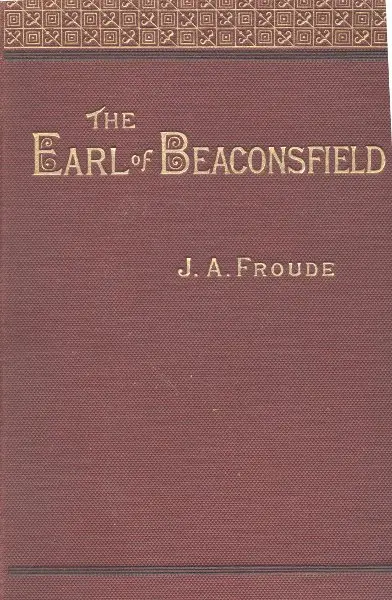
The Earl of Beaconsfield
James Anthony Froude
THE CLASSIC COLLECTION · 1879
"Caesar: A Sketch" by James Anthony Froude is a historical account written in the late 19th century. This work examines the life and historical significance of Julius Caesar, exploring the transition of the Roman Republic into a military empire and the complex political climate of the era. Froude's analysis delves into the societal structures, key figures, and significant events that shaped Rome during Caesar's time, providing insights into both Caesar's character and the broader implications of his leadership. The opening of "Caesar: A Sketch" presents a thorough prelude to the study of Julius Caesar and the fall of the Roman Republic, establishing key themes of political power and moral decay within Roman society. Froude discusses the limited historical resources available for a complete portrait of Caesar, emphasizing the reliance on ancient accounts by figures like Suetonius and Cicero. The text describes how the early Romans had a unique capability for self-governance, contrasting with the later corruption and decline of civic virtue, which ultimately paved the way for Caesar's rise to power. Through an analysis of the institutions and character of the era, Froude underscores the inevitable trends leading to the transformation of Rome from a republic into an autocratic rule, setting the stage for Caesar's historical narrative.
Introduction adapted from the source catalogue; source summaries may be automatically generated.
Free to read · English · 160,700 words · No account needed
MAKE TIME FOR A GOOD BOOK
On by default. Untick to stop anonymous reading totals. Each page counts after 10 seconds in view. How this works.
Anonymous counting is on unless you have switched it off.
The desertion of their own tribune was a serious blow to the Senate. Caelius, who was to be praetor, was inclining to think that Caesar would win, and therefore might take his side also. The constitutional opposition would then be extremely strong; and even Pompey, fiercely as he had spoken, doubted what to do. The question was raised in the Senate, whether the tribunes' vetoes were to be regarded. Marcellus, who had flogged the citizen of Como, voted for defying them, but the rest were timid. Pompey did not know his own mind.[7] Caelius's account of his own feelings in the matter represented probably those of many besides himself.
"In civil quarrels," he wrote to Cicero, "we ought to go with the most honest party, as long as the contest lies within constitutional limits. When it is an affair of camps and battles, we must go with the strongest. Pompey will have the Senate and the men of consideration with him. All the discontented will go with Caesar. I must calculate the forces on both sides, before I decide on my own part." [8]
When the question next came on in the Senate, Curio, being of course instructed in Caesar's wishes, professed to share the anxiety lest there should be a military Dictatorship; but he said that the danger was as great from Pompey as from Caesar. He did not object to the recall of Caesar, but Pompey, he thought, should resign his province also, and the Constitution would then be out of peril. Pompey professed to be willing, if the Senate desired it; but he insisted that Caesar must take the first step. Curio's proposal was so fair, that it gained favor both in Forum and Senate. The populace, who hated Pompey, threw flowers upon the tribune as he passed. Marcellus, the consul, a few days later, put the question in the Senate: Was Caesar to be recalled? A majority answered Yes. Was Pompey to be deprived of his province? The same majority said No. Curio then proposed that both Pompey and Caesar should dismiss their armies. Out of three hundred and ninety-two senators present, three hundred and seventy agreed. Marcellus told them bitterly that they had voted themselves Caesar's slaves. But they were not all insane with envy and hatred, and in the midst of their terrors they retained some prudence, perhaps some conscience and sense of justice. By this time, however, the messengers who had been sent to communicate the Senate's views to Caesar had returned. They brought no positive answer from himself; but they reported that Caesar's troops were worn out and discontented, and certainly would refuse to support him in any violent action. How false their account of the army was, the Senate had soon reason to know; but it was true that one, and he the most trusted officer that Caesar had, Labienus, who had fought through so many battles with him in the Forum as well as in the field, whose high talents and character his Commentaries could never praise sufficiently--it was true that Labienus had listened to the offers made to him. Labienus had made a vast fortune in the war. He perhaps thought, as other distinguished officers have done, that he was the person that had won the victories; that without him Caesar, who was being so much praised and glorified, would have been nothing; and that he at least was entitled to an equal share of the honors and rewards that might be coming; while if Caesar was to be disgraced, he might have the whole recompense for himself. Caesar heard of these overtures; but he had refused to believe that Labienus could be untrue to him. He showed his confidence, and he showed at the same time the integrity of his own intentions, by appointing the officer who was suspected of betraying him Lieutenant-General of the Cisalpine Province. None the less it was true that Labienus had been won over. Labienus had undertaken for his comrades; and the belief that Caesar could not depend on his troops renewed Pompey's courage and gave heart to the faction which wished to precipitate extremities. The aspect of things was now altered. What before seemed rash and dangerous might be safely ventured. Caesar had himself followed the messengers to Ravenna. To raise the passions of men to the desired heat, a report was spread that he had brought his troops across and was marching on Rome. Curio hastened off to him, to bring back under his own hand a distinct declaration of his views.
Your reading position is saved on this browser. Take it to another device with a library code. Reading pages adapt to text, rather than matching a printed edition.
James Anthony Froude
James Anthony Froude
James Anthony Froude
James Anthony Froude
BEHIND THE BOOK
This eBook is for the use of anyone anywhere in the United States and most other parts of the world at no cost and with almost no restrictions whatsoever. You may copy it, give it away or re-use it under the terms of the Project Gutenberg License included with this eBook or online at www.gutenberg.org. If you are not located in the United States, you will have to check the laws of the country where you are located before using this eBook. Read the source licence.
The original source file, including credits and licence, is retained by this library. Request an original-format copy at no charge. Please include the book title and Project Gutenberg identifier #8425.
KEEP YOUR CURIOSITY GOING
Cécile Tormay

Moritz Busch
John L. Ransom
Frances Wright
Cécile Tormay

Mabel Potter Daggett