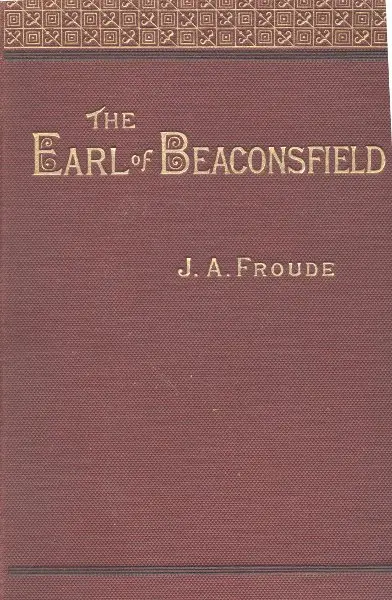
The Earl of Beaconsfield
James Anthony Froude
THE CLASSIC COLLECTION · 1879
"Caesar: A Sketch" by James Anthony Froude is a historical account written in the late 19th century. This work examines the life and historical significance of Julius Caesar, exploring the transition of the Roman Republic into a military empire and the complex political climate of the era. Froude's analysis delves into the societal structures, key figures, and significant events that shaped Rome during Caesar's time, providing insights into both Caesar's character and the broader implications of his leadership. The opening of "Caesar: A Sketch" presents a thorough prelude to the study of Julius Caesar and the fall of the Roman Republic, establishing key themes of political power and moral decay within Roman society. Froude discusses the limited historical resources available for a complete portrait of Caesar, emphasizing the reliance on ancient accounts by figures like Suetonius and Cicero. The text describes how the early Romans had a unique capability for self-governance, contrasting with the later corruption and decline of civic virtue, which ultimately paved the way for Caesar's rise to power. Through an analysis of the institutions and character of the era, Froude underscores the inevitable trends leading to the transformation of Rome from a republic into an autocratic rule, setting the stage for Caesar's historical narrative.
Introduction adapted from the source catalogue; source summaries may be automatically generated.
Free to read · English · 160,700 words · No account needed
MAKE TIME FOR A GOOD BOOK
On by default. Untick to stop anonymous reading totals. Each page counts after 10 seconds in view. How this works.
Anonymous counting is on unless you have switched it off.
Clodius was a licensed libertine; but license has its limits. He had been useful so far; but a rein was wanted for him, and Pompey decided at last that Cicero might now be recalled. Clodius's term of office ran out. The tribunes for the new year were well disposed to Cicero. The new consuls were Lentulus, a moderate aristocrat, and Cicero's personal friend, and Metellus Nepos, who would do what Pompey told him. Caesar had been consulted by letter and had given his assent. Cicero, it might be thought, had learnt his lesson, and there was no desire of protracting his penance. There were still difficulties, however. Cicero, smarting from wrath and mortification, was more angry with the aristocrats, who had deserted him, than with his open enemies. His most intimate companions, he bitterly said, had been false to him. He was looking regretfully on Caesar's offers,[4] and cursing his folly for having rejected them. The people, too, would not sacrifice their convictions at the first bidding for the convenience of their leaders; and had neither forgotten nor forgiven the killing of the Catiline conspirators; while Cicero, aware of the efforts which were being made, had looked for new allies in an imprudent quarter. His chosen friend on the conservative side was now Annius Milo, one of the new tribunes, a man as disreputable as Clodius himself; deep in debt and looking for a province to indemnify himself--famous hitherto in the schools of gladiators, in whose arts he was a proficient, and whose services were at his disposal for any lawless purpose.
[Sidenote: B.C. 57.] A decree of banishment could only be recalled by the people who had pronounced it. Clodius, though no longer in office, was still the idol of the mob; and two of the tribunes, who were at first well inclined to Cicero, had been gained over by him. As early as possible, on the first day of the new year, Lentulus Spinther brought Cicero's case before the Senate. A tribune reminded him of a clause, attached to the sentence of exile, that no citizen should in future move for its repeal. The Senate hesitated, perhaps catching at the excuse; but at length, after repeated adjournments, they voted that the question should be proposed to the Assembly. The day fixed was the 25th of January. In anticipation of a riot the temples on the Forum were occupied with guards. The Forum itself and the senate-house were in possession of Clodius and his gang. Clodius maintained that the proposal to be submitted to the people was itself illegal, and ought to be resisted by force. Fabricius, one of the tribunes, had been selected to introduce it. When Fabricius presented himself on the Rostra, there was a general rush to throw him down. The Forum was in theory still a sacred spot, where the carrying of arms was forbidden; but the new age had forgotten such obsolete superstitions. The guards issued out of the temples with drawn swords. The people were desperate and determined. Hundreds were killed on both sides; Quintus Cicero, who was present for his brother, narrowly escaping with life. The Tiber, Cicero says--perhaps with some exaggeration--was covered with floating bodies; the sewers were choked; the bloody area of the Forum had to be washed with sponges. Such a day had not been seen in Rome since the fight between Cinna and Octavius.[5] The mob remained masters of the field, and Cicero's cause had to wait for better times. Milo had been active in the combat, and Clodius led his victorious bands to Milo's house to destroy it. Milo brought an action against him for violence; but Clodius was charmed even against forms of law. There was no censor as yet chosen, and without a censor the praetors pretended that they could not entertain the prosecution. Finding law powerless, Milo imitated his antagonist. He, too, had his band of gladiators about him; and the streets of the Capital were entertained daily by fights between the factions of Clodius and Milo. The Commonwealth of the Scipios, the laws and institutions of the mistress of the civilized world, had become the football of ruffians. Time and reflection brought some repentance at last. Toward the summer "the cause of order" rallied. The consuls and Pompey exerted themselves to reconcile the more respectable citizens to Cicero's return; and, with the ground better prepared, the attempt was renewed with more success. In July the recall was again proposed in the Senate, and Clodius was alone in opposing it. When it was laid before the Assembly, Clodius made another effort; but voters had been brought up from other parts of Italy who outnumbered the city rabble; Milo and his gladiators were in force to prevent another burst of violence; and the great orator and statesman was given back to his country. Sixteen months he had been lamenting himself in Greece, bewailing his personal ill-treatment. He was the single object of his own reflections. In his own most sincere convictions he was the centre on which the destinies of Rome revolved. He landed at Brindisi on the 5th of August. His pardon had not yet been decreed, though he knew that it was coming. The happy news arrived in a day or two, and he set out in triumph for Rome. The citizens of Brindisi paid him their compliments; deputations came to congratulate from all parts of Italy. Outside the city every man of note of all the orders, save a few of his declared enemies, were waiting to receive him. The roofs and steps of the temples were thronged with spectators. Crowds attended him to the Capitol, where he went to pour out his gratitude to the gods, and welcomed him home with shouts of applause.
Your reading position is saved on this browser. Take it to another device with a library code. Reading pages adapt to text, rather than matching a printed edition.
James Anthony Froude
James Anthony Froude
James Anthony Froude
James Anthony Froude
BEHIND THE BOOK
This eBook is for the use of anyone anywhere in the United States and most other parts of the world at no cost and with almost no restrictions whatsoever. You may copy it, give it away or re-use it under the terms of the Project Gutenberg License included with this eBook or online at www.gutenberg.org. If you are not located in the United States, you will have to check the laws of the country where you are located before using this eBook. Read the source licence.
The original source file, including credits and licence, is retained by this library. Request an original-format copy at no charge. Please include the book title and Project Gutenberg identifier #8425.
KEEP YOUR CURIOSITY GOING
Cécile Tormay

Moritz Busch
John L. Ransom
Frances Wright
Cécile Tormay

Mabel Potter Daggett