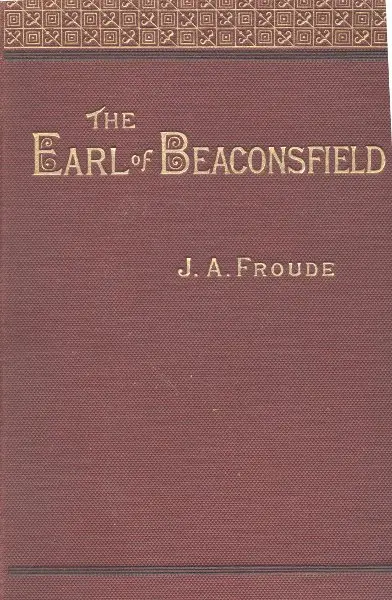
The Earl of Beaconsfield
James Anthony Froude
THE CLASSIC COLLECTION · 1879
"Caesar: A Sketch" by James Anthony Froude is a historical account written in the late 19th century. This work examines the life and historical significance of Julius Caesar, exploring the transition of the Roman Republic into a military empire and the complex political climate of the era. Froude's analysis delves into the societal structures, key figures, and significant events that shaped Rome during Caesar's time, providing insights into both Caesar's character and the broader implications of his leadership. The opening of "Caesar: A Sketch" presents a thorough prelude to the study of Julius Caesar and the fall of the Roman Republic, establishing key themes of political power and moral decay within Roman society. Froude discusses the limited historical resources available for a complete portrait of Caesar, emphasizing the reliance on ancient accounts by figures like Suetonius and Cicero. The text describes how the early Romans had a unique capability for self-governance, contrasting with the later corruption and decline of civic virtue, which ultimately paved the way for Caesar's rise to power. Through an analysis of the institutions and character of the era, Froude underscores the inevitable trends leading to the transformation of Rome from a republic into an autocratic rule, setting the stage for Caesar's historical narrative.
Introduction adapted from the source catalogue; source summaries may be automatically generated.
Free to read · English · 160,700 words · No account needed
MAKE TIME FOR A GOOD BOOK
On by default. Untick to stop anonymous reading totals. Each page counts after 10 seconds in view. How this works.
Anonymous counting is on unless you have switched it off.
So Cicero had construed the situation before his exile, and he had construed it ill. If he had wished to retire he could not. He had been called to account for the part of his conduct for which he most admired himself. The ungracious Senate, as guilty as he, if guilt there had been, had left him to bear the blame of it, and he saw himself driven into banishment by an insolent reprobate, a patrician turned Radical and demagogue, Publius Clodius. Indignity could be carried no farther.
Clodius is the most extraordinary figure in this extraordinary period. He had no character. He had no distinguished talent save for speech; he had no policy; he was ready to adopt any cause or person which for the moment was convenient to him; and yet for five years this man was the omnipotent leader of the Roman mob. He could defy justice, insult the consuls, beat the tribunes, parade the streets with a gang of armed slaves, killing persons disagreeable to him; and in the Senate itself he had his high friends and connections who threw a shield over him when his audacity had gone beyond endurance. We know Clodius only from Cicero; and a picture of him from a second hand might have made his position more intelligible, if not more reputable. Even in Rome it is scarcely credible that the Clodius of Cicero could have played such a part, or that the death of such a man should have been regarded as a national calamity. Cicero says that Clodius revived Catiline's faction; but what was Catiline's faction? or how came Catiline to have a faction which survived him?
Be this as it may, Clodius had banished Cicero, and had driven him away over the seas to Greece, there, for sixteen months, to weary Heaven and his friends with his lamentations. Cicero had refused Caesar's offered friendship; Caesar had not cared to leave so powerful a person free to support the intended attacks on his legislation, and had permitted, perhaps had encouraged, the prosecution. Cicero out of the way, the second person whose presence in Rome Caesar thought might be inconvenient, Marcus Cato, had been got rid of by a process still more ingenious. The aristocracy pretended that the acts of Caesar's consulship had been invalid through disregard of the interdictions of Bibulus; and one of those acts had been the reduction of Clodius to the order of plebeians. If none of them were valid, Clodius was not legally tribune, and no commission which Clodius might confer through the people would have validity. A service was discovered by which Cato was tempted, and which he was induced to accept at Clodius's hands. Thus he was at once removed from the city, and it was no longer open to him to deny that Caesar's laws had been properly passed. The work on which he was sent deserves a few words. The kingdom of Cyprus had long been attached to the crown of Egypt. Ptolemy Alexander, dying in the year 80, had bequeathed both Egypt and Cyprus to Rome; but the Senate had delayed to enter on their bequest, preferring to share the fines which Ptolemy's natural heirs were required to pay for being spared. One of these heirs, Ptolemy Auletes, or "the Piper," father of the famous Cleopatra, was now reigning in Egypt, and was on the point of being expelled by his subjects. He had been driven to extortion to raise a subsidy for the senators, and he had made himself universally abhorred. Ptolemy of Cyprus had been a better sovereign, but a less prudent client. He had not overtaxed his people; he had kept his money. Clodius, if Cicero's story is true, had a private grudge against him. Clodius had fallen among Cyprian pirates. Ptolemy had not exerted himself for his release, and he had suffered unmentionable indignities. At all events, the unfortunate king was rich, and was unwilling to give what was expected of him. Clodius, on the plea that the King of Cyprus protected pirates, persuaded the Assembly to vote the annexation of the island; and Cato, of all men, was prevailed on by the mocking tribune to carry out the resolution. He was well pleased with his mission, though he wished it to appear to be forced upon him. Ptolemy poisoned himself; Cato earned the glory of adding a new province to the Empire, and did not return for two years, when he brought 7,000 talents--a million and a half of English money--to the Roman treasury.
Your reading position is saved on this browser. Take it to another device with a library code. Reading pages adapt to text, rather than matching a printed edition.
James Anthony Froude
James Anthony Froude
James Anthony Froude
James Anthony Froude
BEHIND THE BOOK
This eBook is for the use of anyone anywhere in the United States and most other parts of the world at no cost and with almost no restrictions whatsoever. You may copy it, give it away or re-use it under the terms of the Project Gutenberg License included with this eBook or online at www.gutenberg.org. If you are not located in the United States, you will have to check the laws of the country where you are located before using this eBook. Read the source licence.
The original source file, including credits and licence, is retained by this library. Request an original-format copy at no charge. Please include the book title and Project Gutenberg identifier #8425.
KEEP YOUR CURIOSITY GOING
Cécile Tormay

Moritz Busch
John L. Ransom
Frances Wright
Cécile Tormay

Mabel Potter Daggett