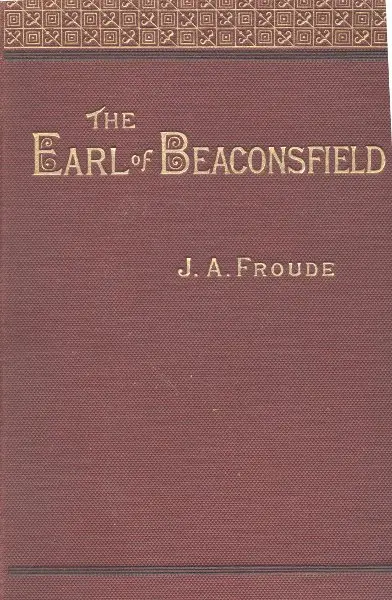
The Earl of Beaconsfield
James Anthony Froude
THE CLASSIC COLLECTION · 1879
"Caesar: A Sketch" by James Anthony Froude is a historical account written in the late 19th century. This work examines the life and historical significance of Julius Caesar, exploring the transition of the Roman Republic into a military empire and the complex political climate of the era. Froude's analysis delves into the societal structures, key figures, and significant events that shaped Rome during Caesar's time, providing insights into both Caesar's character and the broader implications of his leadership. The opening of "Caesar: A Sketch" presents a thorough prelude to the study of Julius Caesar and the fall of the Roman Republic, establishing key themes of political power and moral decay within Roman society. Froude discusses the limited historical resources available for a complete portrait of Caesar, emphasizing the reliance on ancient accounts by figures like Suetonius and Cicero. The text describes how the early Romans had a unique capability for self-governance, contrasting with the later corruption and decline of civic virtue, which ultimately paved the way for Caesar's rise to power. Through an analysis of the institutions and character of the era, Froude underscores the inevitable trends leading to the transformation of Rome from a republic into an autocratic rule, setting the stage for Caesar's historical narrative.
Introduction adapted from the source catalogue; source summaries may be automatically generated.
Free to read · English · 160,700 words · No account needed
MAKE TIME FOR A GOOD BOOK
On by default. Untick to stop anonymous reading totals. Each page counts after 10 seconds in view. How this works.
Anonymous counting is on unless you have switched it off.
[Sidenote: October, B.C. 60.] [Sidenote: November, B.C. 60.] Cicero might well despair of a Senate who had taken Cato to lead them. Pompey had come home in the best of dispositions. The Senate had offended Pompey, and, more than that, had offended his legionaries. They had quarrelled with the knights. They had quarrelled with the moneyed interests. They now added an entirely gratuitous affront to Caesar. His Spanish administration was admitted by every one to have been admirable. He was coming to stand for the consulship, which could not be refused; but he asked for a triumph also, and as the rule stood there was a difficulty, for if he was to have a triumph, he must remain outside the walls till the day fixed for it, and if he was a candidate for office, he must be present in person on the day of the election. The custom, though convenient in itself, had been more than once set aside. Caesar applied to the Senate for a dispensation, which would enable him to be a candidate in his absence; and Cato, either from mere dislike of Caesar or from a hope that he might prefer vanity to ambition, and that the dreaded consulship might be escaped, persuaded the Senate to refuse. If this was the expectation, it was disappointed. Caesar dropped his triumph, came home, and went through the usual forms, and it at once appeared that his election was certain, and that every powerful influence in the State was combined in his favor. From Pompey he met the warmest reception. The Mucia bubble had burst. Pompey saw in Caesar only the friend who had stood by him in every step of his later career, and had braved the fury of the Senate at the side of his officer Metellus Nepos. Equally certain it was that Caesar, as a soldier, would interest himself for Pompey's legionaries, and that they could be mutually useful to each other. Caesar had the people at his back, and Pompey had the army. The third great power in Rome was that of the capitalists, and about the attitude of these there was at first some uncertainty. Crassus, who was the impersonation of them, was a friend of Caesar, but had been on bad terms with Pompey. Caesar, however, contrived to reconcile them; and thus all parties outside the patrician circle were combined for a common purpose. Could Cicero have taken his place frankly at their side, as his better knowledge told him to do, the inevitable revolution might have been accomplished without bloodshed, and the course of history have been different. Caesar wished it. But it was not so to be. Cicero perhaps found that he would have to be content with a humbler position than he had anticipated, that in such a combination he would have to follow rather than to lead. He was tempted. He saw a promise of peace, safety, influence, if not absolute, yet considerable. But he could not bring himself to sacrifice the proud position which he had won for himself in his consulship, as leader of the Conservatives; and he still hoped to reign in the Senate, while using the protection of the popular chiefs as a shelter in time of storms. Caesar was chosen consul without opposition. His party was so powerful that it seemed at one time as if he could name his colleague, but the Senate succeeded with desperate efforts in securing the second place. They subscribed money profusely, the immaculate Cato prominent among them. The machinery of corruption was well in order. The great nobles commanded the votes of their clientèle, and they succeeded in giving Caesar the same companion who had accompanied him through the aedileship and the praetorship, Marcus Bibulus, a dull, obstinate fool, who could be relied on, if for nothing else, yet for dogged resistance to every step which the Senate disapproved. For the moment they appeared to have thought that with Bibulus's help they might defy Caesar and reduce his office to a nullity. Immediately on the election of the consuls, it was usual to determine the provinces to which they were to be appointed when their consulate should expire. The regulation lay with the Senate, and, either in mere spleen or to prevent Caesar from having the command of an army, they allotted him the department of the "Woods and Forests." [16] A very few weeks had to pass before they discovered that they had to do with a man who was not to be turned aside so slightingly.
Your reading position is saved on this browser. Take it to another device with a library code. Reading pages adapt to text, rather than matching a printed edition.
James Anthony Froude
James Anthony Froude
James Anthony Froude
James Anthony Froude
BEHIND THE BOOK
This eBook is for the use of anyone anywhere in the United States and most other parts of the world at no cost and with almost no restrictions whatsoever. You may copy it, give it away or re-use it under the terms of the Project Gutenberg License included with this eBook or online at www.gutenberg.org. If you are not located in the United States, you will have to check the laws of the country where you are located before using this eBook. Read the source licence.
The original source file, including credits and licence, is retained by this library. Request an original-format copy at no charge. Please include the book title and Project Gutenberg identifier #8425.
KEEP YOUR CURIOSITY GOING
Cécile Tormay

Moritz Busch
John L. Ransom
Frances Wright
Cécile Tormay

Mabel Potter Daggett