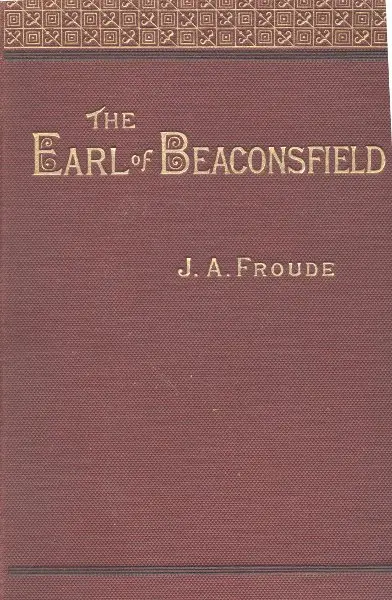
The Earl of Beaconsfield
James Anthony Froude
THE CLASSIC COLLECTION · 1879
"Caesar: A Sketch" by James Anthony Froude is a historical account written in the late 19th century. This work examines the life and historical significance of Julius Caesar, exploring the transition of the Roman Republic into a military empire and the complex political climate of the era. Froude's analysis delves into the societal structures, key figures, and significant events that shaped Rome during Caesar's time, providing insights into both Caesar's character and the broader implications of his leadership. The opening of "Caesar: A Sketch" presents a thorough prelude to the study of Julius Caesar and the fall of the Roman Republic, establishing key themes of political power and moral decay within Roman society. Froude discusses the limited historical resources available for a complete portrait of Caesar, emphasizing the reliance on ancient accounts by figures like Suetonius and Cicero. The text describes how the early Romans had a unique capability for self-governance, contrasting with the later corruption and decline of civic virtue, which ultimately paved the way for Caesar's rise to power. Through an analysis of the institutions and character of the era, Froude underscores the inevitable trends leading to the transformation of Rome from a republic into an autocratic rule, setting the stage for Caesar's historical narrative.
Introduction adapted from the source catalogue; source summaries may be automatically generated.
Free to read · English · 160,700 words · No account needed
MAKE TIME FOR A GOOD BOOK
On by default. Untick to stop anonymous reading totals. Each page counts after 10 seconds in view. How this works.
Anonymous counting is on unless you have switched it off.
The list submitted for judgment contained the names of none but those who were indisputably guilty. The Senate voted at once that they were traitors to the State. The next question was of the nature of their punishment. In the first place the persons of public officers were sacred, and Lentulus was at the time a praetor. And next the Sempronian law forbade distinctly that any Roman citizen should be put to death without a trial, and without the right of appeal to the assembly.[16] It did not mean simply that Roman citizens were not to be murdered, or that at any time it had been supposed that they might. The object was to restrain the extraordinary power claimed by the Senate of setting the laws aside on exceptional occasions. Silanus, the consul-elect for the following year, was, according to usage, asked to give his opinion first. He voted for immediate death. One after the other the voices were the same, till the turn came of Tiberius Nero, the great-grandfather of Nero the Emperor. Tiberius was against haste. He advised that the prisoners should be kept in confinement till Catiline was taken or killed, and that the whole affair should then be carefully investigated. Investigation was perhaps what many senators were most anxious to avoid. When Tiberius had done, Caesar rose. The speech which Sallust places in his mouth was not an imaginary sketch of what Sallust supposed him likely to have said, but the version generally received of what he actually did say, and the most important passages of it are certainly authentic. For the first time we see through the surface of Caesar's outward actions into his real mind. During the three quarters of a century which had passed since the death of the elder Gracchus one political murder had followed upon another. Every conspicuous democrat had been killed by the aristocrats in some convenient disturbance. No constitution could survive when the law was habitually set aside by violence; and disdaining the suspicion with which he knew that his words would be regarded, Caesar warned the Senate against another act of precipitate anger which would be unlawful in itself, unworthy of their dignity, and likely in the future to throw a doubt upon the guilt of the men upon whose fate they were deliberating. He did not extenuate, he rather emphasized, the criminality of Catiline and his confederates; but for that reason and because for the present no reasonable person felt the slightest uncertainty about it, he advised them to keep within the lines which the law had marked out for them. He spoke with respect of Silanus. He did not suppose him to be influenced by feelings of party animosity. Silanus had recommended the execution of the prisoners, either because he thought their lives incompatible with the safety of the State, or because no milder punishment seemed adequate to the enormity of their conduct. But the safety of the State, he said, with a compliment to Cicero, had been sufficiently provided for by the diligence of the consul. As to punishment, none could be too severe; but with that remarkable adherence to fact, which always distinguished Caesar, that repudiation of illusion and sincere utterance of his real belief, whatever that might be, he contended that death was not a punishment at all. Death was the end of human suffering. In the grave there was neither joy nor sorrow. When a man was dead he ceased to be.[17]He became as he had been before he was born. Probably almost every one in the Senate thought like Caesar on this subject. Cicero certainly did. The only difference was that plausible statesmen affected a respect for the popular superstition, and pretended to believe what they did not believe. Caesar spoke his convictions out. There was no longer any solemnity in an execution. It was merely the removal out of the way of troublesome persons; and convenient as such a method might be, it was of graver consequence that the Senate of Rome, the guardians of the law, should not set an example of violating the law. Illegality, Caesar told them, would be followed by greater illegalities. He reminded them how they had applauded Sylla, how they had rejoiced when they saw their political enemies summarily despatched; and yet the proscription, as they well knew, had been perverted to the license of avarice and private revenge. They might feel sure that no such consequence need be feared under their present consul: but times might change. The worst crimes which had been committed in Rome in the past century had risen out of the imitation of precedents, which at the moment seemed defensible. The laws had prescribed a definite punishment for treason. Those laws had been gravely considered; they had been enacted by the great men who had built up the Roman dominion, and were not to be set aside in impatient haste. Caesar therefore recommended that the estates of the conspirators should be confiscated, that they themselves should be kept in strict and solitary confinement dispersed in various places, and that a resolution should be passed forbidding an application for their pardon either to Senate or people.
Your reading position is saved on this browser. Take it to another device with a library code. Reading pages adapt to text, rather than matching a printed edition.
James Anthony Froude
James Anthony Froude
James Anthony Froude
James Anthony Froude
BEHIND THE BOOK
This eBook is for the use of anyone anywhere in the United States and most other parts of the world at no cost and with almost no restrictions whatsoever. You may copy it, give it away or re-use it under the terms of the Project Gutenberg License included with this eBook or online at www.gutenberg.org. If you are not located in the United States, you will have to check the laws of the country where you are located before using this eBook. Read the source licence.
The original source file, including credits and licence, is retained by this library. Request an original-format copy at no charge. Please include the book title and Project Gutenberg identifier #8425.
KEEP YOUR CURIOSITY GOING
Cécile Tormay

Moritz Busch
John L. Ransom
Frances Wright
Cécile Tormay

Mabel Potter Daggett