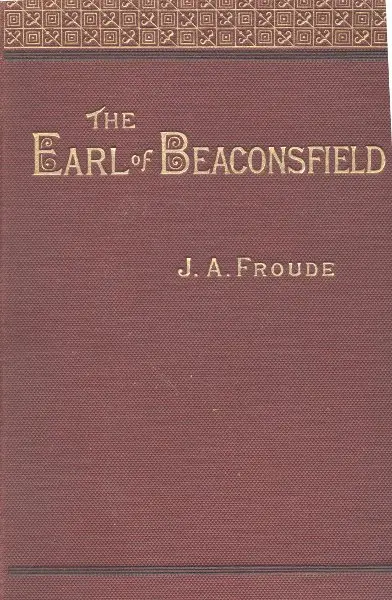
The Earl of Beaconsfield
James Anthony Froude
THE CLASSIC COLLECTION · 1879
"Caesar: A Sketch" by James Anthony Froude is a historical account written in the late 19th century. This work examines the life and historical significance of Julius Caesar, exploring the transition of the Roman Republic into a military empire and the complex political climate of the era. Froude's analysis delves into the societal structures, key figures, and significant events that shaped Rome during Caesar's time, providing insights into both Caesar's character and the broader implications of his leadership. The opening of "Caesar: A Sketch" presents a thorough prelude to the study of Julius Caesar and the fall of the Roman Republic, establishing key themes of political power and moral decay within Roman society. Froude discusses the limited historical resources available for a complete portrait of Caesar, emphasizing the reliance on ancient accounts by figures like Suetonius and Cicero. The text describes how the early Romans had a unique capability for self-governance, contrasting with the later corruption and decline of civic virtue, which ultimately paved the way for Caesar's rise to power. Through an analysis of the institutions and character of the era, Froude underscores the inevitable trends leading to the transformation of Rome from a republic into an autocratic rule, setting the stage for Caesar's historical narrative.
Introduction adapted from the source catalogue; source summaries may be automatically generated.
Free to read · English · 160,700 words · No account needed
MAKE TIME FOR A GOOD BOOK
On by default. Untick to stop anonymous reading totals. Each page counts after 10 seconds in view. How this works.
Anonymous counting is on unless you have switched it off.
As he felt the ground stronger under his feet, Caesar now began to assume an attitude more peremptorily marked. He had won a reputation in the Forum; he had spoken in the Senate; he had warmly advocated the appointment of Pompey to his high commands; and he was regarded as a prominent democratic leader. But he had not aspired to the tribunate; he had not thrown himself into politics with any absorbing passion. His exertions had been intermittent, and he was chiefly known as a brilliant member of fashionable society, a peculiar favorite with women, and remarkable for his abstinence from the coarse debauchery which disgraced his patrician contemporaries. He was now playing for a higher stake, and the oligarchy had occasion to be reminded of Sylla's prophecy. In carrying out the proscription, Sylla had employed professional assassins, and payments had been made out of the treasury to wretches who came to him with bloody trophies in their hands to demand the promised fees. The time had come when these doings were to be looked into; hundreds of men had been murdered, their estates confiscated, and their families ruined, who had not been even ostensibly guilty of any public crime. At Caesar's instance an inquiry was ordered. He himself was appointed Judex Quaestionis, or chairman of a committee of investigation; and Catiline, among others, was called to answer for himself--a curious commentary on Caesar's supposed connection with him.
[Sidenote: B.C. 63.] Nor did the inquisition stop with Sylla. Titus Labienus, afterward so famous and so infamous, was then tribune of the people. His father had been killed at the side of Saturninus and Glaucia thirty-seven years before, when the young lords of Rome had unroofed the senate-house, and had pelted them and their companions to death with tiles. One of the actors in the scene, Caius Rabirius, now a very old man, was still alive. Labienus prosecuted him before Caesar. Rabirius was condemned, and appealed to the people; and Cicero, who had just been made consul, spoke in his defence. On this occasion Cicero for the first time came actively in collision with Caesar. His language contrasted remarkably with the tone of his speeches against Verres and for the Manilian law. It was adroit, for he charged Marius with having shared the guilt, if guilt there had been, in the death of those men; but the burden of what he said was to defend enthusiastically the conservative aristocracy, and to censure with all his bitterness the democratic reformers. Rabirius was acquitted, perhaps justly. It was a hard thing to revive the memory of a political crime which had been shared by the whole patrician order after so long an interval. But Cicero had shown his new colors; no help, it was evident, was thenceforward to be expected from him in the direction of reform. The popular party replied in a singular manner. The office of Pontifex Maximus was the most coveted of all the honors to which a Roman citizen could aspire. It was held for life, it was splendidly endowed, and there still hung about the pontificate the traditionary dignity attaching to the chief of the once sincerely believed Roman religion. Like other objects of ambition, the nomination had fallen, with the growth of democracy, to the people, but the position had always been held by some member of the old aristocracy; and Sylla, to secure them in the possession of it, had reverted to the ancient constitution, and had restored to the Sacred College the privilege of choosing their head. Under the impulse which the popular party had received from Pompey's successes, Labienus carried a vote in the assembly, by which the people resumed the nomination to the pontificate themselves. In the same year it fell vacant by the death of the aged Metullus Pius. Two patricians, Quintus Catulus and Caesar's old general Servilius Isauricus, were the Senate's candidates, and vast sums were subscribed and spent to secure the success of one or other of the two. Caesar came forward to oppose them. Caesar aspired to be Pontifex Maximus--Pope of Rome--he who of all men living was the least given to illusion; he who was the most frank in his confession of entire disbelief in the legends which, though few credited them any more, yet almost all thought it decent to pretend to credit. Among the phenomena of the time this was surely the most singular. Yet Caesar had been a priest from his boyhood, and why should he not be Pope? He offered himself to the Comitia. Committed as he was to a contest with the richest men in Rome, he spent money freely. He was in debt already for his expenses as aedile. He engaged his credit still deeper for this new competition. The story ran that when his mother kissed him as he was leaving his home for the Forum on the morning of the election, he told her that he would return as pontiff, or she would never see him more. He was chosen by an overwhelming majority, the votes given for him being larger than the collective numbers of the votes entered for his opponents.
Your reading position is saved on this browser. Take it to another device with a library code. Reading pages adapt to text, rather than matching a printed edition.
James Anthony Froude
James Anthony Froude
James Anthony Froude
James Anthony Froude
BEHIND THE BOOK
This eBook is for the use of anyone anywhere in the United States and most other parts of the world at no cost and with almost no restrictions whatsoever. You may copy it, give it away or re-use it under the terms of the Project Gutenberg License included with this eBook or online at www.gutenberg.org. If you are not located in the United States, you will have to check the laws of the country where you are located before using this eBook. Read the source licence.
The original source file, including credits and licence, is retained by this library. Request an original-format copy at no charge. Please include the book title and Project Gutenberg identifier #8425.
KEEP YOUR CURIOSITY GOING
Cécile Tormay

Moritz Busch
John L. Ransom
Frances Wright
Cécile Tormay

Mabel Potter Daggett