THE CLASSIC COLLECTION✦An outlaw’s diary: the CommuneCLASSIC FREE BOOKS
An outlaw’s diary: the Commune
Cécile Tormay
THE CLASSIC COLLECTION · 1896
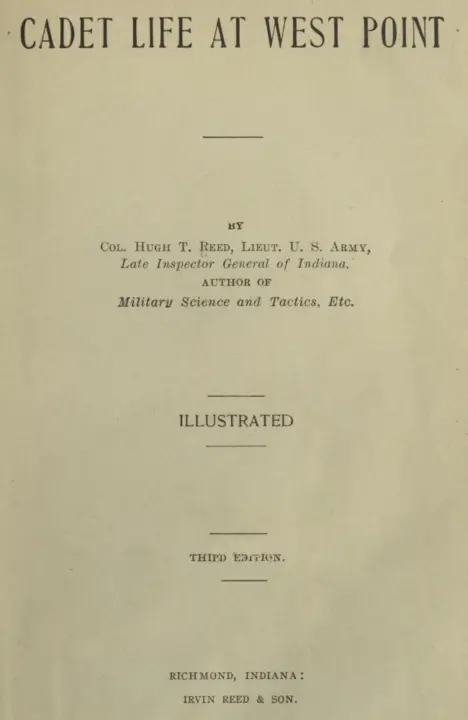
"Cadet Life at West Point" by Hugh T. Reed is a historical account written in the early 20th century, reflecting on military education and experience at the United States Military Academy during the late 19th century. The book delves into the regimented life of cadets and serves as both a memoir and a guide for those interested in pursuing a military career, capturing the challenges and experiences faced during their formative years at this prestigious institution. At the start of this memoir, Reed recounts the fervent desire he had as a young boy to attend West Point, underscoring his early admiration for the military. He describes the meticulous process of seeking appointment as a cadet, detailing his determination to overcome obstacles such as poor eyesight and familial resistance. The narrative introduces his journey from childhood dreams to the rigorous preparations required for admission, establishing a tone that mixes nostalgia with the gravity of the military training environment. As Reed progresses into his experiences at the academy, he provides a glimpse into the strict discipline, camaraderie, and the demanding expectations that shape the life of a plebe, marking the beginning of a compelling exploration of cadet life.
Introduction adapted from the source catalogue; source summaries may be automatically generated.
Free to read · English · 61,239 words · No account needed
MAKE TIME FOR A GOOD BOOK
On by default. Untick to stop anonymous reading totals. Each page counts after 10 seconds in view. How this works.
Anonymous counting is on unless you have switched it off.
[44] Then just east of Seacoast Battery.
[45] See Appendix.
[46] Soon to be torn down to give way to a giant new one now partly built.
[47] Then a part of the ground floor room of the old Academic Building.
[48] Then in the south end of the Mess Hall. Mr. Bratt, then caterer of the Cadet Mess, lived in the north end.
[49] From songs by the Class of 1897.
[50] Now called Drill Regulations.
[51] See Appendix.
[52] Chevrons are made of gold lace ⅜ inch wide; sewed on dark blue cloth with ⅜ inch intervals between the bars.
[53] Worn above the elbows, points up.
[54] Worn above the elbow, points up.
[55] Worn below the elbows, points up.
[56] A life membership costs only ten dollars. Address Secretary of the Association of Graduates, West Point, N. Y.
[57] The new Chapel and Chaplain’s quarters on the hill near old Fort Putnam are now in one large beautiful building that was dedicated in June, 1910. Graduates have contributed for a handsome memorial window and Professor Weir’s grand painting, now in the old Chapel, will be put over this window in the new Chapel.
[58] Cullum Memorial Hall is now used for hops.
[59] In the old Academic Building.
[60] See page 202, Note 1.
[61] In conformity with the provisions of this section, the Chief of Staff is now, by direction of the Secretary, charged with the supervision of matters in the War Department pertaining to the Academy.
[62] Four of the class of 1880 accepted this offer, and, as there were not then vacancies enough for the balance, some were first appointed brevet second lieutenants, and as vacancies occurred they were commissioned second lieutenants.
[63] The army is supplied with second lieutenants from four sources, viz.: First, the Military Academy; second, graduates from other military schools; third, from meritorious enlisted men, and fourth, from civil life.
[64] The Act of 1910 increased this number 25% for six years. The total number of graduates from 1802 to August 31, 1910, is 4,935.
[65] Alternates have been appointed since 1877.
[66] See Appendix.
[67] The Board before which a candidate is directed to appear will be, without exception, the one convened at the nearest or most convenient to his home, or to the school at which he is in regular attendance at the time of appointment.
[68] On December 8, 1910, the Adjutant General of the Army wrote to the author saying “that while it has been decided to admit the next class of cadets into the Military Academy on the 14th day of June instead of on the 1st day of March, no change has been made in the date and places of examination of cadet candidates.”
Your reading position is saved on this browser. Take it to another device with a library code. Reading pages adapt to text, rather than matching a printed edition.
BEHIND THE BOOK
This eBook is for the use of anyone anywhere in the United States and most other parts of the world at no cost and with almost no restrictions whatsoever. You may copy it, give it away or re-use it under the terms of the Project Gutenberg License included with this eBook or online at www.gutenberg.org. If you are not located in the United States, you will have to check the laws of the country where you are located before using this eBook. Read the source licence.
The original source file, including credits and licence, is retained by this library. Request an original-format copy at no charge. Please include the book title and Project Gutenberg identifier #64925.
KEEP YOUR CURIOSITY GOING
Cécile Tormay

Moritz Busch
John L. Ransom
Frances Wright
Cécile Tormay

Mabel Potter Daggett